Delaware alone recorded 334,461 new entities in 2025, up from 289,810 the year before, according to the Delaware Division of Corporations. Stripe Atlas reported incorporations from founders in 169 countries during the same year, per its 2025 year-in-review report.
But the paperwork trips up plenty of first-time founders. Which documents are mandatory? Do requirements change by state? What happens if you don't have a Social Security Number?
This guide breaks down the core registration documents, state-specific variations, and the extra paperwork foreign founders need, plus what to keep on file after filing.
Key Takeaways
- LLCs file Articles of Organization; corporations file Articles of Incorporation
- Foreign nationals can get an EIN without an SSN via Form SS-4's fax or mail option
- Delaware, Wyoming, and Nevada differ in fees, privacy rules, and reporting requirements
- Annual reports and your EIN letter matter as much as your formation paperwork
Foundational Decisions Before You Register: Structure and State
Before you gather a single document, you need two answers: what type of entity you're forming and where you're forming it. These decisions dictate everything downstream, including which forms you'll file and which taxes you'll owe.
Choosing Between LLC, C-Corporation, and S-Corporation
Each structure comes with its own paperwork trail:
- LLC – Pass-through taxation, governed by an Operating Agreement, simpler compliance burden
- C-Corporation – Requires Bylaws and a defined stock structure, generally the preferred vehicle for outside investors and venture funding
- S-Corporation – Offers pass-through taxation like an LLC but restricted almost entirely to US citizens and residents
Here's the catch for international founders: the IRS explicitly bars nonresident aliens from holding S-corp shares, per its official S-corporation guidance. That leaves LLCs and C-Corps as the only realistic options for most foreign founders.
Selecting the Right State for Registration
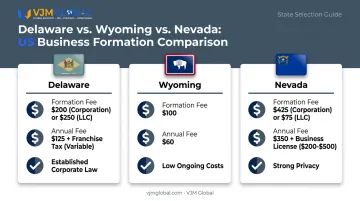
Your state choice determines your formation document's name, your filing fees, and your ongoing tax obligations. Three states dominate among international founders:
| State | LLC Formation Fee | Annual Obligation |
|---|---|---|
| Delaware | $110 | $300 LLC tax (due June 1) or franchise tax for corporations (minimum $175, due March 1) |
| Wyoming | $100 | $60 minimum annual report/license tax |
| Nevada | $75 + $150 initial list + $200 license | $150 annual list + $200 license (LLC) |
Delaware uses a Certificate of Formation for LLCs and a Certificate of Incorporation for corporations. Wyoming and Nevada, by contrast, call both documents Articles of Organization or Incorporation. Terminology aside, Delaware's established corporate law and Wyoming's low ongoing costs make them the two most common picks for founders outside the US.
Essential Documents Required for US Company Registration
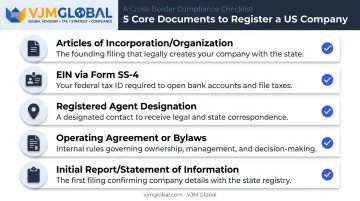
Regardless of which state you choose, five documents form the baseline every founder needs.
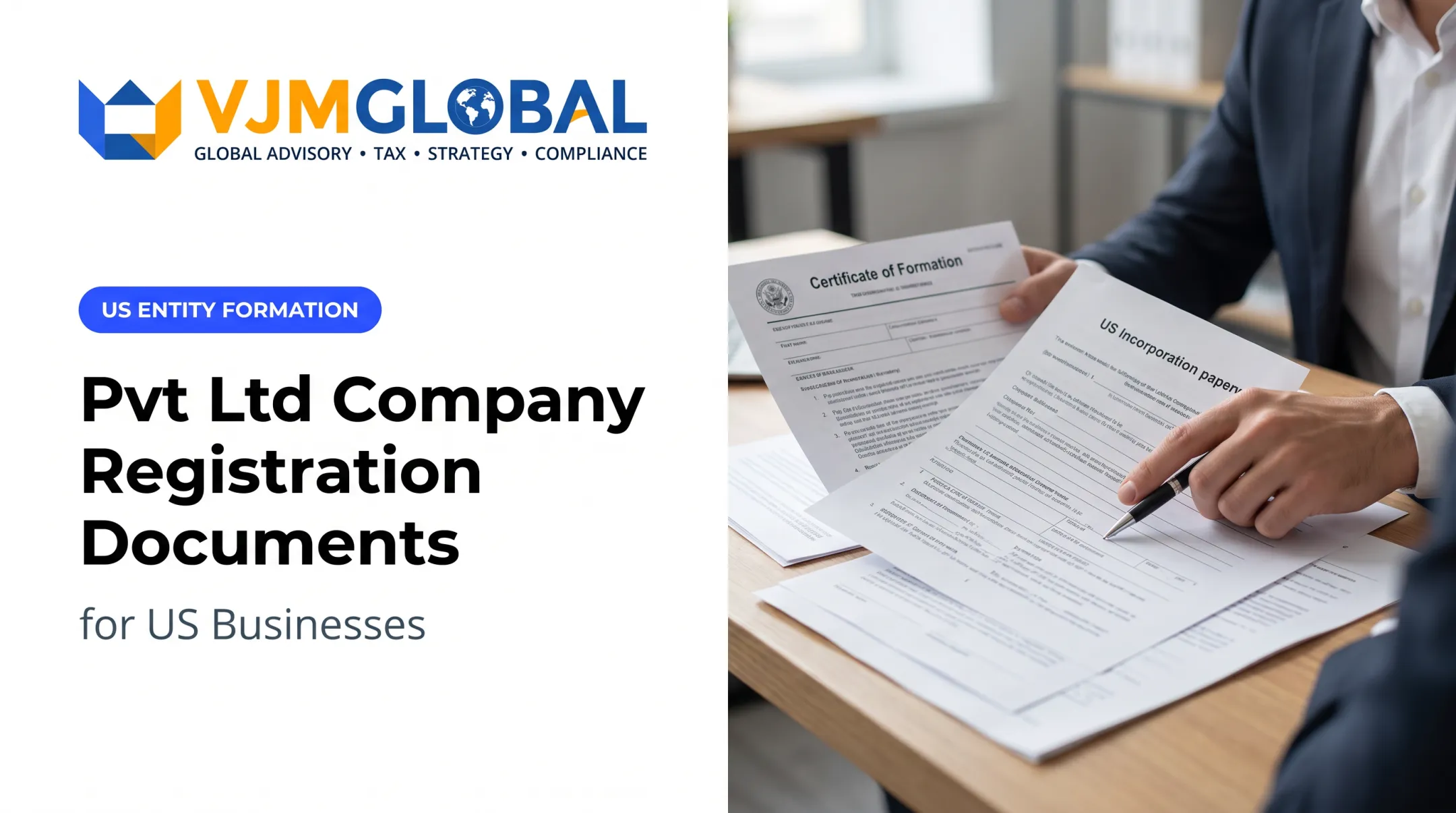
Articles of Incorporation or Articles of Organization
This is the document that legally creates your company. It typically includes:
- Company name (checked for availability before filing to avoid rejection)
- Registered agent name and address
- Business purpose statement
- Share structure (corporations) or member/manager details (LLCs)
You file this directly with the Secretary of State in your chosen state.
Employer Identification Number (EIN) via IRS Form SS-4
Think of the EIN as your company's Social Security Number. You need it to file federal taxes, open a business bank account, and hire employees.
US residents typically apply online through the IRS portal and get their EIN instantly. Foreign founders, as we'll cover below, follow a different path.
Registered Agent Designation
Every state requires a physical US address, known as a registered agent, to receive service of process and official state or tax correspondence. A P.O. box won't work here; it needs to be a real street address in the state of formation.
Operating Agreement (LLCs) or Corporate Bylaws (Corporations)
Neither document usually gets filed with the state, but don't skip them. Banks and investors routinely ask for a copy before opening an account or wiring funds. Skipping this step often causes delays later.
Initial Report or Statement of Information
Many states require a follow-up filing shortly after formation, listing your officers, directors, or managers. California, for example, requires LLCs to file Form LLC-12 within 90 days of registration, and again every two years, for a $20 fee. Miss this and you risk penalties or administrative dissolution.
Additional Documents Foreign Founders and International Entrepreneurs Need
Most paperwork is identical whether you're a US resident or not. A handful of extra steps apply specifically to non-residents, starting with proof of identity.
Without a US-issued ID, banks and some service providers commonly request a notarized passport copy to verify your identity before opening a business account.
Alternate EIN Application Process (No SSN Required)
This is where most foreign founders get stuck: you don't need an SSN to get an EIN.
Form SS-4's instructions allow foreign responsible parties without a Social Security Number or ITIN to write "Foreign" on line 7b. The online EIN tool only works for applicants with a valid SSN, ITIN, or existing EIN, so foreign founders must apply by fax or mail instead, according to the IRS Form SS-4 instructions.
Fax applications are typically processed in about 4 business days when a return fax number is provided, while mail applications take roughly 4 weeks.
Firms with dedicated CPAs and US-compliant professionals, such as VJM Global, help founders prepare Form SS-4 correctly the first time. Errors on this form are a common cause of rejected or delayed applications.
US Mailing Address and Registered Agent Requirement
Since a US street address is mandatory, non-resident owners typically appoint a commercial registered agent service or a virtual business address provider in their state of formation. Most states also require this address to be a physical street location, not a P.O. box, since it's where the state and IRS send legal notices and compliance reminders.
This satisfies the legal requirement without requiring you to lease office space or relocate. Many international founders keep the same registered agent for years, since switching later means updating your address across state filings, bank records, and IRS correspondence.
Foreign Qualification Certificate (for Expanding Foreign Companies)
If an existing overseas company, rather than an individual founder, wants to operate in a US state, it needs to "foreign qualify" there. This means submitting a Certificate of Good Standing from its home jurisdiction alongside the foreign-qualification application.
Navigating this paperwork, plus the related EIN and structuring decisions, gets complicated quickly for first-time filers. Experienced cross-border advisors add real value here, helping structure the entity correctly and file the right forms in the right order.
Step-by-Step Process to Register Your US Company
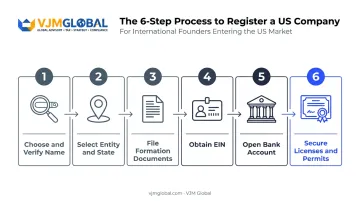
Once you've gathered the right paperwork, moving through these six steps typically takes two to four weeks from start to finish.
- Choose and verify your company name – Check availability with your target state's Secretary of State database
- Select your entity type and state – Weigh LLC versus C-Corp, and compare Delaware, Wyoming, or Nevada based on fees and privacy
- File formation documents – Submit Articles of Organization or Incorporation with the Secretary of State
- Obtain your EIN – Apply online (US residents) or via fax/mail (foreign founders) using Form SS-4
- Open a business bank account – Most banks require your formation documents, EIN confirmation, and Operating Agreement or Bylaws
- Secure licenses and permits – Check state and industry-specific requirements before you start operating
Post-Registration Compliance Documents You Shouldn't Overlook
Getting registered is step one. Staying in good standing is the ongoing part founders tend to underestimate.
Annual report and franchise tax deadlines vary by state and entity type:
| Entity Type | Deadline | Fee |
|---|---|---|
| Delaware Corporation | March 1 | Franchise tax (varies) |
| Delaware LLC | June 1 | Flat $300 |
| Wyoming / Nevada | Formation anniversary month | Varies by state |
Beyond tax deadlines, two other documents deserve a permanent spot in your compliance file:
- EIN confirmation letter (CP 575) – The IRS issues this only once and won't provide a duplicate original. Store it with your formation documents for banking and tax purposes
- Bookkeeping records and tax filings – Most foreign-owned entities face IRS penalties from missed quarterly deadlines or misunderstood filing requirements
VJM Global's team of CPAs and accounting professionals supports foreign-owned US entities with outsourced bookkeeping, US GAAP-compliant financial statements, and corporate tax return preparation. This helps founders stay audit-ready without building an in-house finance function from scratch.
Frequently Asked Questions
What documents do I need to register a company in the UK?
UK registration through Companies House requires a memorandum of association and articles of association, which differ substantially from US filing requirements. If you're focused on US registration, the sections above cover exactly what you'll need.
What is the best way to register a company?
Start by choosing the right entity structure and state for your goals. Then file directly through the Secretary of State, or work with a registered agent or formation service for added accuracy and speed.
Can a foreigner register a company in the US without visiting in person?
Yes. Most states allow fully remote registration using a registered agent and online filing systems. No physical presence in the US is required to form an LLC or corporation.
Do I need a Social Security Number (SSN) to get an EIN?
No. Foreign founders can apply for an EIN via fax or mail using Form SS-4, listing themselves as the "responsible party" without an SSN or ITIN.
Which state is best for foreigners to register an LLC or corporation?
Delaware, Wyoming, and Nevada are the top choices for foreign founders. These states combine low filing fees with strong privacy protections, plus corporate laws that keep ongoing compliance simple.
How long does it take to register a company in the US?
State filing typically takes a few days to two weeks, depending on the state and processing tier. EIN processing without an SSN adds roughly 4 business days by fax, or about 4 weeks by mail.