: Full Guide](https://file-host.link/website/vjmglobal-l8s6go/assets/blog-images/2fa988ee-c049-40fc-bd3f-cef060e6eed6/1785089485921824_594bf2112b564a3686b9194af62bf171/360.webp)
This guide is written for domestic entrepreneurs, foreign investors, and MLM companies planning to enter India's direct selling market. Compliance matters here more than in most sectors. India's regulators have spent years untangling genuine direct selling businesses from pyramid and money circulation schemes, and enforcement has picked up recently.
Even so, most businesses remain confused about which laws apply, what "registration" actually involves, and how state rules differ from the central framework. This guide walks through the legal structure, the practical registration steps, and what foreign entrants specifically need to watch for.
Key Takeaways
- Direct selling is legal under the Consumer Protection Act 2019, distinct from banned pyramid schemes.
- Entities must incorporate as a company, LLP, or partnership before selling through direct sellers.
- No central "direct selling license" exists; compliance depends on state-level registrations and tax filings.
- Foreign investment is permitted, but FDI approval depends on the underlying trading or manufacturing activity.
- Early professional guidance helps avoid compliance gaps that regulators are increasingly policing.
What Is Direct Selling & Why Registration Is Required in India?
Direct selling is the legal process of establishing an entity authorised to sell products or services through a network of independent sellers, directly to end consumers, rather than through fixed retail stores. Registration here means incorporating a proper legal entity and meeting the compliance conditions set out in the 2021 Rules, not obtaining one single licence from a central body.
The goal of this process is legal recognition. A properly registered and compliant direct selling entity can run a commission-based sales model while staying clearly separated from illegal money circulation schemes.
Direct Selling vs. Pyramid Schemes
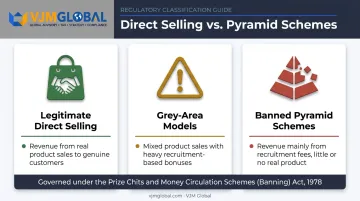
This distinction is the heart of Indian direct selling law. The Direct Selling Rules 2021 explicitly exclude any entity engaged in a pyramid or money circulation scheme from the definition of a legitimate direct selling entity. Both entities and sellers are barred from promoting or enrolling people into either type of scheme under the Prize Chits and Money Circulation Schemes (Banning) Act, 1978.
In practice, the line comes down to:
- Legitimate direct selling: Revenue comes from actual product or service sales to end consumers.
- Banned schemes: Revenue depends primarily on recruitment fees or payments from new entrants, with little or no real product movement.
- Grey-area models: Entities that mix genuine product sales with heavy recruitment-based bonuses draw closer scrutiny from state authorities.
Why This Market Still Matters
India's direct selling industry is not small. IDSA-Ipsos estimates place FY2024-25 sales at roughly INR 23,021 crore, up from INR 22,142 crore the year before, with about 93.2 lakh active sellers nationwide. Nutraceuticals and wellness products alone account for around 60% of that volume.
For foreign entrants, this scale cuts both ways. Indian regulators scrutinise direct selling models closely because of the industry's history with consumer protection issues. Proper registration and documented compliance are not just legal formalities. They build the credibility that Indian consumers, banks, and state authorities expect before they will deal with a new entrant.
Legal & Regulatory Framework for Direct Selling Companies in India
Several layers of law apply simultaneously to a direct selling business in India. None of them work as a single umbrella license, which is where most founders get confused.
The parent legislation is the Consumer Protection Act, 2019, which gives the Central Consumer Protection Authority power to investigate unfair trade practices, misleading advertising, and consumer-rights violations. Section 94 specifically authorises measures concerning direct selling entities.
The Consumer Protection (Direct Selling) Rules, 2021
These Rules set the operational obligations. According to the official Rules published by the Ministry of Consumer Affairs, a direct selling entity must:
| Requirement | What it means in practice |
|---|---|
| Legal form and presence | Company, registered partnership, or LLP with at least one physical location in India |
| Self-declaration | Confirm compliance with the Rules and no involvement in pyramid/money circulation schemes |
| Licenses | Hold PAN, GST, FSSAI, and drug licenses where applicable |
| Grievance handling | Appoint a grievance officer; acknowledge complaints within 48 hours, resolve within one month |
| Seller governance | Maintain written, enforceable contracts with each direct seller |
| Consumer disclosures | Publish entity details, pricing, returns, and complaint channels on a website |
There's a common misconception worth clearing up here. The Rules don't name DPIIT as a registrar for direct selling entities, and they don't prescribe a DPIIT intimation form, acknowledgement, or certificate.
The often-cited "90 days" figure was a one-time transition window given in 2021 to entities already operating before the Rules took effect. It isn't a recurring filing deadline for new entrants. What the Rules actually require is an ongoing self-declaration of compliance, backed by proper documentation.
Companies Act, 2013 and State-Level Rules
Before any of the above matters, the entity needs to exist legally. Incorporation as a private limited company, LLP, or registered partnership happens under the Companies Act, 2013, typically through MCA's SPICe+ portal.
Beyond the central Rules, Rule 11 requires each state to run its own monitoring mechanism. Kerala's October 2024 order is a good example — it introduced a separate enrolment process with a ₹10,000 processing fee plus a one-time ₹1,00,000 technology support fund, alongside inspection and reporting powers.
Sikkim has its own direct selling guidelines too, which means a state-wise legal review is genuinely necessary before scaling beyond one region.
FDI and FEMA Obligations
Foreign investment in direct selling doesn't have its own dedicated FDI category. Instead, the applicable route depends on the underlying activity, whether that's wholesale trading, manufacturing, or retail. Cash-and-carry wholesale trading, for instance, permits 100% FDI under the automatic route, but only when the activity meets that policy's specific definition.
For companies issuing shares to foreign investors, two RBI filings matter most:
- FC-GPR: filed within 30 days of share issuance to a non-resident
- FC-TRS: filed within 60 days of a covered share transfer
Missing these deadlines creates FEMA exposure that can require formal compounding with the RBI later, which is why many direct selling entities engage FEMA advisory specialists like VJM Global to track FC-GPR and FC-TRS timelines from day one.
Step-by-Step Process to Register a Direct Selling Company in India
The full journey covers five distinct areas: business structuring, incorporation, compliance documentation, tax registrations, and operational setup for grievance handling. There's no single official timeline for a foreign-promoted entity, since the process runs through separate statutory clocks rather than one combined filing.
Incorporation alone takes several weeks, and building a fully compliant direct selling operation on top of that adds more time depending on state requirements and product category. The six steps below walk through each stage in order.
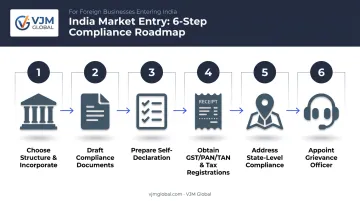
Step 1: Choose Business Structure & Incorporate the Company
Register as a private limited company or LLP under the Companies Act, 2013. This requires:
- A resident director (someone who has stayed in India for the required period in the preceding financial year)
- A registered office address in India
- Digital Signature Certificates and Director Identification Numbers for proposed directors
Step 2: Draft Compliance Documents
Before onboarding a single seller, the entity needs three core documents in place:
- A direct selling agreement or policy governing the relationship with sellers
- A compensation plan disclosure document, showing exactly how earnings are calculated
- A buy-back policy, since the Rules require entities to offer sellers a way to return unsold inventory
Step 3: Prepare the Self-Declaration Under the Rules
Rather than a formal "DPIIT intimation," what's actually required is a documented self-declaration confirming the entity meets the Rules' conditions and isn't running a pyramid or money circulation model. Supporting documents (incorporation certificate, licenses, seller contracts) should be assembled and retained, since state authorities and consumer regulators can request them during inspection.
Step 4: Obtain GST, PAN/TAN & Other Tax Registrations
- GST registration is compulsory for entities making inter-state taxable supplies (which most direct sellers do)
- PAN and TAN are needed for standard tax compliance
- FSSAI registration or license applies if products fall under food, nutraceuticals, or wellness categories — FSSAI created a dedicated "Direct Sellers" business category in FoSCoS in July 2024
Step 5: Address State-Level Registration or Compliance
Check each state where the company plans to operate. Kerala and Sikkim currently have documented state-specific processes; other states may issue their own guidelines over time. Verifying this before launch avoids scrambling to retrofit compliance after sellers are already active in a region.
Step 6: Appoint a Grievance Officer & Set Up Consumer Redressal
The Rules mandate a named grievance officer whose contact details are publicly displayed. Complaints must be acknowledged within 48 hours and typically resolved within one month, with delays documented and justified.
Given the number of moving parts, many foreign-promoted entities engage firms like VJM Global to manage incorporation, tax registrations, and compliance filings in parallel, rather than sequencing each step manually.
Documents Required and Post-Registration Compliance
Getting registered is only the starting point. The core documents to have on file include:
- Certificate of incorporation, MOA/AOA
- PAN and TAN
- Registered office proof
- Self-declaration of compliance with the Direct Selling Rules
- Signed direct selling agreements with each seller
- GST registration certificate and applicable product licenses (such as FSSAI)
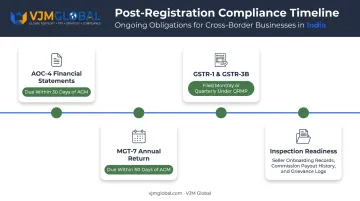
Ongoing compliance doesn't stop after registration. Companies must file:
- AOC-4 (financial statements) within 30 days of the AGM
- MGT-7 (annual return) within 60 days of the AGM
- GST returns — GSTR-1 and GSTR-3B monthly, or quarterly under QRMP for turnover up to ₹5 crore
Regulators can also request seller onboarding records, commission payout history, and grievance logs during inspections. States like Kerala explicitly reserve the right to call for accounts, registers, and returns as part of their monitoring mechanism. Keeping these records organised from day one saves considerable stress later, and partnering with compliance specialists like VJM Global can help ensure filings stay accurate and on time.
Common Challenges, Mistakes & How Professional Support Simplifies Registration
Most founders enter this process expecting a single central license. That expectation causes problems.
The registration process is layered rather than a single step. It typically involves:
- Company incorporation
- Self-declared compliance under the Direct Selling Rules
- Tax registrations
- Increasingly, state-specific filings
Treating any one of these as sufficient on its own leaves gaps regulators can act on.
Compensation plan confusion is common too. Founders often assume any multi-level commission structure counts as legitimate direct selling. It doesn't: if a plan pays out primarily for recruitment rather than product sales, it risks classification under the banned schemes law, regardless of how it's branded.
The Enforcement Directorate's 2022 action against Amway India illustrates this risk. Regulators provisionally attached assets worth roughly ₹757 crore, alleging its compensation model amounted to a pyramid structure. Even established players face this scrutiny.
Foreign companies face an additional set of hurdles:
- FEMA reporting deadlines (FC-GPR, FC-TRS) that are easy to miss without a local compliance partner
- Local resident director requirements that need advance planning
- Inconsistent enforcement across states, since Rule 11 leaves monitoring mechanisms up to each state government
This is where firms like VJM Global fit in. The firm works with foreign entities entering the Indian market on entity incorporation, FEMA and RBI reporting, GST registration, and ongoing ROC and tax compliance.
For a direct selling entrant, that support means getting the company structure right, keeping FEMA filings on schedule, and staying current on GST and annual compliance. Market entry doesn't have to stall on paperwork a specialist could handle from the start.
Frequently Asked Questions
How to start a direct selling business?
Incorporate a private limited company or LLP, draft your direct selling agreement, compensation disclosure, and buy-back policy, then prepare your self-declaration of compliance with the 2021 Rules before onboarding sellers.
How do direct selling companies work?
They sell products through a network of independent sellers who market directly to consumers, outside fixed retail stores, earning commissions based on their own sales rather than store margins.
Is direct selling legal in India?
Yes. It's legal under the Consumer Protection Act 2019 and the Direct Selling Rules 2021, provided the entity incorporates properly and meets the Rules' self-declaration and disclosure requirements.
What is the difference between direct selling and MLM/pyramid schemes in India?
Legitimate direct selling earns revenue from real product sales to consumers. Banned pyramid schemes rely mainly on recruitment fees, which the Prize Chits and Money Circulation Schemes (Banning) Act, 1978 prohibits.
Do foreign companies need special approval to start direct selling in India?
There's no dedicated direct selling FDI category. The applicable route depends on the underlying trading or manufacturing activity, and FEMA reporting through FC-GPR or FC-TRS still applies to foreign share issuances, an area where VJM Global's FEMA advisory team regularly assists foreign investors.
What is DPIIT's role in direct selling company registration?
DPIIT doesn't operate a dedicated direct selling registration or intimation process. Its relevance is mainly through FDI policy, since it determines which investment route applies based on the entity's actual business activity.