This guide is written for Indian entrepreneurs, startups, NRIs, OCIs, and foreign investors from the US, UK, and Australia who want to establish a legal presence in India. Many founders search for "company registration" without fully understanding which structure fits them, what documents they need, or which deadlines follow incorporation.
That confusion causes real delays: rejected name applications, incomplete filings, missed auditor deadlines. This guide walks through the entity types, the step-by-step MCA process, required documents, and the mistakes that trip up first-time founders most often.
Key Takeaways
- Registration creates a separate legal entity with limited liability and funding access
- Private Limited, LLP, OPC, Partnership, and Sole Proprietorship are the main structures
- The process runs online via the MCA portal using SPICe+, DSC, DIN, and name approval
- Filing wraps up in 7-15 working days once documents and the name are verified
- Auditor appointment, bank setup, and ROC filings stay mandatory after incorporation
What Is Company Registration in India?
Company registration in India is the formal process of incorporating a business under the Companies Act, 2013, through the Ministry of Corporate Affairs.
Once approved, the business becomes a distinct legal entity that exists independently of its founders. It can own assets, enter contracts, and sue or be sued in its own name.
This legal status is formalized through two specific provisions. Section 7 of the Act requires the Registrar of Companies (RoC) to issue a Certificate of Incorporation (COI) once the registration documents clear verification.
Section 9 confirms that from the date on the COI, the company becomes a body corporate with perpetual succession. This means it continues to exist even if directors or shareholders change (see the Companies Act, 2013).
The COI carries a unique Corporate Identity Number (CIN). Alongside it, the company receives its Permanent Account Number (PAN) and Tax Deduction Account Number (TAN), both allotted through the same SPICe+ filing.
Types of Companies You Can Register in India
Founders in India can choose from six common business structures:
- Private Limited Company – separate legal entity, limited liability, minimum 2 shareholders
- One Person Company (OPC) – single-owner structure with limited liability protection
- Public Limited Company – suited for larger businesses planning to raise capital publicly
- Limited Liability Partnership (LLP) – hybrid structure combining partnership flexibility with limited liability
- Partnership Firm – simple, low-compliance structure for small, jointly-run businesses
- Sole Proprietorship – single-owner business with no separate legal identity
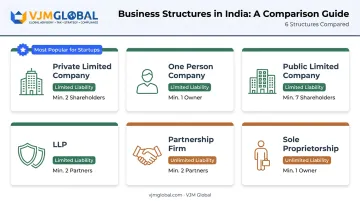
Only the first three are technically "companies" incorporated under the Companies Act. LLPs, partnerships, and sole proprietorships sit under separate legislation entirely.
For startups and foreign-backed businesses, Private Limited is usually the preferred route. It scales more easily and is the structure most banks and investors expect to see.
Why Company Registration Is Important in India
Registering a company changes how the business is treated by law, by lenders, and by the market.
Limited liability protection is the starting point. In a sole proprietorship or partnership, personal assets stay exposed to business debts. Once incorporated, the company's liabilities stay with the company, protecting the personal savings and property of founders and investors.
Credibility with banks, investors, and clients follows close behind. Registered companies find it easier to open institutional accounts, negotiate vendor contracts, and pass due diligence before a funding round.
Startup India's own guidance points to the private limited structure as the form best suited to attracting outside equity, mainly because it offers governance and share-transfer mechanisms other structures lack.
Tax and scheme eligibility adds another layer. DPIIT-recognised startups can claim a 100% profit deduction for 3 consecutive years within their first 10 years under Section 80-IAC, subject to turnover and incorporation-window conditions.
This isn't automatic; it requires separate DPIIT recognition on top of incorporation. It also sits alongside standard corporate tax rates of 25% (or 22% under Section 115BAA for companies foregoing certain exemptions).
Perpetual succession and name protection matter for continuity. A registered company's name is protected under the Companies Act, and the entity continues regardless of changes in ownership, something a proprietorship cannot offer.
Foreign Investors, NRIs, and OCIs Face an Extra Layer
For non-residents, registration is only part of the picture. FEMA governs how foreign capital enters an Indian company, whether through the automatic route or one needing prior government approval under the RBI's Master Direction on Foreign Investment in India, and what sectoral caps apply.
Getting the entry route wrong, or missing an FC-GPR filing after share allotment, creates compliance problems that cost far more to fix than to prevent.
This is where firms like VJM Global work alongside foreign founders, from choosing the right entity structure and checking FDI sector rules, through incorporation, to ongoing RBI reporting and ROC compliance.
Without proper registration, founders typically run into three problems:
- Personal liability for business debts
- Inability to raise institutional funding, since most VCs and banks require a registered entity
- Rejected government tenders or vendor contracts requiring a valid CIN and PAN
Step-by-Step Process of Company Registration in India
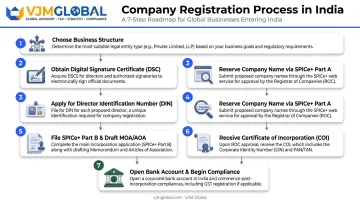
Company registration in India runs entirely online through the MCA (Ministry of Corporate Affairs) portal, moving from digital identity creation to name approval, then final incorporation.
Step 1: Choose a Business Structure
The right choice depends on funding plans, liability preference, and how much compliance the founders can manage. Common options include:
- Private Limited Company: best for startups raising external funding
- LLP: lighter compliance, suited for professional services
- OPC: limited liability for solo founders
Step 2: Obtain a Digital Signature Certificate (DSC)
Every proposed director or subscriber needs a DSC to sign incorporation forms electronically. These are issued by licensed Certifying Authorities and typically remain valid for 1-2 years.
Step 3: Apply for a Director Identification Number (DIN)
First-time directors receive their DIN through SPICe+ Part B, filed alongside the incorporation application itself, not the earlier name-reservation stage. Directors who already hold a DIN from a previous company skip this step.
Step 4: Reserve a Unique Company Name
File two proposed names through SPICe+ Part A. Names must follow MCA naming guidelines and avoid resembling any existing registered company or trademark. Once approved, the reservation holds for 20 days.
Step 5: File the SPICe+ Form and Draft the MOA/AOA
SPICe+ Part B bundles several filings into one submission:
- Incorporation application
- DIN allotment
- PAN and TAN request
- GST, EPFO, and ESIC registration (optional)
Alongside this form, the Memorandum and Articles of Association define the company's objectives and internal rules.
Step 6: Certificate of Incorporation (COI)
Once the Registrar verifies every document, it issues the COI carrying the company's CIN, PAN, and TAN. In practice, straightforward filings often clear this stage within about a week of document approval, though the Companies Act sets no fixed statutory deadline for it.
Step 7: Open a Business Bank Account and Begin Compliance
With the COI and MOA/AOA in hand, the company can open a current account. From there, the compliance clock starts running: appointing an auditor and filing INC-20A to declare commencement of business.
Foreign founders often work with an India-focused advisory firm like VJM Global to manage these filings, RBI approvals, and FEMA compliance without delays.
Documents Required & Key Factors That Affect Registration
Getting the paperwork right the first time avoids most of the delays founders run into.
For directors and shareholders:
- PAN card (mandatory for Indian nationals)
- Passport (mandatory for foreign nationals and NRIs)
- Aadhaar or voter ID as address proof
- Recent passport-size photographs
- Valid email and mobile number for OTP verification
For the registered office:
- A recent utility bill (electricity, water, or gas)
- Rent agreement or ownership proof
- No Objection Certificate (NOC) from the property owner, if the premises are rented
Factors that commonly affect timelines:
- Name conflicts – a proposed name too similar to an existing company or trademark gets rejected, forcing a resubmission
- Authorised capital details – errors in stated capital figures at the SPICe+ stage cause processing delays
- Foreign national directors – documents signed outside India need notarisation and, where the Hague Apostille Convention applies, an apostille; otherwise consular authentication is required
For NRI, OCI, and foreign national directors, this last point is where most delays start. A passport in a language other than English needs a notarised translation, and address proof older than two to three months is routinely rejected by the Registrar. VJM Global works with foreign directors on this regularly, helping them assemble apostilled documents and certified translations before the SPICe+ filing goes in.
Common Mistakes, Misconceptions & Post-Incorporation Compliance
Compliance obligations begin the day a company incorporates and continue every year after.
Misconception: registration alone doesn't make a business compliant. Every registered company, even one with zero revenue, owes the Registrar annual filings, financial statements, and tax returns. A dormant company still has to file Form MSC-3 to formally maintain that status. Dormancy isn't automatic just because there's no turnover.
Filing mistakes early in the process create similar headaches.
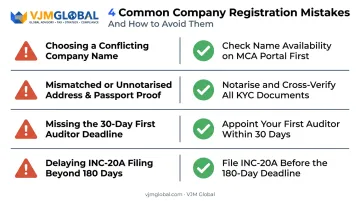
Common mistakes founders make:
- Choosing a name that conflicts with an existing company or trademark, wasting a filing attempt
- Submitting address proof or passport copies that don't match the application, or aren't notarised where required
- Missing the 30-day deadline to appoint the company's first auditor
- Delaying the Commencement of Business filing (INC-20A), due within 180 days of incorporation
When DIY filing stops making sense:
Multi-director structures involving foreign shareholders, businesses in FEMA-regulated sectors, or fundraising rounds on a tight timeline are situations where a small filing error can cost weeks. That's usually the point where founders bring in professional support rather than risk a rejected form resetting the clock.
VJM Global handles this end-to-end for foreign and multinational clients. Support spans pre-incorporation entity selection, DSC and DIN procurement, and SPICe+ filing, through post-incorporation work like auditor appointment, INC-20A, and ongoing ROC compliance.
Conclusion
Company registration in India follows a defined sequence: DSC, DIN, name approval, SPICe+ filing, and finally the Certificate of Incorporation. Each step depends on the one before it, so a rejected name or an unattested document can delay the process or reset a completed step entirely.
Choosing the right structure upfront, whether that's a Private Limited Company for a funded startup or an LLP for a low-compliance service business, prevents most of the rework founders run into later.
The calculus shifts, though, for NRIs, OCIs, and foreign investors, who face FEMA rules layered on top of the standard process that domestic founders don't have to navigate. Getting the entry route, sectoral caps, and RBI filings right the first time matters more than moving fast. VJM Global specializes in this exact intersection, guiding NRIs, OCIs, and foreign investors through entry-route selection, sectoral caps, and RBI filings from day one.
Frequently Asked Questions
How to register a government company in India?
"Government company registration" usually refers to incorporating a private company through official MCA channels. The sequence is the same for everyone: DSC, DIN, name approval via SPICe+ Part A, SPICe+ Part B filing, then the Certificate of Incorporation.
What are the types of company registration in India?
Private Limited Company, One Person Company, LLP, Partnership Firm, Sole Proprietorship, and Public Limited Company. Private Limited remains the most common choice for startups and funded businesses.
How long does company registration take in India?
With accurate documents and an available name, founders typically see registration complete within 7-15 working days via the MCA portal. Delays often stem from name rejections or incomplete documentation.
Can a foreign national or NRI register a company in India?
Yes. Foreign nationals and NRIs can register a company subject to DIN, passport-based verification, and FEMA compliance. Private Limited Company and LLP are the most commonly used structures.
What is the minimum capital required to register a company in India?
There's no mandatory minimum paid-up capital for a Private Limited Company since the 2015 amendment removed that requirement. Most founders still start with a nominal amount, commonly around ₹1 lakh.
What documents are required for company registration in India?
Core requirements include PAN or passport, address proof, recent photographs, and registered office proof such as a utility bill, rent agreement, and NOC from the property owner.