What still exists is a network of energy-focused free zones, DEWA's solar ecosystem, and a regulatory maze most US founders don't see coming until they're already mid-application.
Forming a solar, wind, or clean-energy company in Dubai means securing a standard trade license, then clearing additional sign-offs from the Ministry of Energy and Infrastructure (MOEI), Dubai Electricity and Water Authority (DEWA), and the Regulatory and Supervisory Bureau (RSB). Skip that second layer, and your license won't get you anywhere near a grid connection or a power purchase agreement.
This guide covers eligibility, the step-by-step formation process, licensing structures, realistic costs, and the compliance work that follows incorporation.
Key Takeaways
- Free zones allow 100% foreign ownership, but tax-free status applies only to Qualifying Income.
- Formation needs sign-off from MOEI, DEWA, and RSB, not just free zone registration
- Setup starts around AED 9,000, with annual licenses running AED 10,000 to 50,000 plus extras
- Dubai targets 36% clean energy by 2030 and 100% by 2050, driving demand for private players
- Post-formation compliance needs ongoing cross-border accounting and tax support
What Is Dubai Energy Park Company Formation?
The phrase "Dubai Energy Park" doesn't map to a current official free zone. For US founders, it's best read as shorthand for Dubai's broader energy-focused free zone ecosystem: Dubai Science Park, DMCC's Energy Ecosystem, JAFZA, DAFZ, and Dubai Industrial City, rather than a single address.
In practice, "Dubai Energy Park company formation" means establishing a legal entity within one of these zones (or on the mainland) to conduct solar, wind, waste-to-energy, or clean-energy consulting activities. The end result is a licensed entity authorized to generate, consult on, manufacture, or install renewable energy systems, subject to UAE regulatory oversight.
How this differs from standard free zone setup: Generic free zone formation covers registration alone, meaning trade name, license, and visa quota.
Energy-sector formation adds a second track: approvals from the Ministry of Energy and Infrastructure (MOEI) for federal strategy, the Dubai Electricity and Water Authority (DEWA) for grid access and offtake, and the Regulation and Supervision Bureau (RSB) for generation licensing. A trade license without these sign-offs authorizes your business activity, not power generation or grid connection.
Free Zone vs Mainland: Which Fits Your Business
| Factor | Free Zone | Mainland |
|---|---|---|
| Foreign ownership | 100% | 100% for most activities (strategic-impact exceptions apply) |
| Market access | Export markets, limited local access without a distributor | Direct access to UAE government energy contracts |
| Tax treatment | 0% on Qualifying Income if QFZP conditions are met | Standard 9% above AED 375,000 |
| Best suited for | Manufacturing, trading, consulting, R&D | Utility-scale projects, PPAs, government tenders |
Free zones remain the faster route for manufacturing, trading, or consulting activities. Mainland entities can bid directly on government energy contracts and DEWA's Independent Power Producer tenders, a route many solar and wind developers eventually need.
The sector itself is expanding quickly. UAE renewable capacity reached 7.91 GW by the end of 2025, up from 6.85 GW the year before, according to IRENA's 2026 renewable capacity statistics. That growth is exactly why more US energy businesses are looking at Dubai now.
Why US Businesses Are Choosing Dubai for Energy Company Formation
Dubai's own targets explain much of the pull. The Dubai Clean Energy Strategy now aims for 36% clean energy in the power mix by 2030, rising to 100% of energy requirements from clean sources by 2050.
The Mohammed bin Rashid Al Maktoum Solar Park alone is planned to exceed 8,060 MW by 2030, and private developers are part of how that gets built.
At the federal level, the UAE Energy Strategy 2050 aims to triple renewable energy's contribution and lift installed clean capacity from 14.2 GW to 19.8 GW, backed by an estimated AED 150 billion to 200 billion in investment through 2030.
For US investors, that diversification (clean, gas, nuclear) opens multiple entry points beyond solar: wind, waste-to-energy, storage, and efficiency consulting all have a role.
Ownership advantages that matter to American founders:
- 100% foreign ownership in free zones, no local sponsor required
- Full repatriation of capital and profits
- Reduced import duties on qualifying equipment
- No personal income tax on salary or dividends
Dubai also backs this with financing. The strategy includes a Dubai Green Fund pillar worth AED 100 billion, offering reduced-interest loans to clean-energy investors. Eligibility and underwriting criteria apply per project, so it's not an automatic grant.
Tax reality check: UAE corporate tax follows a two-tier structure:
- 0% on taxable income up to AED 375,000; 9% above that threshold
- Qualifying Free Zone Persons pay 0% only on Qualifying Income, with 9% on non-qualifying income
- No US-UAE income tax treaty exists, though a Model 1 FATCA agreement has applied since 2015
American owners still carry US reporting duties such as Form 5471 and, where applicable, FBAR filings.
Skipping the regulatory groundwork risks more than just paperwork delays. Projects that assume a trade license equals grid access frequently stall at the DEWA or RSB stage for months. Proper structuring from day one keeps that timeline intact.
How to Form an Energy Company in Dubai: Step-by-Step Process
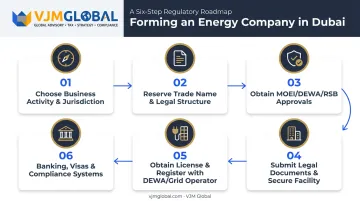
Forming an energy company in Dubai runs on two parallel tracks: standard free zone (or mainland) registration, and energy-specific regulatory clearance. Miss the second track, and you'll have a legal entity that can't touch a solar farm or grid connection.
Expect to gather a business plan, passport copies, proof of address, and a lease agreement early, since most stages ask for some combination of these documents.
Step 1: Choose Business Activity & Legal Jurisdiction
Decide whether you're pursuing solar, wind, waste-to-energy, manufacturing, or consulting. Each maps to a different license and jurisdiction. Solar panel manufacturing points toward JAFZA or Dubai Industrial City; consulting or R&D activities suit Dubai Science Park or DMCC's Energy Ecosystem.
Step 2: Reserve Trade Name & Select Legal Structure
Reserve a trade name that follows UAE naming conventions (no religious or political references, no abbreviated personal names). Then pick a legal structure:
- FZE for single shareholders
- FZCO/FZ-LLC for multiple shareholders
- Mainland LLC for onshore operations
- Branch office of your US parent company
JAFZA's FZCO allows 2 to 50 shareholders, while DMCC permits single-shareholder free zone companies.
Step 3: Obtain Initial Approvals from Energy Regulators
This is where energy formation splits from standard company setup. Beyond free zone registration, you'll need sign-off from MOEI, DEWA, and RSB under Dubai Law No. 6 of 2011. Expect to submit technical project details, ownership documents, and, for generation projects, an outline of your connection or procurement route.
Step 4: Submit Legal Documents & Secure a Facility
Submit your MOA/AOA, parent company documents for branches, and a lease or flexi-desk agreement. Energy companies often need more than a desk. Manufacturing requires warehouse or industrial plots, while testing and R&D activities may need lab space. Free zone incorporation typically can't finalize without an approved premises agreement.
Step 5: Obtain Business License & Register with DEWA/Grid Operator
Once documents clear, you receive a trade license authorizing your listed activity, not power generation. For utility-scale projects, this is where Environmental Clearance from Dubai Municipality and RSB's generation license come in, followed by DEWA's project-specific procurement process for anyone pursuing a PPA. There's no open PPA registration; DEWA runs competitive tenders for solar park phases.
Step 6: Set Up Banking, Visas & Compliance Systems
With a license in hand, open a corporate bank account, allocate employee visas through your free zone or mainland authority, and build out bookkeeping and reporting systems from day one.
This back-office layer is where many US founders lose time, juggling UAE compliance while still running US-side accounting. A cross-border advisory firm such as VJM Global, which has supported 500+ American business owners with outsourced accounting and cross-border tax structuring, can keep the US side of your books straight while you handle Dubai-specific compliance locally.
Business Structures, Licensing & Costs for US Energy Companies
Which structure fits your business:
- Free Zone (FZE/FZCO): 100% foreign ownership, liability limited to paid-up capital, best for manufacturing, trading, and consulting
- Mainland LLC: full foreign ownership available for most activities, required for direct government contract bidding
- Foreign Branch: owned entirely by your US parent, registered through Dubai's Ministry of Economy and Tourism process, useful for extending an existing US entity
Licensing depends on what you're actually doing:
- Equipment manufacturing or assembly needs an industrial or manufacturing license
- Trading or importing/exporting equipment needs a commercial license
- Technical or engineering advisory needs a professional/service license
- Energy audits or ESCO work require RSB accreditation as an energy auditor
- Electricity generation requires a separate RSB generation license
What Setup Actually Costs
Costs vary sharply by free zone, activity, and visa count. DMCC's 2026 guidance puts registration from AED 9,000 (roughly $2,450), with annual licenses running AED 10,000 to 50,000 (about $2,725 to $13,620).
That's before office space, visas, industrial inspections, or the environmental and RSB approvals energy activities require. Other zones publish similar calculators, but none offer one universal number since an equipment-manufacturing setup with a warehouse costs far more than a two-person consulting license.
Budget separately for:
- Office, warehouse, or land lease
- Visa allocation, including medical and Emirates ID fees per employee
- Environmental Impact Assessment costs for construction-linked projects
- RSB accreditation or generation licensing fees
Common Challenges & Compliance Considerations for US Businesses
Beyond paperwork, energy businesses in Dubai face a few recurring operational headaches:
- Intermittency: Solar and wind output fluctuates, which is why DEWA has expanded battery, pumped, and thermal storage alongside solar park phases
- Water constraints: Concentrated solar technologies relying on water cooling face availability limits in a desert environment
- Overlapping approvals: Because MOEI, DEWA, RSB, and Dubai Municipality each review different parts of a project, timelines slip when applications aren't sequenced correctly
Beyond these operational hurdles, regulatory risk carries the highest stakes. Environmental compliance is non-negotiable: Federal Law No. 24 of 1999 bars construction or operational start before securing relevant environmental licensing. Dubai Municipality requires Environmental Clearance ahead of construction, with the depth of review (a full Environmental Impact Assessment Report versus a lighter Summary) depending on project scale and sensitivity.
Once the company is running, compliance work doesn't stop. US-owned entities need ongoing attention to bookkeeping, tax filings, and US-side reporting like Form 5471 and FBAR thresholds.
This back-office load pulls founders away from actually running an energy business. Firms like VJM Global, which bring 30+ years of experience helping American businesses manage cross-border tax and reporting obligations, can handle the bookkeeping and US-side filings, freeing founders to focus on grid approvals and project delivery.

Frequently Asked Questions
How much does it cost to set up a free zone company in Dubai?
Registration typically starts around AED 9,000, with annual licenses ranging AED 10,000 to 50,000 depending on activity and zone. Office space, visas, and any energy-specific approvals add to that base cost.
How do I start a renewable energy company in Dubai?
Choose your activity (solar, wind, consulting, manufacturing) and jurisdiction, then secure approvals from MOEI, DEWA, and RSB alongside your license. Only after these clear can you pursue grid connection or a power purchase agreement.
Can a US citizen own 100% of an energy company in Dubai's free zones?
Yes. Free zones permit full foreign ownership with no local sponsor required. Most mainland activities now allow 100% foreign ownership too, though a handful of strategic-impact sectors still require additional approvals.
Which regulatory bodies approve renewable energy projects in Dubai?
The Ministry of Energy and Infrastructure sets federal strategy, DEWA manages grid access and power procurement, and RSB licenses electricity generation activity in Dubai.
Do US-owned energy companies pay corporate tax in the UAE?
Yes, 9% on taxable income above AED 375,000. Free zone companies may qualify for 0% on Qualifying Income only, so tax treatment depends on your specific activity and structure.
Which Dubai free zone is best suited for renewable energy businesses?
Dubai Science Park suits consulting and R&D, DMCC's Energy Ecosystem covers trading and services, and JAFZA or Dubai Industrial City fit manufacturing and equipment-heavy operations. The right choice depends on your specific activity.