Introduction
More American entrepreneurs are eyeing Dubai as a base for tech, media, and digital-services ventures. The Dubai Technology and Media Free Zone (DTMFZ) sits at the center of that trend. It operates within TECOM Group's business districts and is licensed by the Dubai Development Authority (DDA).
Yet most US business owners researching DTMFZ from abroad run into the same wall. Conflicting information about license types, legal structures, real costs, and what compliance looks like once the company is live clouds the process.
This guide breaks down licensing and structure options, the registration process, and realistic costs. It also covers visa rules, documentation, tax and VAT obligations, and how DTMFZ stacks up against other Dubai free zones.
Key Takeaways
- DTMFZ permits 100% foreign ownership, with no UAE partner required.
- License type, office solution, and visa count drive first-year setup costs.
- Qualifying free zone income earns 0% Corporate Tax; non-qualifying income is taxed at 9%.
- US owners still owe US federal tax under FATCA and CFC rules, plus UAE compliance.
- A cross-border tax advisor should review both sides before you file.
What Is DTMFZ and Why US Businesses Are Choosing It
DTMFZ is best understood as a cluster of TECOM Group business districts, including Dubai Internet City, Dubai Media City, Dubai Studio City, Dubai Production City, and Dubai Design District. TECOM Group develops and operates these districts, while the Dubai Development Authority (DDA) handles registration, licensing, and regulation. Confirm current sector and district details directly on DDA's and TECOM's official pages before applying, since offerings shift periodically.
The zone primarily supports:
- Technology and software companies
- Media, broadcasting, and content production
- Digital marketing and e-commerce
- Design and creative services
- Professional and consultancy services
Why US Businesses Specifically Choose DTMFZ
Several factors pull American founders toward this zone over other UAE options:
- Full foreign ownership: no local sponsor needed to hold shares
- English-language legal environment: contracts, licensing, and government portals operate in English
- Time zone bridge: Dubai sits between US working hours and Asian markets, useful for follow-the-sun operations
- Sector-specific ecosystem: clustering with other tech and media companies creates networking and partnership opportunities that a generic trading license won't offer
Here's a quick-glance summary. Treat these as a starting baseline, not final figures; verify current details on DDA's official site before budgeting or signing anything.
| Factor | Typical Baseline |
|---|---|
| Foreign ownership | Up to 100% (confirm at incorporation stage) |
| Minimum shareholders | One or more; natural or corporate persons |
| Minimum share capital | Generally AED 10,000, with higher amounts for select activities |
| License categories | Service Provider, Consultancy, E-commerce, Media/Production, Freelancer |
| Office requirement | Registered office mandatory; co-working and flexi-desk options vary by district |
Who Should (and Shouldn't) Set Up in DTMFZ
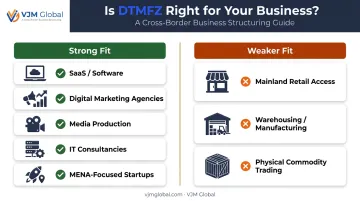
DTMFZ tends to fit:
- SaaS and software companies
- Digital marketing and advertising agencies
- Media production and broadcasting firms
- IT consultancies and managed service providers
- US startups seeking a regional base to serve MENA clients
It's a weaker fit if your business needs:
- Direct, unrestricted access to UAE mainland retail or government clients without a dual-license arrangement
- Warehousing, heavy manufacturing, or industrial floor space
- A trading license focused on physical commodities (DMCC or JAFZA usually fit better here)
DTMFZ License Types and Legal Structures for US Companies
Many generic Dubai free zone guides talk about FZE and FZCO structures as if every zone uses them identically. DDA's current public framework for TECOM districts doesn't publish separate FZE/FZCO entity labels. Instead, companies are registered as FZ-LLCs, which can have one shareholder or several, whether natural persons, corporate entities, or a mix of both.
In practice, this covers the same ground US founders usually ask about:
- Single-shareholder US entities: a solo founder or a US parent company can hold 100% of the FZ-LLC without adding partners
- Multi-shareholder structures: US co-founders or a US company partnering with other investors can register jointly under one FZ-LLC, with no fixed maximum shareholder count published by DDA
- Branch offices: an existing US company can open a dependent branch in DTMFZ rather than forming a new subsidiary, keeping the parent company legally responsible for the branch's obligations
License Categories That Fit US Business Models
- Service Provider / Consultancy: fits most SaaS, IT consulting, and professional service firms
- E-commerce (Express): available through districts like Dubai Design District
- Media, Advertising, and Production: covers content studios, broadcasting, and marketing agencies
- Freelancer permits: for solo professionals not forming a full company
Branch Documentation for US Parent Companies
If you're extending a US company rather than forming a new entity, expect to submit:
- Certificate of incorporation and a certificate of good standing/continuity for the parent
- Parent company's Memorandum and Articles of Association
- A board resolution authorizing the branch and naming a general manager
- Passport copies for directors and the general manager
Important correction to a common assumption: many US applicants assume an apostille alone satisfies DDA's legalization requirements. DDA's published checklist calls for the branch resolution and any power of attorney to be notarized and attested by the UAE Embassy, not simply apostilled. Confirm this step with your registered agent before submitting documents.
One more clarification worth flagging: the AED 10,000 minimum share capital figure is a capital requirement, not your total setup cost. Some free zone marketing materials quote lower figures like AED 1,000 for other zones, which has caused confusion. DTMFZ's baseline sits higher, and certain activities (outsourcing, printing, broadcasting) require significantly more.
Beyond capital requirements, mainland access is another area with fine print. Dual-licensing or mainland-access arrangements do exist in Dubai for certain free zone companies wanting to serve mainland clients directly, but availability depends on activity type and current DDA policy. Confirm eligibility before assuming your DTMFZ license covers mainland work automatically.
Step-by-Step DTMFZ Company Formation Process for US Applicants
- Define your business activity. Confirm it aligns with an approved DTMFZ license category. This decision affects your banking access, tax treatment, and visa allocation.
- Choose your legal structure. Decide between a single-shareholder FZ-LLC, a multi-shareholder FZ-LLC, or a branch, based on your ownership plans and how your US parent company wants the entity to relate to headquarters long term.
- Reserve a trade name. Names must comply with UAE naming conventions: no religious references, no political terms, and no unauthorized use of trademarked brand names.
- Prepare and submit documentation. US applicants typically need notarized passport copies, branch registration documents (if applicable), proof of address, and background details. Some documents require UAE Embassy attestation instead of apostille, so confirm requirements with DDA before finalizing.
- Secure office space. Sign a lease for a registered office, flexi-desk, or co-working space (TECOM's D/Quarters is one option), then receive initial approval ahead of final license issuance.
- Complete post-license registrations. This includes opening your establishment/immigration file, applying for investor and employee visas, obtaining Emirates IDs, opening a corporate bank account, and registering for Corporate Tax and VAT where applicable.
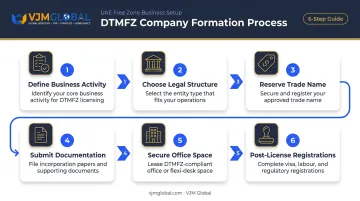
DDA's published service standard is 10 working days for provisional approval plus 2 working days for registration, according to DDA's FZ-LLC registration service page. Treat that as an authority-processing benchmark, not a full end-to-end timeline — document legalization, bank KYC, and visa processing typically add several more weeks.
DTMFZ Company Formation Cost Breakdown
There's no single "DTMFZ cost." Total spend depends on your license type, office solution, share capital deposit, and visa count. Here's what the published fee schedule shows, though you should request current figures before budgeting:
| Cost Component | Typical Range/Amount |
|---|---|
| Registration fee | AED 3,500 (plus small Knowledge/Innovation Dirham fees) |
| Annual license fee | AED 15,000 for most tech/media/service/e-commerce activities; AED 20,000 for select advertising/publishing activities |
| Freelancer permit | AED 7,500 annually |
| Additional business segment | AED 10,000 annually (not prorated) |
| Minimum share capital | AED 10,000 baseline; higher for specific activities |
| Office/flexi-desk lease | No published flat rate — varies by district and space |
| Visa costs (investor/employee, medical, Emirates ID) | No published flat rate — quote through TECOM's AXS platform |
A warning worth taking seriously: advertised "starting price" packages from third-party consultants often exclude government fees, security deposits, immigration file costs, and annual audit fees. Always request a fully itemized written quote before applying, and ask specifically what's excluded.
As a rough planning guide:
- Basic single-shareholder setups with no employee visas typically total AED 28,500-33,500 (roughly $7,750-$9,100) before office and banking costs
- Adding 2-3 employee visas raises first-year costs meaningfully once medical tests, Emirates IDs, and visa fees stack on the base license
- Extra business activities or premium office space add further costs, since additional segments run AED 10,000 annually and flexi-desk rates vary by district
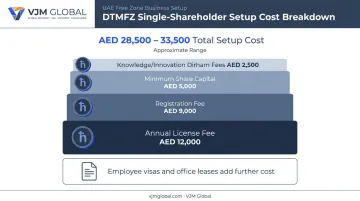
Verify current numbers directly through DDA or TECOM's AXS portal rather than relying on older blog estimates, since fee schedules get revised regularly.
Documents, Visas, and Post-Setup Compliance
Required Documents for US Shareholders and Companies
For individual US shareholders, expect to submit:
- Valid passport copies
- A recent photo
- Proof of residential address
For US corporate shareholders, add:
- Apostilled or attested certificate of incorporation
- Certificate of good standing/continuity
- Board resolution authorizing the DTMFZ entity
- Parent company's constitutional documents (MoA/AoA)
Visa and Employee Sponsorship
Visa quotas typically tie back to your office size and license type, though DDA hasn't published a fixed square-footage formula publicly — confirm your allocation with your leasing agent before signing. The general process runs:
- Open an establishment/immigration file
- Apply for entry permits per employee
- Complete medical fitness testing
- Issue Emirates ID cards
Corporate Tax, VAT, and Accounting Obligations
UAE Corporate Tax applies at 0% on taxable income up to AED 375,000, and 9% above that threshold. But free zone status alone doesn't guarantee a 0% rate across the board.
According to the Federal Tax Authority's Corporate Tax Guide for Free Zone Persons, a Qualifying Free Zone Person receives 0% only on Qualifying Income. Non-qualifying income is taxed at 9%, with eligibility depending on maintaining adequate substance and staying under specific revenue thresholds.
VAT registration follows separate thresholds:
- Mandatory at AED 375,000 in taxable supplies
- Voluntary at AED 187,500
DTMFZ companies must keep proper accounting records, and audited financial statements may be required depending on your structure and revenue.
For US owners, UAE compliance is only half the picture. Under IRS rules, a US shareholder generally means someone owning at least 10% of vote or value in a foreign corporation, and a Controlled Foreign Corporation (CFC) exists when US shareholders collectively hold more than 50%.
Per the IRS instructions for Form 5471, CFC status can trigger Subpart F income or GILTI inclusions, meaning you might owe US tax on UAE profits even before distributing them. FATCA reporting thresholds (Form 8938) may apply too, depending on your foreign asset totals.
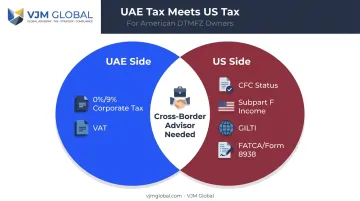
This overlap is exactly where a cross-border tax advisor earns their fee.
DTMFZ vs Other Dubai Free Zones — and When US Businesses Should Also Consider India
| Free Zone | Best Suited For |
|---|---|
| DTMFZ / TECOM | Technology, media, design, education, and digital services |
| DMCC | Trading, commodities, and general business (25,000+ companies) |
| DAFZA | Airport-linked, time-sensitive international trade |
| JAFZA | Sea freight, logistics, and industrial/manufacturing operations |
If your business runs on code, content, or consulting, DTMFZ is the natural fit. If you're moving physical goods, trading commodities, or need port access, DMCC, DAFZA, or JAFZA line up better with your operational needs.
Many US companies expanding globally don't stop at the UAE. They evaluate India in parallel, drawn by cost-efficient talent pools, back-office operations, and manufacturing capacity.
Running a UAE entity alongside an Indian operation works well, but it adds separate compliance layers:
- FEMA regulations for cross-border transactions
- RBI approval requirements
- Transfer pricing documentation
- US-India tax treaty considerations
This is where a firm like VJM Global fits into the picture. The firm has supported over 500 American business owners with India market entry, accounting outsourcing, and cross-border tax compliance.
That experience helps US companies plan a coordinated UAE-India growth strategy or manage the accounting and compliance side of a multi-country structure. Businesses avoid coordinating three separate advisors across three time zones.
Frequently Asked Questions
How much does it cost to incorporate a company in Dubai?
Costs vary by free zone, license type, and legal structure, with total AED expenses shaped by office space, visa count, and share capital requirements. Request an itemized written quote before committing to see the full cost breakdown.
How do I check if a company is registered in Dubai?
Use the relevant free zone authority's public register, or search the UAE's official Invest in Dubai portal using the license number or business name to confirm registration status.
How do I find who owns a company in Dubai?
Ownership details are kept confidential under UAE regulations. They can sometimes be verified through the free zone authority, trade license documents, or an authorized due-diligence request.
Can a US citizen own 100% of a DTMFZ company?
Yes. DTMFZ permits full foreign ownership, meaning a US citizen or US company can hold 100% of the entity without a local UAE partner.
What's the difference between a DTMFZ free zone company and a Dubai mainland company?
DTMFZ companies typically operate within the free zone or internationally, while mainland companies can trade directly across the UAE without restriction. Ownership rules and office requirements also differ between the two.
How long does DTMFZ registration take for US applicants?
DDA's benchmark is roughly 12 working days for provisional approval and registration, but document legalization, banking, and visa steps for US applicants usually extend the full process to several weeks.