This guide is written for US-based physicians, medtech founders, wellness brands, and investors evaluating DHCC. Generic UAE setup content rarely addresses the cross-border details that actually matter to Americans, such as ownership documentation, US tax exposure, and IRS reporting tied to a foreign entity.
Here, we'll cover the legal structures available, licensing categories, the step-by-step formation process, realistic costs, required documents, and the US tax angles that founders frequently underestimate.
Key Takeaways
- DHCC permits 100% foreign ownership across all entity types, with no UAE national sponsor required
- DHCC entities are structured as an FZ-LLC or a Branch, replacing the older FZE/FZCO terminology
- 0% tax for 50 years under Article 15, Law 16/2024, doesn't exempt US founders from CFC/NCTI (GILTI) tax on worldwide income
- UAE isn't a Hague Apostille Convention member, so US documents require Embassy/VFS legalization, not a simple apostille
- Underestimated bank KYC timelines and activity-license mismatches are the costliest planning mistakes for US founders
What Is Dubai Healthcare City and Why US Businesses Choose It
DHCC was established in 2002 as a purpose-built healthcare free zone. It's now governed under Law No. (16) of 2024, which makes DHCA a financially and administratively autonomous public authority responsible for licensing, registering establishments, and developing the zone. Healthcare activities inside DHCC also require the applicable DHA approval, so clinical operators answer to both regulators, not one.
That's different from mainland UAE, where healthcare licensing runs through a separate set of authorities entirely, and from general-purpose free zones, which have no sector-specific clinical licensing framework at all. DHCC remains the only zone built specifically around clinical care, medical education, research, and health technology under a single administrative umbrella.
Why US Founders Are Drawn to DHCC
Full foreign ownership is the first draw. There's no requirement for a UAE national partner or equity dilution, regardless of whether you're forming a solo practice or a multi-founder medtech venture.
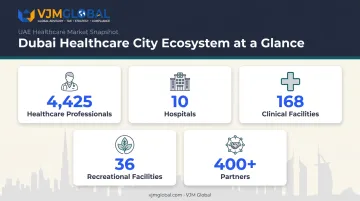
Ecosystem scale matters too. DHCC's own figures put the zone at 4,425 healthcare professionals, 10 hospitals, 168 clinical facilities, 36 recreational facilities, and more than 400 partners operating within its boundaries, according to DHCC's official site. That's a dense, healthcare-specific cluster you won't find replicated in a generic free zone.
Beyond ownership and scale, two structural advantages stand out. Long-term tax certainty: Article 15 of Law No. 16/2024 sets a 0% tax rate on DHCC operations for 50 years, renewable by Ruler resolution. Single regulatory interface: DHCA handles both commercial licensing and coordinates with DHA on clinical compliance, simplifying interactions compared to mainland UAE's multi-authority structure.
Step-by-Step Process to Form a Company in DHCC
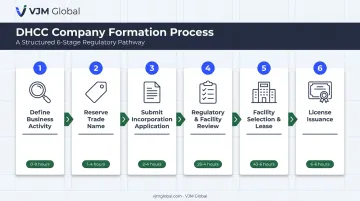
Formation moves sequentially through DHCA's digitized portal, from activity definition to license issuance. Skipping a step or misjudging documentation at any point pushes the whole timeline back, so understanding what each stage requires upfront keeps the process on track.
Step 1: Define Business Activity and License Type
Before anything else, decide which cluster your venture fits. A telehealth platform, a medical device trading business, a clinic, and a research center are governed by different licensing clusters, external approval requirements, and facility standards. Getting this wrong early is the single most common source of delay later.
Step 2: Reserve a Trade Name
Names go through the DHCA portal and can't duplicate existing registrations or imply government affiliation. Once reserved, a name stays held for up to 120 days, giving you room to finish the rest of the application without racing the clock.
Step 3: Submit the Initial Incorporation Application
This is where you provide shareholder and director details, including US parent company data if a corporate entity is involved, ownership percentages, and a description of the business model. For a US-owned FZ-LLC, expect to submit notarized incorporation documents alongside standard registry forms.
Step 4: Regulatory and Facility Review
DHCA reviews the application and, for clinical applicants, verifies professional credentials. Initial approval typically takes 3 to 10 working days, though clinical or research activities requiring external academic or health authorizations often take longer.
Step 5: Facility Selection and Lease Execution
A physical presence within DHCC is mandatory. You'll reserve premises with a deposit, then finalize the lease once provisional approval comes through. This lease establishes your registered business address and is required before the license is issued.
Step 6: License Issuance and Post-Registration Steps
Once everything clears, you receive the Certificate of Incorporation, Memorandum of Association, and Business License. From there, you can open a corporate bank account, apply for establishment cards, and sponsor visas for staff and dependents.
Choosing the Right Legal Structure and License Type
Legal Structures Available to US Investors
Current DHCA materials define two structures for foreign investors, not the FZE/FZCO terminology often quoted in outdated guides:
- FZ-LLC — Requires one shareholder and one director, with no cap on shareholders. Fits solo practitioners, multi-founder practices, and US corporate holding structures, since a corporate entity can serve as sole shareholder
- Branch — A branch of an existing UAE company or of a foreign (US) parent. It has no separate legal personality; its activities mirror the parent, on which it fully depends
Most US healthcare founders default to an FZ-LLC because it offers limited liability protection that a branch structure doesn't provide.
License Categories at a Glance
Rule No. 1 of 2025 organizes DHCC activities into 10 licensing clusters, covering Healthcare, Education, Research, Wellness, Hospitality, Retail, Business Support, Support Services, Regional Headquarters, and Property Services. For US healthcare founders, three clusters cover most use cases:
- Healthcare (including Clinical activities) — Required for direct patient care. Demands facility compliance certification plus DHCA-recognized credential verification for US-trained physicians and clinicians
- Education & Research — Covers medical training institutes, research centers, and continuing education providers, some of which need additional authorization from bodies like KHDA or MOHESR
- Business Support — The lowest-cost entry point, suited to health-tech startups, consulting practices, or medical equipment trading ventures that only need office-grade facilities rather than clinical space
Annual commercial license fees under this rule generally sit around AED 15,000 for Education, Research, Wellness, and Business Support activities. Healthcare-cluster fees range higher, from AED 15,000 to AED 45,000, depending on the specific activity.
Costs, Documents, and Tax Compliance for US Founders
What It Actually Costs
Verified DHCA charges break down into a few core line items, plus costs that scale with your entity type:
- AED 1,550 initial application fee and an AED 3,500 registration fee, plus small AED 10 knowledge and innovation fees
- Annual license fee starting at AED 15,000 and rising depending on cluster
- Facility lease costs and standard visa components (entry permits, medical testing, Emirates ID processing, establishment cards)
A Business Support setup lands at the lower end of this range. A Clinical entity, with its facility certification and credentialing requirements, costs meaningfully more.
Documentation for US Shareholders
For an individual-shareholder FZ-LLC, you'll typically need:
- Passport copies and a business plan
- Notarized incorporation resolution and registry forms
- MOA/AOA documentation
Corporate shareholders (including US parent companies) additionally provide their Certificate of Incorporation or Good Standing, constitutional documents, board resolutions, and UBO declarations for anyone holding 25% or more of the entity.
Important correction for US founders: the UAE is not currently a party to the Hague Apostille Convention. That means US-issued documents can't simply be apostilled and submitted. They still require authentication through the US Department of State followed by UAE Embassy or VFS legalization, with Arabic translation where required. Budget extra time for this step; it's easy to underestimate.
UAE Corporate Tax and QFZP Status
| Rule | Treatment |
|---|---|
| Standard Corporate Tax | 0% up to AED 375,000 taxable profit; 9% above it |
| Qualifying Free Zone Person (QFZP) | 0% on Qualifying Income only; 9% on non-qualifying income |
| De minimis threshold | Non-qualifying revenue capped at the lower of AED 5 million or 5% of total revenue |
To keep QFZP status, an entity must maintain documented economic substance in the free zone, derive genuinely qualifying income, follow arm's-length transfer pricing, and keep audited financials, according to the UAE's Corporate Tax Guide for Free Zone Persons. Losing that status carries a penalty: you're locked out of QFZP treatment for the current tax period and the following four.
The US Side of the Equation
Here's the part generic guides skip entirely: a 0% UAE rate doesn't touch your US filing obligations. A foreign corporation becomes a Controlled Foreign Corporation (CFC) when US shareholders holding 10% or more each collectively own over 50% of vote or value, triggering Form 5471 reporting requirements under IRS rules. Depending on your ownership structure, you may also face:
- NCTI exposure (the renamed GILTI regime for tax years starting after December 31, 2025)
- FATCA reporting via Form 8938, with thresholds starting at $50,000 for US residents
- FBAR filing with FinCEN if foreign accounts exceed $10,000 at any point during the year
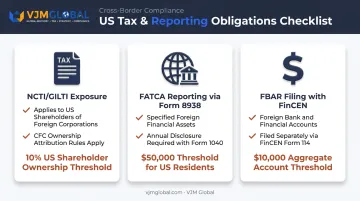
Because these three tests (DHCC status, UAE QFZP status, and US tax residency rules) operate independently, a compliant DHCC entity doesn't automatically mean a compliant US tax position.
This is where firms like VJM Global come in. Their team of CPAs and Chartered Accountants works across FATCA reporting, FBAR filings, and international tax structuring for US-based founders, helping keep both sides of a dual-jurisdiction structure in order rather than treating UAE and US compliance as separate problems.
Common Mistakes, When DHCC May Not Be Right, and Final Thoughts
The most expensive mistake we see is a mismatch between licensed activity and actual operations. If your bank account activity doesn't match what's on your license, US-linked entities face enhanced KYC and AML scrutiny that can freeze operations for weeks.
Bank account timing deserves its own warning: advisory benchmarks suggest corporate account opening in the UAE runs 5 to 7 weeks, often longer than the entire company formation process itself. Plan for this gap; don't assume you'll be operational the moment your license issues.
Another persistent misconception: a 0% UAE tax rate doesn't eliminate US filing obligations. CFC exposure, NCTI calculations, and FATCA reporting apply regardless of what rate you pay locally.
Beyond these operational pitfalls, some founders find that DHCC simply isn't the right structure for their venture. DHCC may not be the right fit if:
- You need unrestricted mainland UAE market access without free zone restrictions
- Your venture isn't healthcare-related and would be better served by a general-purpose free zone or mainland license
- You're not prepared to complete external clinical, academic, or research approvals tied to your activity cluster
For the right founder, though, DHCC offers a genuinely tax-advantaged, sector-specific hub, provided you plan for both UAE compliance and US reporting from day one rather than treating them as an afterthought.
Frequently Asked Questions
How do I set up a healthcare company in Dubai Healthcare City?
Setting up involves defining your business activity and license cluster, reserving a trade name, submitting your incorporation application, and passing DHCA's regulatory review. From there, you secure a facility lease and receive your license, with the entire sequence handled through DHCA's digital portal.
Can a foreigner start a company in Dubai Healthcare City?
Yes. DHCC permits 100% foreign ownership across all entity types, whether structured as an FZ-LLC or a branch, with no UAE national partner required.
Who owns Dubai Healthcare City?
DHCC is a Dubai Government free zone regulated by the Dubai Healthcare City Authority, established as a public authority under Law No. (16) of 2024.
Do US citizens have to pay US tax on income earned through a DHCC company?
Yes. US citizens and entities are taxed on worldwide income regardless of the UAE's 0% rate, and CFC, NCTI (formerly GILTI), and FATCA/FBAR reporting typically apply.
How long does it take to set up a company in DHCC?
Initial approval generally takes 3 to 10 working days with complete documentation. Clinical licenses often take longer due to credential verification and external health authority approvals.
What is the cost of setting up a business in DHCC?
Costs vary by license cluster and facility type but generally include an AED 1,550 application fee, AED 3,500 registration fee, annual license fees from AED 15,000, plus facility lease and visa expenses.