The appeal is straightforward. DGDP offers 100% foreign ownership, a favorable tax structure, and direct access to a global luxury retail and trade hub the US market simply doesn't replicate at home. DGDP itself is a JAFZA-regulated, sector-specific free zone on Sheikh Zayed Road, built exclusively for gold, diamond, gemstone, and jewelry businesses — combining manufacturing blocks, retail showrooms, and offices in one integrated complex.
This guide walks US business owners through licensing, costs, the setup process, and the compliance considerations Americans face when they set up shop abroad.
TL;DR
- DGDP is a JAFZA-regulated free zone for jewelry, gold, and gemstone businesses
- Setup requires choosing a license type, securing a facility lease, and completing JAFZA registration
- Licenses start at AED 5,000; JAFZA typically processes applications within 3-14 business days
- US owners face additional IRS reporting obligations most general DGDP guides skip entirely
Why DGDP Makes Sense for US Businesses
DGDP isn't an automatic win for every American entrepreneur, but under the right conditions, it's a genuinely strong move.
No local partner required. DGDP permits 100% foreign ownership across FZE, FZCo, and branch structures, with full repatriation of capital and profits. That removes the local UAE sponsor requirement that trips up many first-time foreign investors elsewhere in the region.
A favorable tax position, with caveats. There's no personal income tax in the UAE, and qualifying free zone income can be taxed at 0% corporate tax under the UAE's Qualifying Free Zone Person (QFZP) rules. But this isn't automatic.
The Federal Tax Authority's Corporate Tax Guide for Free Zone Persons sets strict conditions for qualifying:
- Adequate substance and arm's-length pricing
- Audited financials
- Qualifying Income that passes strict activity tests (manufacturing generally qualifies; retail and e-commerce need case-by-case review)
- Non-qualifying revenue capped at the lower of 5% of total revenue or AED 5 million
Miss any of these, and QFZP status can be lost for the current period plus the following four.
A concentrated global buyer base. UAE gold exports reached $53.41 billion in 2024-25, placing the country among the world's largest gold exporters. DGDP itself was built to house dozens of retailers and manufacturers under one roof, giving smaller brands proximity to buyers they'd otherwise never reach from a US storefront.
Purpose-built infrastructure. The manufacturing blocks come with gas lines, ventilation systems, and acid disposal already in place — costs a US manufacturer would otherwise absorb building from scratch.
Foot traffic that actually converts. Sheikh Zayed Road puts you in front of tourists, trade buyers, and B2B wholesale contacts simultaneously, something a standalone location rarely offers.
Licenses, Costs & Documents You Need to Know
Most DGDP setup delays trace back to one thing: picking the wrong license or structure for the intended activity, not paperwork problems.
License Types & Business Structures
DGDP operates under JAFZA's license framework, which includes six main categories:
| License Type | Covers |
|---|---|
| Trading | Buying/selling physical goods and related permitted services |
| Manufacturing/Industrial | Producing, assembling, or processing goods (requires a production facility) |
| Retail | Direct sales through a dedicated retail unit |
| Service | Consulting or service activity without holding physical inventory |
| E-commerce | Online sales operations, typically paired with an office or logistics setup |
| National Industrial | A specialized industrial category with its own fee schedule |
For structure, three options fit most US applicants:
- FZE – single shareholder, ideal for solo founders or a wholly owned US subsidiary
- FZCo – multiple shareholders, better for partnerships or joint ventures
- Branch – an extension of an existing US company, useful if you want to keep everything under one corporate umbrella
Setup Costs to Budget For
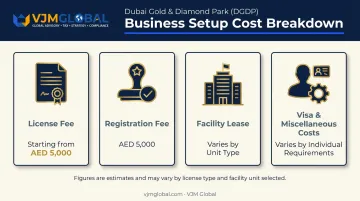
JAFZA's published license fee schedule starts licenses at AED 5,000 annually for a single activity group, but that figure excludes registration, facility lease, and visa costs. One-time FZE, FZCo, or branch registration typically runs another AED 5,000, with PLC registration higher.
Facility costs vary significantly depending on whether you need:
- A manufacturing block (highest cost, includes specialized infrastructure)
- Retail floor space within the showroom
- Standard office space for service-based operations
There's no fixed minimum share capital requirement since 2017, though your practical working capital needs (inventory, showroom fit-out, staffing) can add up fast. Use JAFZA's official cost calculator for a quote specific to your license and unit type before budgeting.
Documents Required for US Applicants
Core documents include:
- Passport copies for shareholders and managers
- UBO (Ultimate Beneficial Owner) KYC declaration
- Signed lease agreement
- Completed application form
For US corporate applicants, add: certificate of incorporation, board resolution authorizing the DGDP entity, and constitutional documents.
Here's the friction point most first-time applicants miss: the US is a Hague Apostille Convention member, but the UAE is not currently listed among Apostille Convention parties.
That means US corporate documents generally need the full authentication and UAE Embassy legalization chain rather than a simple apostille stamp. This step catches out applicants who assume apostille alone will suffice.
Step-by-Step Process to Set Up Your DGDP Business
JAFZA cites an estimated 3-14 business days from complete document submission to approval. Here's how that breaks down in practice.
Step 1 – Choose Your License, Activity & Business Structure
Confirm your intended activity fits within DGDP's permitted jewelry and precious metals categories before submitting anything. The most common misstep here: applicants select a license type that doesn't actually match what they plan to do, forcing a rework and resubmission later.
Step 2 – Prepare Documents and Register for AML Compliance
Gather your passport copies, UBO KYC documentation, and (for US corporate applicants) the apostilled and legalized incorporation documents. If you're trading gold or stones above the regulatory threshold, register on the UAE's goAML platform, since DGDP businesses fall under Dealers in Precious Metals and Stones (DPMS) anti-money-laundering rules.
Step 3 – Secure Your Facility Lease Within the Park
A signed lease is mandatory before licensing proceeds. Match the facility to your license: manufacturing activities need a manufacturing block, not office space. Leasing the wrong unit type is a frequent cause of approval delays.
Step 4 – Submit Your Application, Pay Fees & Receive Your License
Submit through JAFZA's digital portal or the Dubai Trade platform, then complete fee payment. Once approved, your license downloads digitally. Remember: it requires annual renewal alongside an active lease.
Step 5 – Open a Bank Account and Apply for Visas
With your license and lease in hand, open a UAE corporate bank account. Apply for employee and investor visas through Dubai Trade, and request an increased visa quota upfront if your initial allocation won't cover your hiring plans.
Compliance & Tax Considerations for US Business Owners
Setting up a UAE free zone company creates US-side reporting obligations that most DGDP guides never mention — and ignoring them can trigger real IRS penalties.
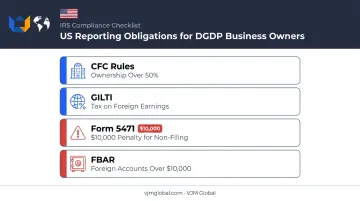
Depending on your ownership structure, these commonly apply:
- Controlled Foreign Corporation (CFC) rules – if US shareholders own more than 50% of your DGDP entity's voting power or value
- GILTI (Global Intangible Low-Taxed Income) – US shareholders of a CFC may owe US tax on foreign earnings even when UAE tax is 0%
- Form 5471 – required for US persons meeting certain ownership thresholds in a foreign corporation; the IRS lists penalties starting at $10,000 per failure to file
- FBAR (FinCEN Form 114) – required if your combined foreign financial accounts exceed $10,000 at any point during the year
None of these are automatic for every DGDP entity. Ownership structure and percentage ownership determine what actually applies to you.
This is exactly where the two sides of a DGDP setup need to talk to each other. Your UAE-side accounting handles DMCC free zone compliance and tax positioning, while your US-side reporting needs a separate, coordinated review.
VJM Global's team has spent over 30 years advising American business owners on cross-border tax planning and international structuring. We work alongside clients' US tax counsel and UAE-side advisors to help ensure the entity setup and US filings reflect the same facts, rather than surfacing a mismatch during an audit.
Conclusion
Succeeding at DGDP comes down to three fundamentals:
- Matching the right license and structure to your actual activity
- Budgeting realistically for costs beyond the headline license fee
- Staying ahead of both AML and US reporting obligations
DGDP's specialized infrastructure and tax position make it a genuinely strong option for American jewelry businesses. But that advantage only materializes when you handle the setup and compliance basics correctly from day one.
Work with experienced advisors on both the UAE and US sides before you sign a lease — it's far cheaper than fixing a structural mistake after the fact.
Frequently Asked Questions
How do I start a diamond business in Dubai Gold and Diamond Park?
Choose a license type that matches your diamond trading or manufacturing activity, secure a facility lease within the park, and register your entity through JAFZA. Getting the activity-to-license match right upfront prevents most delays.
How much does it cost to set up a company in Dubai Gold and Diamond Park?
Costs include a JAFZA license fee starting around AED 5,000, plus facility lease costs and visa fees that vary by unit type. Use JAFZA's cost calculator for a figure specific to your setup.
Can a foreigner set up a company in Dubai Gold and Diamond Park?
Yes. DGDP permits 100% foreign ownership with no UAE national partner required, whether you set up as an FZE, FZCo, or branch of your existing US company.
Is the jewelry business profitable in Dubai Gold and Diamond Park?
The park's steady tourist and trade traffic supports strong sales volume, while its co-located manufacturing-retail ecosystem and tax advantages help control costs. Actual results still depend on your pricing strategy and execution.
Do US business owners need to report their DGDP company to the IRS?
Generally yes. US persons owning a foreign company typically face CFC, FBAR, and Form 5471 reporting obligations depending on ownership percentage. Confirm your specific requirements with a cross-border tax advisor.
How long does it take to get a DGDP business license?
JAFZA cites an estimated 3-14 business days after all required documents are submitted. Having your facility lease signed in advance typically speeds up the overall approval timeline.