Introduction
Dubai attracts thousands of American entrepreneurs each year — yet most guides skip the details that actually trip people up. Choosing the wrong jurisdiction, mishandling US-origin document authentication, or missing continued IRS obligations can derail a setup that looked straightforward on paper. American founders face a distinct set of requirements that generic Dubai guides rarely address in full.
This guide is written for US-based founders and business executives considering Dubai as a base for Middle East expansion, international trade, or tax-efficient operations. It covers the three setup structures available to Americans, the step-by-step registration process, and critically, the US tax obligations that follow you regardless of where your business is incorporated.
Key Takeaways
- Most free zone setups can be completed remotely without traveling to the UAE
- Americans must choose between Mainland, Free Zone, or Offshore — each with distinct ownership rules and market access
- Dubai incorporation does not eliminate US tax obligations — Americans are taxed on worldwide income
- FBAR and FATCA filings are required for UAE corporate bank accounts exceeding $10,000
- Free zone setups take 2–4 weeks once documents are ready — authentication delays are the most common bottleneck
Why US Entrepreneurs Are Setting Up Businesses in Dubai in 2026
Dubai's appeal for American entrepreneurs comes down to a tax math comparison. The UAE corporate tax rate is 0% on taxable income up to AED 375,000, and 9% above that threshold — against US federal corporate tax rates of 21%, plus state-level taxes in most jurisdictions. There's no personal income tax, no capital gains tax, and no withholding tax on dividends or profit repatriation.
The numbers back up the interest. Dubai recorded 1,826 announced FDI projects in 2024, with estimated FDI capital of AED 52.3 billion (approximately USD 14.24 billion) — up 33% year-on-year. The US accounted for 13.7% of that capital and 14% of announced projects, with concentration in software and IT services.
What Makes Dubai Strategically Attractive in 2026
Beyond the tax structure, three specific developments since 2024 have made Dubai meaningfully more accessible for American investors:
- FATF removal — The UAE was removed from FATF's increased monitoring list in February 2024, improving banking relationships and international credibility
- UAE Golden Visa — Investors can qualify for a 10-year residency visa with an approved fund deposit or company capital of at least AED 2 million; entrepreneurs with projects valued at AED 500,000+ in innovative or tech-oriented sectors can qualify for a 5-year residency
- Geographic position — Dubai sits within 8 hours of 2/3 of the world's population, making it a practical hub for US companies serving Europe, Asia, or Africa simultaneously
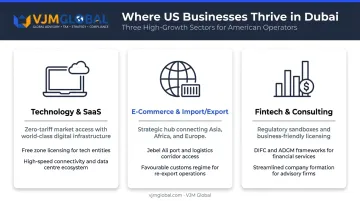
American businesses have seen the strongest results in sectors where Dubai's infrastructure and free zone ecosystem create a structural edge:
- Technology & SaaS — zero-tariff access and digital infrastructure
- E-commerce & import/export — proximity to Asia, Africa, and European markets
- Fintech & consulting — regulatory sandboxes and a business-friendly licensing regime
Dubai Business Setup Options for Americans: Mainland, Free Zone & Offshore
Before any registration begins, US citizens must select one of three jurisdictions. This decision determines ownership structure, market access, tax treatment, and ongoing compliance requirements — so it deserves careful analysis before committing.
Mainland Setup
Mainland companies, licensed through Dubai's Department of Economy and Tourism (DET), can trade freely across the UAE market and internationally. The UAE now permits full foreign ownership across most economic sectors. Exceptions apply to activities with strategic impact: security and defense, banking and finance, telecommunications, and fisheries-related services still require 100% Emirati ownership.
Key requirements for mainland companies:
- Physical office space (registered via the EJARI tenancy contract system)
- Annual financial audits
- Compliance with Emiratisation rules for companies above certain employee thresholds
Mainland is the right choice if direct access to UAE local customers is central to your business model. If you're primarily serving international markets, a free zone is typically the better fit.
Free Zone Setup
Free zones are the most popular entry point for US businesses. The core benefits:
- 100% foreign ownership across all permitted activities
- 0% personal income tax
- 0% corporate tax for Qualifying Free Zone Persons on Qualifying Income (note: income attributable to mainland or foreign permanent establishments is taxed at 9%)
- 100% repatriation of capital and profits
- Many processes completable entirely remotely
The key limitation: free zone companies cannot trade directly within the UAE local market without a local distributor or a separate mainland entity.
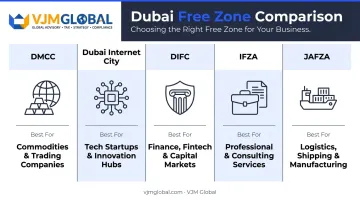
Dubai has more than 20 free zones, and the choice should match your industry:
| Free Zone | Best For |
|---|---|
| DMCC | Trading, commodities, digital assets |
| Dubai Internet City | Technology and innovation |
| DIFC | Financial services, fintech, startups |
| IFZA | Professional, commercial, industrial activities |
| JAFZA | Logistics, petrochemicals, food and agriculture |
Offshore Setup
Offshore registration suits US businesses using Dubai as an asset-holding vehicle or international trade conduit. Unlike mainland or free zone structures, there's no UAE market access, no physical office requirement, and no minimum capital threshold. Both JAFZA and RAK ICC offer offshore formation with 100% foreign ownership.
One practical challenge worth planning for: UAE bank account opening for offshore entities involves additional scrutiny. US persons also face FATCA-driven compliance requirements that can extend approval timelines significantly.
Step-by-Step: How to Register Your Business in Dubai from the USA
The following sequence applies broadly across jurisdictions and can be initiated remotely by a US-based owner.
Step 1: Define Your Business Activity and Structure
The UAE offers more than 2,000 approved economic activities. Your chosen activity determines:
- The license type required (Commercial, Professional, Industrial, Tourism, Agricultural, or Crafts)
- Whether additional government approvals are needed
- Which free zones are eligible for that activity
Choose carefully — adding or changing activities post-registration takes time and incurs additional costs.
Step 2: Choose a Jurisdiction
Evaluate your options against three criteria:
- Do you need UAE local market access? → Mainland
- Are you serving international markets with full ownership and tax benefits? → Free zone
- Do you need an asset-holding vehicle with minimal operational requirements? → Offshore
US businesses should also consider which free zones have established processes for working with US-registered entities or parent companies, as this affects banking and compliance workflows.
Step 3: Reserve a Trade Name and Obtain Initial Approval
UAE trade name rules require that the name:
- Carries the correct legal-form abbreviation
- Matches the registered business activity
- Does not include names of Allah, government authorities, or third-party trademarks
- Does not duplicate an existing registered company name
Initial DET approval signals no government objection to formation — it does not authorize operations.
Step 4: Prepare and Authenticate US Documents
This is where most US applicants lose time. US-origin documents — including passport copies, bank statements, business registration certificates, and powers of attorney — must be authenticated before UAE authorities will accept them.
Per current UAE Embassy guidance (effective August 2025), corporate document authentication follows three stages:
- Secretary of State attestation — issued by the state where the document originates
- UAE Embassy attestation — submitted through VFS Global
- UAE MOFA attestation — the final in-country verification step
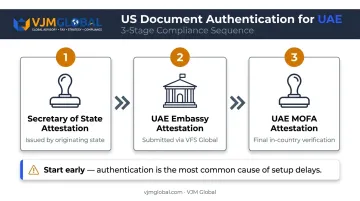
Practical tip: State-level processing times vary. California currently processes mailed apostille requests within weeks, with in-person requests processed within 30 minutes. New York offers same-day walk-in processing with a 10-document limit. Start this process early — it's the most common cause of setup delays.
Step 5: Secure Office Space and Submit for Final License Approval
- Mainland: Requires a physical lease registered through Dubai Land Department's EJARI system
- Free zones: Offer flexi-desks, dedicated desks, and physical offices; the option chosen affects the number of employee visas available
DMCC's Jump Start package, for example, includes a company license, flexi-desk or coworking space, and one UAE residence visa for AED 43,780 per year. Dubai South Business Hub starts at AED 12,500 for a trade license and flexi-desk (visas as add-ons). DIFC's Innovation License runs USD 1,500 per year with coworking access.
Free zone licenses are issued only once the lease agreement is confirmed.
Step 6: Open a UAE Corporate Bank Account
Banking is where most US applicants hit unexpected friction. UAE banks operate under the US-UAE Model 1 FATCA IGA, meaning they report US account holders to the UAE competent authority, which then shares that data with the IRS.
For US persons, bank onboarding typically requires:
- FATCA self-certification of entity status
- US tax identification information (EIN and/or SSN)
- Identification of US controlling persons for passive entities
- Standard corporate KYC documentation
Banks including HSBC UAE, Emirates NBD, and ADCB have established FATCA compliance processes and experience with US-national account holders.
Account approval for US nationals runs longer than for non-US applicants. Working with an advisor who has existing UAE banking relationships can reduce rejection risk — and keeps the process moving when documentation questions arise.
US Tax and Legal Obligations You Cannot Ignore
Worldwide Income Taxation
US citizens and resident aliens, including Green Card holders, are subject to US federal income tax on worldwide income — regardless of where their business is incorporated. A Dubai free zone company does not create a tax exemption for its American owner. You still file US tax returns. You still pay US taxes on business profits, subject to applicable exclusions.
The two main relief mechanisms:
- Foreign Earned Income Exclusion (FEIE): Up to $132,900 per qualifying person in 2026, applicable to earned income only (not passive or business profit), and requires a genuine foreign tax home
- Foreign Tax Credit: Offsets US tax on foreign-source income where foreign taxes have been paid
Neither of these eliminates US obligations — they reduce them, under specific conditions.
FBAR and FATCA Reporting
Income tax compliance is only part of the picture. Americans with UAE bank accounts also face two separate disclosure regimes:
| Obligation | Threshold | Deadline |
|---|---|---|
| FBAR (FinCEN 114) | Aggregate foreign accounts exceed $10,000 at any time in the year | April 15, automatic extension to October 15 |
| Form 8938 (FATCA) | Varies by residency and filing status — from $50,000 (US resident, single) to $600,000 (abroad, married filing jointly) | Filed with your federal tax return |
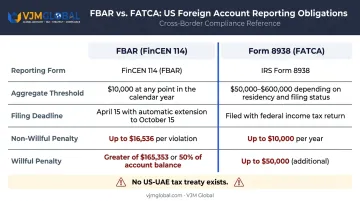
FBAR penalties are serious. Non-willful violations carry a maximum of $16,536 per violation (2025 figures, adjusted for inflation). Willful violations: the greater of $165,353 or 50% of the account balance. Criminal sanctions can reach $250,000 and up to five years imprisonment.
No US-UAE Tax Treaty
The UAE does not appear on the IRS list of US income tax treaty countries. That means Americans cannot use treaty provisions to reduce double taxation. Getting your entity type, ownership structure, and filing strategy right before incorporation — not after — determines how much of that tax burden you can legally minimize.
Common Mistakes US Entrepreneurs Make When Setting Up in Dubai
Most of these mistakes are avoidable — but they tend to surface after commitments are already made. Here are the four that consistently trip up US founders:
Assuming Dubai incorporation eliminates IRS visibility. It doesn't. US citizenship-based taxation applies globally, regardless of where your entity is registered. Founders who skip this step often face expensive restructuring and penalty exposure months or years down the line.
Starting document authentication too late. The notarization and Secretary of State attestation process takes time — often 2–4 weeks. Many US founders begin it only after selecting a free zone, which delays everything unnecessarily. Start the authentication process as soon as Dubai incorporation is seriously on the table.
Not disclosing US person status when opening a UAE bank account. This violates FATCA and creates real legal exposure. UAE banks are required to identify and report US account holders. Proactively disclosing your tax status upfront is both legally required and strategically smart — banks that discover undisclosed US persons post-opening have closed those accounts outright.
Choosing a free zone without checking banking compatibility first. Not every free zone has the same banking relationships. Some offshore structures face additional scrutiny when opening UAE accounts, and US persons add another layer of requirements on top. Confirm banking feasibility before committing to a jurisdiction — it avoids real headaches later.
Frequently Asked Questions
Can a US citizen set up a business in Dubai without traveling to the UAE?
Yes — most free zone setups can be completed remotely through online portals and authorized representatives. Some mainland processes may require a power of attorney arrangement. The one step that typically requires in-person action is document authentication in the US (Secretary of State attestation), which must be handled before UAE-side submission.
Do Americans have to pay US taxes on income earned through a Dubai company?
Yes. US citizens are taxed on worldwide income regardless of where the business is incorporated, and there is no US-UAE tax treaty. FBAR and Form 8938 filings are required for UAE bank accounts meeting the respective thresholds. Consult a US-qualified tax advisor before structuring your entity.
How long does it take to set up a business in Dubai from the USA?
Free zone setups typically take 2–4 weeks once documents are ready. Mainland setups generally run 4–8 weeks. US document authentication — Secretary of State attestation and UAE Embassy attestation — is the most common cause of delays and should be initiated early in the process.
What does it cost to set up a business in Dubai?
Costs vary significantly by free zone. DMCC's Jump Start package runs AED 43,780 per year; Dubai South Business Hub starts at AED 12,500; DIFC's Innovation License is USD 1,500 per year. Most free zones carry no minimum share capital requirement, but visa and office costs add up — request itemized quotes before committing.
Can US citizens open a UAE corporate bank account?
Yes, but the process is more involved than for non-US applicants. UAE banks are FATCA-compliant and require full disclosure of US person status, FATCA self-certification, and identification of US controlling persons. Approval timelines run longer for US nationals, and working with an advisor who has established UAE banking relationships improves success rates considerably.
Is a mainland or free zone company better for a US business expanding to Dubai?
Free zones suit most US businesses — they allow full foreign ownership, offer tax advantages, and support remote setup. Mainland is the right choice only if direct access to UAE local customers is central to your model. Confirm the structure with a professional advisor before committing.