That said, generic UAE setup guides tend to skip the details that actually matter to a US-based founder: how to handle remote registration logistics, whether mainland or free zone fits your business model, and what happens on the US tax side once you own a foreign entity.
This guide walks through the full registration process, realistic costs, required documents, structure selection, and post-registration compliance, all from a US applicant's perspective.
Key Takeaways
- 100% foreign ownership is available to US citizens in most Dubai mainland LLC activities—no local Emirati sponsor required
- Activity selection, trade name, MOA and licensing can be done remotely from the US via Power of Attorney
- Setup costs typically run $3,500 to $15,000+, based on structure, office type and visa count
- US persons must still file IRS Form 5471 and FBAR even though the UAE levies zero personal income tax
- Choose mainland for direct UAE market access; choose free zone for export or remote-service models
What Is a Dubai LLC & Why US Entrepreneurs Are Choosing It
What Is an LLC in Dubai?
Under Federal Decree-Law No. 32 of 2021, a Dubai LLC is a separate legal entity where liability is limited to each shareholder's capital contribution. It can have anywhere from 1 to 50 shareholders, giving solo founders and multi-partner ventures the same structural flexibility.
Unlike a sole establishment or branch office, an LLC operates in its own name. It can:
- Sign contracts and enter into commercial agreements
- Lease commercial property directly
- Hire staff and sponsor employee visas
- Open a corporate bank account under the company's name, not the founder's
Why US Business Owners Are Registering Dubai LLCs
Before 2021, most mainland activities required a UAE national to hold at least 51% ownership. The 2020/2021 reform removed that requirement for most sectors, letting US founders retain full control of their company. Strategic-impact sectors (defense, oil exploration, and similar activities) still carry ownership restrictions, but they're the exception rather than the rule.
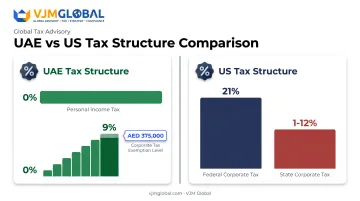
The tax picture is also a major draw. The UAE charges no personal income tax, and federal corporate tax sits at 0% on profits up to AED 375,000 and just 9% above that threshold. Compare that to the US, where the federal C-corp rate alone is 21%, plus state corporate rates ranging from 1% to 12%.
Beyond tax, Dubai functions as a genuine trade hub. Jebel Ali Port connects to more than 150 ports globally through 80+ weekly shipping services, making it a practical base for reaching the GCC, wider Middle East, Africa, and South Asia.
A licensed Dubai LLC also carries more credibility with international banks and partners than an offshore shell, and allows unrestricted profit repatriation back to the US.
VJM Global helps US founders handle both UAE entity formation and US-side compliance without needing a physical presence in the country.
Step-by-Step Process: How to Register a Dubai LLC from the USA
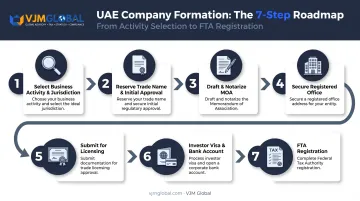
For standard, unregulated activities, registration timelines run about 1-2 weeks once documents are complete, and most steps can be handled remotely through a Power of Attorney.
Select your business activity and jurisdiction. The Dubai Department of Economic Development (DED) maintains a classified activity list. Your choice determines the license type and whether you need mainland status (direct UAE market access) or a free zone (export/remote-focused operations).
Reserve a trade name and get initial approval. Submit a few name options that meet DED naming conventions. Initial approval confirms the authority accepts your business concept and proposed ownership structure.
Draft and notarize the Memorandum of Association (MOA). The MOA outlines shareholding percentages and management authority. US shareholders' personal or corporate documents typically need notarization or attestation in the US before they're valid for use in the UAE.
Secure a registered office address. Every LLC needs a physical office or flexi-desk. Mainland companies register the lease through Ejari; free zone companies use that zone’s facility or flexi-desk options.
Submit for licensing and receive the trade license. File final documents and fees with the DED or free zone authority. On approval, the trade license is issued and the company can operate.
Handle post-licensing setup: investor visa and corporate bank account. The investor visa process starts after licensing if you need UAE residency. Opening the corporate account is separate—US applicants should plan for extra KYC tied to FATCA, which can stretch account opening to several weeks.
Register with the Federal Tax Authority (FTA). Corporate tax registration is mandatory for all legal entities regardless of income level. VAT registration becomes mandatory once taxable turnover crosses AED 375,000 in a rolling 12-month period.
Costs, Documents & Requirements for US Applicants
What US Shareholders Need to Prepare
- Passport copy of each shareholder
- Proof of US residential address
- US LLC or corporation as shareholder: apostilled or attested incorporation documents and a board resolution authorizing the UAE entity
One common point of confusion: the No Objection Certificate (NOC) requirement only applies to shareholders currently employed in the UAE under another company's sponsorship. Most US-based applicants won't encounter this at all.
A Power of Attorney lets a US founder authorize someone in the UAE to sign the MOA and initiate the bank application remotely. Some banks still require a video call or an in-person visit for final KYC before releasing account access.
Representative Cost Breakdown
| Cost Item | AED Range | Approximate USD |
|---|---|---|
| Free zone registration | AED 9,000+ | $2,450+ |
| Free zone annual license | AED 10,000-50,000 | $2,725-$13,615 |
| Free zone office/flexi-desk | AED 15,000-20,000 | $4,085-$5,445 |
| Offshore company registration | AED 10,000 | $2,725 |
| Mainland licensing (typical) | AED 15,000-50,000 | $4,085-$13,615 |
USD figures are approximate conversions and will fluctuate with the exchange rate.
Representative total-cost scenarios:
- Minimal free zone setup, no visa: roughly $3,500-$6,000
- Standard free zone setup with one visa: roughly $6,500-$9,000
- Standard mainland setup with 1-2 visas: roughly $8,000-$15,000
Mainland vs Free Zone vs Offshore: Choosing the Right Structure
Picking the wrong structure is one of the most expensive mistakes a US founder can make, since switching later often means starting over.
- Mainland LLC gives full UAE market access, including government contracts and trade across all seven emirates. Best when you sell directly to UAE consumers or local companies.
- Free zone company offers 100% ownership plus customs and duty exemptions on in-zone or re-exported goods. Fits US e-commerce, consulting, or export-only businesses without a UAE retail footprint.
- Offshore company suits holding structures or asset protection tied to a US business, but cannot trade locally in the UAE. You get a certificate of incorporation, not an operating license.
| Structure | Ownership | Market Access | Typical Use Case |
|---|---|---|---|
| Mainland LLC | 100% (most activities) | Full UAE + government contracts | Retail, services, local trading |
| Free zone | 100% | Zone + international; mainland sales need extra approval | E-commerce, consulting, export |
| Offshore | 100% | No local UAE trading | Holding companies, asset protection |
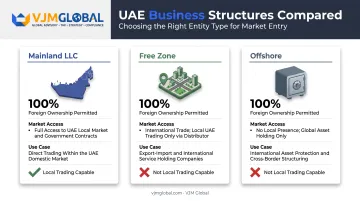
Choose based on where you will actually do business. Most US founders using Dubai for regional operations pick mainland or free zone; offshore is rarely the right operating vehicle.
Common Mistakes & Post-Registration Compliance for US Owners
The biggest misconception among US founders is assuming zero UAE personal income tax means zero US tax obligations. It doesn't. US citizens and residents are taxed on worldwide income regardless of where it's earned.
Depending on ownership percentage and entity classification, that can trigger IRS Form 5471. FinCEN Form 114 (FBAR) is also required whenever foreign account balances exceed $10,000 at any point in the year.
Other frequent missteps:
- Underestimating bank timelines. FATCA disclosures for US persons can add several weeks beyond a standard corporate account opening.
- Choosing structure on cost alone. A cheaper free zone license fails if you need direct UAE market access—match structure to market, not just budget.
- Ignoring FTA registration. Corporate tax registration is mandatory for every UAE entity; VAT registration applies once turnover crosses AED 375,000.
Staying compliant means covering both sides at once: UAE licensing and FTA filings, plus the annual US IRS reporting that comes with owning a foreign entity. VJM Global supports US founders on that dual track—entity formation and FTA requirements in the UAE, paired with cross-border tax reporting on the US side.
Frequently Asked Questions
How do I register an LLC company in Dubai?
Registration involves selecting a business activity, reserving a trade name, drafting the Memorandum of Association (MOA), securing an office address, and submitting for licensing. After licensing, you apply for a visa and open a corporate bank account.
Can a US citizen own 100% of a Dubai LLC?
Yes, for most mainland and free zone activities since the 2020/2021 ownership reform. A handful of strategic-impact sectors still carry ownership restrictions, but these are exceptions.
Do I need to travel to Dubai to register my LLC, or can I do it remotely from the USA?
Most steps, including trade name reservation, MOA signing, and licensing, can be handled remotely via Power of Attorney. Bank KYC occasionally requires a video call or in-person visit.
Do I have to pay US taxes on income earned through my Dubai LLC?
Yes. US citizens and residents are taxed on worldwide income regardless of the UAE's 0% personal tax rate. You may also need to file Form 5471 and FBAR depending on ownership structure.
How long does it take to register a Dubai LLC from the USA?
Standard activities typically take 1-2 weeks once all documents are ready. Regulated activities or slow document attestation can extend this timeline.
Should I choose a Mainland or Free Zone LLC as a US-owned business?
Mainland suits businesses needing direct UAE market access or government contracts. Free zone fits export, e-commerce, or remote-service models that don't need a local retail presence.