Introduction
A US-based founder wants to register a company in Dubai without packing a suitcase. Good news: most free zone formations can be completed entirely from a laptop in New York, Austin, or anywhere else in the country.
Generic Dubai setup guides rarely mention the friction points that actually trip up Americans. Document authentication chains through the Secretary of State, FATCA-compliant banking that non-US applicants never deal with, and IRS obligations that follow you home no matter where you incorporate all add extra steps.
Americans supplied 13.7% of Dubai's foreign direct investment capital in 2024, according to Dubai's official FDI data. That made the US the second-largest source of capital behind only one other country.
This guide covers the available business structures, the exact registration sequence, real costs and paperwork, and the US tax duties that don't disappear just because your license says Dubai.
Key Takeaways
- Most free zone formations can be completed remotely; mainland setups usually require more in-person steps
- Free zones offer 100% foreign ownership and preferential tax treatment, but block direct mainland trading
- Dubai incorporation doesn't erase US tax duties: worldwide income taxation, FBAR, and FATCA still apply
- Document authentication through the Secretary of State and UAE Embassy causes the most delays for Americans
- Expect 2-4 weeks for free zone setups once paperwork is ready; mainland takes longer
What Is Dubai Company Formation and Why US Founders Choose It
Dubai company formation means legally registering a business entity under UAE law, either through the Department of Economy and Tourism for mainland companies or through one of the emirate's free zone authorities. The license that results lets you trade, hire staff, sign leases, and hold assets inside the UAE.
Most American founders aren't chasing a fancy address. They want a legal foothold to reach GCC and MENA markets, hold intellectual property or investment assets offshore, or cut their corporate tax bill compared to what they'd owe at home.
The Tax Differential Driving Interest
The math is a big part of the pull. Under the UAE's corporate tax regime, taxable income up to AED 375,000 is taxed at 0%, with 9% applying above that threshold. Compare that to the flat 21% federal corporate rate in the United States.
That gap doesn't erase US filing duties (more on that later), but it does change the math on where profits sit and how they're taxed at the entity level.
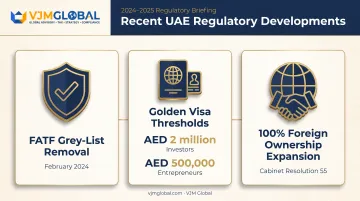
Regulatory Shifts Worth Knowing
Recent developments that matter for American investors:
- FATF grey-list removal (February 2024): The UAE came off the Financial Action Task Force's increased-monitoring list, easing compliance friction for US banks and investors doing business with UAE entities.
- Golden Visa thresholds: Public investors need a minimum AED 2 million for a 10-year visa; entrepreneurs qualify with a project worth at least AED 500,000 if it's innovative or technology-driven.
- 100% foreign ownership expansion: Cabinet Resolution 55 opened most mainland sectors to full foreign ownership, narrowing the list of activities still requiring UAE national participation.
Forming a new UAE entity is not the same as opening a branch of your existing US company. A branch remains legally part of the US parent with no separate identity. A newly incorporated UAE entity (LLC, free zone company, or offshore vehicle) stands on its own under UAE law.
Business Structures Available to Americans: Mainland, Free Zone or Offshore
This is the first and most consequential decision in the entire process. It determines your ownership percentage, market access, tax exposure, and how hard your banking application will be.
Mainland Companies
Mainland companies are licensed through Dubai's Department of Economy and Tourism (DED) and can trade anywhere in the UAE, including directly with government entities.
Full foreign ownership now applies across most sectors. A short list of "strategic impact" activities (banking, insurance, telecommunications, currency printing, and a few others) still involves sector-regulator approval and, in some cases, national participation.
Mainland comes with more operational weight:
- Ejari-registered lease required for a physical office
- Annual financial audit mandatory for LLCs and joint stock companies
- Emiratisation compliance for firms with 50+ employees (2% annual Emirati hiring growth); some sectors at 20–49 also apply
Free Zone Companies
Free zones are the default entry point for American founders. They offer 100% foreign ownership, a largely remote setup process, and full repatriation of capital and profits. The trade-off: free zone companies generally can't sell directly into the UAE mainland market without a local distributor or agent.
Zone selection should follow your business activity, not the other way around:
| Zone | Best For | Ownership | Mainland Access |
|---|---|---|---|
| DMCC | Trading and commodities | 100% foreign, fully digital setup | Requires distributor for mainland sales |
| DIFC | Financial and professional services | 100% ownership, regulated entities | Requires DFSA authorization for regulated activity |
| JAFZA | Logistics, port-linked trade, manufacturing | No foreign-ownership restriction | Standard free zone limitation applies |
Offshore Companies
Offshore structures work well for asset holding or as an international trade conduit. There's no UAE office requirement and no market access inside the UAE. This vehicle exists purely for holding assets or channeling international transactions.
One thing to flag before committing: offshore entities face added banking scrutiny for US persons because of FATCA-driven due diligence. Confirm banking compatibility for your specific ownership structure before you register, not after.
Step-by-Step Guide to Registering Your Dubai Company from the USA
This sequence applies broadly across mainland and free zone routes, and a US-based founder can initiate nearly all of it remotely.
Step 1: Define Business Activity and Choose Your Jurisdiction
The UAE recognizes more than 2,000 approved business activities, and your chosen activity determines both your license type and which free zones you're eligible for. Changing your activity after registration adds cost and delay, so lock this in before moving forward.
Step 2: Reserve a Trade Name and Secure Initial Approval
Trade names must include a legal-form suffix (like LLC), avoid religious or government references, and pass a uniqueness check. Initial approval simply confirms the authorities have no objection to your formation. It doesn't authorize you to start operating.
Step 3: Authenticate US-Origin Documents
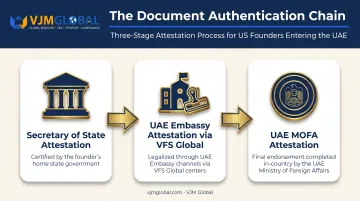
This is where most American founders lose time. Corporate documents run through a three-stage chain before UAE authorities will accept them:
- Secretary of State attestation in your state of incorporation or formation
- UAE Embassy attestation, typically processed through VFS Global
- UAE Ministry of Foreign Affairs (MOFA) attestation, completed in-country
Start this early. Secretary of State processing times vary widely by state, and this chain is the single most common bottleneck for US applicants.
Step 4: Secure Office Space and Finalize Your License
Mainland companies need an Ejari-registered lease before licensing completes. Free zones offer more flexibility, from flexi-desks to full offices, and your choice also caps your visa allocation:
- DMCC flexi-desk: up to 3 visas
- Physical office: roughly 1 visa per 9 square meters
Step 5: Open a UAE Corporate Bank Account
This step catches Americans off guard more than any other. FATCA requires UAE banks to collect self-certification of your entity's status, your EIN or SSN, and identification of any US controlling persons behind passive entities.
Approval timelines for US applicants tend to run longer than for non-US founders, since banks apply extra scrutiny to satisfy their FATCA reporting duties. Working with an advisor who already holds established UAE banking relationships, such as VJM Global's cross-border formation team, can reduce rejection risk and keep documentation questions from stalling your account for weeks.
Step 6: Apply for Visas and Complete Post-Licensing Registrations
Residency visa allocation ties directly to your office space and license type. From there, remaining post-license steps typically include labor registration and, where applicable, pension enrollment for employees.
Costs, Documents and Ongoing US Tax Obligations
What You'll Actually Pay
Free zone pricing varies significantly by zone and activity, but current published packages give a useful benchmark:
| Free Zone | Starting Cost | Notes |
|---|---|---|
| Meydan Free Zone | AED 12,500 | Advertised online setup within 24 hours |
| DMCC | AED 9,000 registration + AED 10,000–50,000 annual license | Plus average AED 50,000 refundable share capital |
Office space, visa allocations, and regulated-activity approvals add to these base figures.
Documents You'll Need
- Passport copies for all shareholders and directors
- Attested business registration and formation documents (see Step 3)
- Proof of residential address
- Memorandum of Association (MOA)
- Translated and notarized copies where the original isn't in English or Arabic
US Tax Obligations Don't Disappear
Dubai incorporation doesn't remove your IRS footprint. US citizens and resident aliens remain taxable on worldwide income regardless of where a business is registered.
Two partial relief mechanisms exist, but neither is a full exemption:
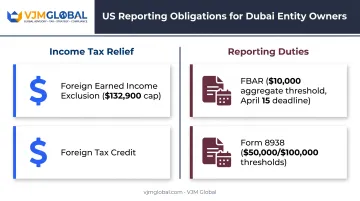
- Foreign Earned Income Exclusion (FEIE): Excludes up to $132,900 of foreign earned income for 2026 if you meet the bona fide residence or physical presence test. Remote ownership of a UAE entity alone does not qualify
- Foreign Tax Credit: Offsets US tax with foreign taxes already paid, though it can't be claimed on income already excluded via FEIE
Reporting duties stack on top of income tax:
- FBAR: Required when aggregate foreign account balances exceed $10,000 at any point in the year (April 15 deadline; automatic extension to October 15)
- Form 8938: Triggers at $50,000+ (unmarried, year-end) or $100,000+ (joint filers), with higher thresholds for qualifying overseas residents
No US-UAE income tax treaty exists, so double taxation relief is limited to FEIE and the Foreign Tax Credit.
Entity type, ownership structure, and filing strategy should be set before you incorporate. Advisors who work across both IRS and UAE compliance, such as VJM Global, help structure this correctly from day one.
Common Mistakes US Entrepreneurs Make (and When Dubai Setup May Not Fit)
First-time American founders tend to hit the same few traps:
- Assuming Dubai incorporation removes IRS visibility. It doesn't. Citizenship-based taxation applies no matter where the entity sits.
- Starting document authentication too late. Secretary of State and embassy processing timelines are longer than most founders expect, and rushing invites rejected paperwork.
- Picking a free zone before confirming banking compatibility. Some zones work better with certain banks for US persons. Confirm fit before you commit, not after the license is issued.
Skip Dubai setup if:
- You have no international revenue plans
- Your activity only needs US market access
- You won't take on the extra FBAR and FATCA compliance any foreign entity brings
Frequently Asked Questions
How much does it cost to establish a company in Dubai?
Free zone packages start around AED 12,500 and can run past AED 50,000 depending on the zone and license type. Visa allocations and office space add to that base license fee.
Can a US citizen set up a business in Dubai without traveling to the UAE?
Yes, most free zone setups can be completed remotely. The main step requiring local action is US-based document authentication through the Secretary of State and UAE Embassy.
Do Americans have to pay US taxes on income earned through a Dubai company?
Yes. Worldwide income taxation applies regardless of where you incorporate, and FBAR and FATCA Form 8938 filings apply once you cross the relevant account or asset thresholds.
How long does it take to register a company in Dubai from the USA?
Free zone setups typically take 2-4 weeks once paperwork is ready. Mainland setups usually take longer due to additional approvals. Document authentication is the most common source of delay for either route.
Is a mainland or free zone company better for a US business expanding to Dubai?
Free zones suit most internationally focused US businesses thanks to full foreign ownership and easier remote setup. Mainland fits founders who need direct access to the UAE's domestic market.
Can US citizens open a UAE corporate bank account?
Yes, but expect added FATCA-driven documentation (including EIN/SSN disclosure and controlling-person identification) and longer approval timelines than non-US applicants typically face.