This guide is for solo Amazon and Shopify sellers, US LLC owners looking to expand internationally, and agencies helping American brands break into the Gulf market. We'll walk through the actual UAE incorporation steps and the US-side tax obligations that come with owning a foreign company, an area many founders overlook until it's too late.
Key Takeaways
- Free zones offer 100% foreign ownership and 0–9% corporate tax; mainland rules differ on ownership and remote setup
- Complete most licensing remotely via Power of Attorney; bank accounts usually need in-person or video KYC
- Owning a UAE company triggers US reporting duties (Form 5471, FBAR, GILTI) regardless of UAE tax rates
- Free zone e-commerce licenses typically start around AED 12,500–14,000 (~$3,400–$3,800), before visas and office space
- Coordinate UAE formation with US tax advisory from day one to avoid compliance gaps later
Why US Entrepreneurs Are Setting Up E-Commerce Companies in the UAE
The UAE's e-commerce sector is expanding fast. Dubai Chambers projects the market will reach $17.2 billion by 2027, growing at an 8.4% compound annual growth rate between 2023 and 2027. That's a forecast, not a done deal, but it signals real demand for founders who want a foothold in a region underserved by Western brands.
American sellers running Amazon, Shopify, or dropshipping operations look to the UAE for a few concrete reasons:
- Retain full ownership in most free zone structures with no local partner required
- Pay zero personal income tax on earnings drawn from the UAE entity
- Qualify for 0% corporate tax on many free zone activities (versus 9% above AED 375,000 for non-qualifying income)
- Reach the GCC, East Africa, and South Asia within a few hours from a UAE base
None of this erases your US tax bill, though. That's a separate conversation we'll get into shortly.
There's also an infrastructure argument. The UAE has built out payment gateways, 3PL fulfillment networks, and dedicated free zones like Dubai CommerCity and Meydan specifically for online retail. A founder who never relocates can still run a functioning UAE-based operation, warehousing included, without setting foot in the country beyond an initial visit or two.
Mainland vs Free Zone: Choosing the Right Structure When Setting Up from the USA
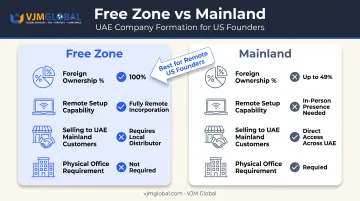
Your jurisdiction choice determines three things: who can own the company, whether you can sell directly to UAE mainland shoppers, and how much of the process you can actually do from your laptop in the US.
Free Zone Company (Best Fit for Most Remote US Founders)
Free zones allow up to 100% foreign ownership, and each authority sets its own conditions. For a founder who won't relocate, this matters more than almost any other factor. UAE free zones were built for exactly this scenario: digital licensing, minimal in-person requirements, and no need for a local sponsor.
Free zone structures work particularly well if you're:
- Dropshipping to customers outside the UAE
- Selling through Amazon, Etsy, or other cross-border marketplaces
- Running a D2C brand that ships internationally rather than targeting Dubai or Abu Dhabi shoppers exclusively
The tradeoff: a free zone license alone typically doesn't authorize you to sell directly to UAE mainland customers. You'd need a distributor or a separate arrangement for that.
Mainland Company
A mainland setup makes sense if your business plan centers on large-scale retail distribution inside the UAE. This route requires a commercial license from the relevant emirate's Department of Economic Development (DED)—or, in Dubai, the Department of Economy and Tourism (DET), plus TDRA approval for the e-commerce activity itself.
Dubai now permits full foreign ownership for more than 1,000 commercial activities, so the old requirement for a 51% Emirati partner no longer applies universally. Strategic sectors are the exception, not the rule.
Ownership is no longer the main barrier. The catch for a US-based founder is operational: mainland companies generally need a physical office and more in-person coordination during setup. It's not impossible to manage remotely, but it's noticeably less streamlined than a free zone application.
Which Structure Fits a US-Based Founder?
Ask yourself these three questions:
- Where are my customers? International or GCC-wide → free zone. UAE mainland exclusively → mainland.
- Can I tolerate occasional in-person requirements? If not, free zone wins by a wide margin.
- Do I want a UAE residency visa eventually? Both can support one; free zones usually bundle visa allocation into the license more simply.
For most Amazon and Shopify sellers reading this, a free zone entity is the practical starting point.
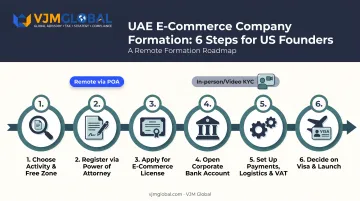
Step-by-Step: How to Set Up an E-Commerce Company in the UAE from the USA
Most of this process happens remotely. The one stage where physical presence (or at least video verification) is usually non-negotiable is banking. Here's the full sequence.
Step 1 – Define Your Business Activity and Choose Your Free Zone
Start by selecting the correct e-commerce activity code for your product category. Then compare free zones like Dubai CommerCity, Meydan, RAKEZ, or Masdar City on three criteria:
- Cost of license and setup
- Remote-application support
- Whether they explicitly permit your product category or marketplace model
Common miss: picking the cheapest free zone without confirming it actually licenses your niche. Some zones restrict certain product categories or business models, and finding that out after payment is a costly mistake.
Step 2 – Register the Company Remotely via Power of Attorney
A US founder can appoint a local PRO (Public Relations Officer) or agent, or use a notarized Power of Attorney, to complete trade name reservation and incorporation without traveling. Meydan, for example, documents a fully digital process for individual shareholders that doesn't require notarized or attested documents.
Corporate shareholders face a different standard. If your UAE entity will be owned by a US LLC or corporation rather than you personally, expect to provide:
- Passport copy and proof of US address
- Certificate of incorporation and articles of organization/incorporation for the US entity
- Notarized and attested memorandum/articles of association (typically required for corporate shareholders, even where individual applicants are exempt)
Step 3 – Apply for and Receive the E-Commerce License
Your application package usually includes your chosen activity code, a business plan, and address proof. Processing speed varies significantly by free zone. Meydan, for instance, states its regular route runs about one business day, with an expedited option under 60 minutes for qualifying applications. Other zones may take longer, so confirm the specific timeline before committing.
Step 4 – Open a UAE Corporate Bank Account
This is where remote setup gets more complicated. Most UAE banks still require an in-person visit or video KYC for accounts owned by US persons, largely due to FATCA-related due diligence obligations that UAE reporting institutions must follow.
Banks commonly request:
- Trade license and incorporation documents
- Passport and proof of address for all signatories
- FATCA self-certification (W-9 or equivalent)
- Business plan or proof of expected transaction volume
Common miss: assuming the account can be opened entirely online. US ownership adds a compliance layer that most other nationalities don't face at UAE banks.
Step 5 – Set Up Payment Gateways, Logistics, and VAT Registration
After licensing and banking, lock in the operating stack:
- Integrate a UAE-approved payment gateway
- Arrange fulfillment through a 3PL or free zone logistics partner
- Register for VAT once required
The standard mandatory VAT threshold is AED 375,000 in taxable supplies. The Federal Tax Authority notes this threshold does not automatically apply to foreign businesses, so confirm your entity's VAT status rather than assuming the standard rule.
VJM Global handles ongoing bookkeeping and reconciliation for e-commerce sellers, tracking sales, refunds, and payouts across platforms such as Shopify and Amazon so VAT thresholds are not missed as revenue scales.
Step 6 – Decide on a Visa and Launch Operations
A UAE residency visa isn't mandatory to own the company. It does simplify banking relationships and future travel. The Green Visa for investors is renewable for five years and doesn't require a sponsor, making it a reasonable option for founders who plan to visit the UAE regularly even without relocating full-time.
US Tax and Compliance Obligations When You Own a UAE E-Commerce Company
Incorporating in the UAE doesn't touch your US tax obligations. American citizens and residents are taxed on worldwide income, regardless of where the company sits or what the UAE itself charges.
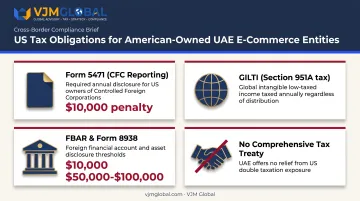
Here's what typically comes into play for US persons who own a UAE entity:
Form 5471 (Controlled Foreign Corporation reporting) A US person owning more than 50% of the UAE entity must file this form annually. The penalty for a late or incomplete filing is $10,000 per form, with additional $10,000 penalties every 30 days after an IRS notice, capped at $50,000 in continuation penalties. This is not a form to miss.
GILTI (Global Intangible Low-Taxed Income) Profits earned through your UAE entity can be taxed on your personal US return under Section 951A, even though the UAE itself charges 0-9% corporate tax. The 0% rate you're celebrating in Dubai doesn't necessarily follow through to your 1040.
FBAR and Form 8938 A UAE corporate bank account can trigger FinCEN Form 114 (FBAR) once aggregate foreign account balances exceed $10,000 at any point in the year. Form 8938 (FATCA) kicks in at higher thresholds: $50,000 at year-end for single filers, $100,000 for joint filers. These are separate filings with different triggers—not interchangeable forms.
No comprehensive tax treaty The UAE doesn't appear in Treasury's list of countries with a comprehensive US income tax treaty. That absence matters for double-taxation planning, since there's no treaty mechanism to automatically resolve overlapping claims between the two systems.
UAE formation and US tax filing run on separate rule sets, so gaps show up when the two sides aren't coordinated. VJM Global handles UAE entity setup and compliance alongside US tax filing, and has supported more than 500 American business owners with dual-jurisdiction structures.
Costs and Common Mistakes for US-Based Founders
Free zone pricing varies by zone and package, so treat any single "UAE-wide" number with skepticism. Publicly documented ranges include:
| Free Zone | License Cost | Visa Costs | Office/Desk |
|---|---|---|---|
| Meydan | From AED 12,500 (3 activity groups) | Investor visa ~AED 4,000; employment visa AED 3,500 | Flexi-desk included; dedicated desk from AED 3,500/month |
| RAKEZ | AED 14,000/year (all-inclusive package) | Not itemized separately | Included in package |
Beyond pricing, the mistakes we see most often among American founders fall into a few patterns:
- Assuming no US filing is required because income sits in a UAE bank account. Worldwide income taxation doesn't care where the money physically lives
- Not budgeting time for in-person bank KYC. This catches people off guard when it's the one stage that resists full remote completion
- Choosing a free zone that restricts mainland selling without confirming a distributor arrangement first
- Underestimating VAT registration timing as revenue scales past the threshold—and facing penalties or blocked filings when registration lags growth
Frequently Asked Questions
How much does an e-commerce license cost in the UAE?
Free zone e-commerce licenses typically start around AED 12,500-14,000 (roughly $3,400-$3,800) for the base package. Mainland licenses vary more, since costs depend on activity type, office requirements, and approvals needed.
Is e-commerce profitable in Dubai?
The UAE e-commerce market is projected to reach $17.2 billion by 2027. Actual profitability still depends on your niche, logistics costs, and competition, so treat market growth as an opportunity, not a guarantee.
Can a US citizen own 100% of a UAE e-commerce company?
Yes, free zone entities generally allow full foreign ownership with no local sponsor required. Mainland ownership rules vary by activity, though Dubai now permits 100% foreign ownership for more than 1,000 commercial activities.
Do I need to visit the UAE in person to set up my company?
Licensing and registration can largely be completed remotely through Power of Attorney, especially for free zone entities. Banking is the exception. Most UAE banks still require an in-person visit or video KYC for US-owned accounts.
Do I have to pay US taxes on income from my UAE e-commerce business?
Yes. US citizens and residents are taxed on worldwide income regardless of where the company is incorporated. Depending on ownership percentage, you may also face Form 5471, GILTI, and FBAR reporting obligations.
Can I open a UAE corporate bank account remotely from the USA?
Some banks offer video onboarding, but most apply additional verification steps for US-owned accounts due to FATCA-related due diligence requirements. Budget for the possibility of an in-person visit during this stage.