So which story is true? Both, actually. The real question isn't "is the economy good or bad." It's "can my specific business model work regardless of the cycle?"
Prospective founders feel this tension every day: credit is harder to secure, prices keep creeping up, and nobody wants to be the person who quit a stable job to launch something that fails within a year. Those fears are valid.
This guide breaks down the actual advantages and risks of starting now, which business types hold up best, and a practical framework (including cross-border considerations) to help you decide with confidence instead of guesswork.
Key Takeaways
- Downturns shrink the competitor pool, cutting overhead and freeing up skilled talent for early movers
- Business model resilience and financial discipline matter more than the broader economic cycle
- Essential-service and low-overhead models tend to post steadier survival numbers
- A real cash cushion, lean cost structure, and proper legal setup shift the odds in your favor
Why This Economy Might Actually Be a Smart Time to Start a Business
Fewer people start businesses when things feel shaky, and that works in your favor if you're one of the ones who does.
Formation data backs this up. The Kauffman Foundation's Rate of New Entrepreneurs tracks adults who started a business while working at least 15 hours a week. That rate actually rose during the Great Recession, climbing from 0.30% in 2007 to 0.34% in 2009. Entrepreneurial activity didn't collapse during the downturn. It picked up, according to Kauffman Foundation research on early-stage entrepreneurship.
Why does this matter for you? A few reasons:
- Less noise, more attention. Established competitors often pull back on marketing and R&D spend when budgets tighten, leaving room for a nimble new entrant to grab market share
- Lower launch costs. Commercial rent, equipment, and even talent tend to get cheaper during weak economic stretches
- A deeper hiring pool. Skilled professionals laid off elsewhere become easier to recruit, often at lower salary expectations
- Favorable borrowing windows. Interest rate cycles occasionally swing in a founder's favor, keeping borrowing costs more manageable than in tighter-rate stretches
History backs this up too. Consider the timing behind three companies built during downturns:
- Microsoft launched in 1975, during a brutal stagflation period
- Airbnb hosted its first guests in October 2007, right as the housing crisis unfolded
- Uber's founding idea took shape in late 2008, at the depth of the financial crisis
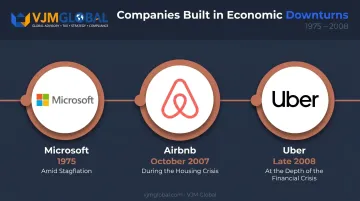
None of these companies had it easy, yet all three built something durable.
There's a loyalty dividend too. Customers who find you during hard times, because you're affordable and reliable, tend to stick around once conditions improve. That loyalty reflects trust earned under pressure, not luck.
What Makes Starting a Business Riskier Right Now (And How to Prepare)
None of this means the path is smooth. A few real risks deserve honest attention before you commit capital.
Credit is tighter than it looks. According to the Federal Reserve Banks' 2026 Small Business Credit Survey, only 38% of firms even applied for financing. Among applicants, just 42% received the full amount they sought, and another 22% got nothing at all.
Online lenders carried more surprise costs too: 60% of borrowers using them reported higher-than-expected fees, compared to 32% at large banks.
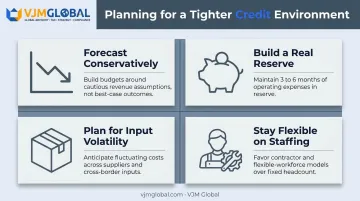
That reality demands a shift in planning:
- Forecast conservatively. Reduced consumer and B2B spending threatens early revenue plans, so model a slower ramp, not a best case.
- Build a real reserve. Wells Fargo recommends 3-6 months of operating expenses on hand, and 9-12 months for seasonal or downturn-sensitive businesses.
- Plan for input volatility. Supply chains can spike shipping costs fast, so if you sell physical goods or import inputs, price in a cost-shock buffer.
- Stay flexible on staffing. Hiring and retention get harder if the economy shifts mid-launch. Contractors and phased hiring keep your fixed costs low.
None of these risks are disqualifying. They're just the cost of admission, and each one has a straightforward mitigation.
Industries and Business Models With the Highest Success Rates
Not every business faces the same odds. Some categories are simply built to weather rough patches better than others.
Which Types of Businesses Tend to Survive Any Economy
BLS data on the 2013 business cohort, tracked through 2023, shows meaningful variation by industry:
| Industry | 10-Year Survival Rate |
|---|---|
| Agriculture, forestry, fishing, hunting | 50.5% |
| Manufacturing | 43.6% |
| Retail trade | 41.7% |
| Other services (includes repair) | 39.6% |
| Accommodation and food services | 38.2% |
| Health care and social assistance | 35.7% |
| Total private sector average | 34.7% |
Essential-demand categories don't guarantee a survival edge on their own; food services and repair-type businesses beat the average, but health care only marginally outperformed it. What actually correlates with longevity is cost structure, not just category.
Low-overhead, digitally delivered models, think coaching, consulting, freelance services, or subscription offerings, carry fewer fixed costs and therefore fewer ways to fail early. The Kauffman Firm Survey tracked 4,928 businesses started in 2004. By the end of 2008, right through the financial crisis, 67.6% were still operating, and survivors had injected roughly $78,000 in additional capital that year to stay afloat.
The pattern that emerges:
- Diversified revenue cushions against any single client or channel drying up
- Niche specialization often reaches profitability faster than broad, capital-heavy plays
- Recurring revenue (retainers, subscriptions) smooths out the lumpy months
Getting the underlying entity structure, tax registration, and payroll compliance right from day one, the groundwork firms like VJM Global handle daily, keeps overhead low enough for lean models to survive the tough years.
A Practical Framework: How to Decide If Now Is the Right Time for You
Timing isn't really the variable that decides success. Preparation is. Here's a sequence that removes the guesswork.
1. Validate real demand, not economic sentiment. General pessimism about "the economy" tells you nothing about whether people will pay for your specific product. Run focused market research: talk to 20-30 potential customers, test a landing page, or pre-sell before building.
2. Build a lean business plan with a break-even number. Know exactly how many units, clients, or subscriptions you need to cover costs each month. Skip the 40-page plan. A tight one-pager with real assumptions beats a polished document nobody revisits.
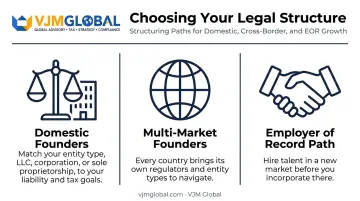
3. Choose your legal structure and jurisdiction deliberately. This step gets rushed constantly, and it shouldn't. Incorporation type, tax residency, and compliance obligations directly affect your startup costs and legal exposure from day one.
- Founders launching domestically need the right entity type (LLC, corporation, sole proprietorship) matched to their liability and tax goals
- Multi-market founders face a harder version of this problem: every country has its own regulator, entity types, and filing rules
- Hiring before incorporating? An Employer of Record lets you test a new market without setting up a local entity first
This is exactly where founders with cross-border ambitions tend to get stuck. Navigating an unfamiliar regulatory system alone eats months of runway, even when the underlying business idea is sound.
Firms like VJM Global support entity formation, accounting, and tax compliance across 100+ countries. This approach lets founders launch compliantly in a new market without becoming their own in-house regulatory expert first.
Smart Strategies to Set Your New Business Up for Long-Term Success
Getting the launch right is half the job. Staying lean and compliant as you scale is the other half.
Look beyond big banks for financing. Credit unions, SBA-style mentoring programs, friends and family, and crowdfunding all remain viable paths when traditional loan approval feels out of reach.
Get a trusted second opinion on your business plan before applying anywhere. A fresh set of eyes catches weak assumptions you've stopped noticing.
Start lean and scale only when revenue proves demand.
- Keep fixed costs minimal in year one
- Hire in phases, starting with contractors before full-time roles
- Negotiate vendor terms instead of accepting the first quote
Lean staffing solves half the overhead equation. The other half is compliance infrastructure: plan for the back-office grind early, especially if you're expanding across state lines or borders.
Bookkeeping, payroll, and tax filing requirements multiply fast once you're operating in more than one jurisdiction. Missed deadlines and misfiled returns cost more than the outsourcing fee ever would.
Outsourcing these functions to a firm like VJM Global, rather than hiring an in-house team for each new market, reduces overhead while keeping compliance current as you grow. It's a smaller decision than choosing your entity type, but it compounds just as much over time.
Frequently Asked Questions
Is it smart to start a business now?
Timing matters less than preparation. Businesses with strong unit economics, lean overhead, and real cash reserves can succeed in almost any climate, and downturns even offer cost and competitive advantages.
Which businesses have the highest success rates?
Essential-service, low-overhead, and niche specialty businesses tend to post the strongest survival rates. Cost discipline and recurring revenue matter more than the category alone.
What is the small business survival rate?
According to the SBA Office of Advocacy, roughly two-thirds of new businesses survive two years, and about half survive five years. Planning and reserves meaningfully improve those odds.
Is it necessary to have a large capital investment to start a business right now?
No. Capital helps, but it's not mandatory. Lean models, phased growth, and smart use of contractors can offset limited starting funds without sacrificing quality.
What are the first steps to take when starting a business in a challenging economy?
Start with focused market research, then build a lean business plan with a break-even number. Choose the right legal and entity structure, then secure initial funding through the option that fits your risk tolerance.
How do I know if my business idea can survive an economic downturn?
Stress-test it against reduced consumer spending scenarios. Ideas with recurring revenue or essential-demand characteristics tend to hold up better than one-time, discretionary purchases.