New business owners juggle entity selection, licensing, IRS registrations, and employment law rules simultaneously — often without a lawyer or CPA in the room to catch mistakes before they compound.
The SBA reports that new-employer businesses have a 67.9% survival rate at two years and 49.2% at five years, meaning roughly half of new employers close within five years. Compliance gaps are frequently part of that story.
This guide breaks down what actually matters: choosing a structure, registering properly, planning for taxes, protecting your IP, and classifying workers correctly.
Key Takeaways
- Entity choice locks in liability, tax treatment, and fundraising options long-term
- Skipping EIN registration, state filing, or licensing invites fines and legal exposure
- Commingled funds and worker misclassification rank among the costliest first-year tax mistakes
- A CPA or entity-formation specialist catches structuring errors before they become expensive problems
Choosing the Right Business Structure for Your Startup
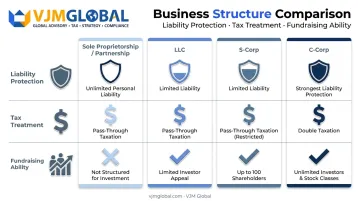
Entity selection is the single most consequential legal decision you'll make as a founder. It determines:
- How much personal liability you carry for business debts and lawsuits
- Which tax forms you file and how much self-employment tax you owe
- Whether you can issue stock to raise venture capital later
Get it wrong, and you're stuck with an expensive restructuring bill down the road, or worse, a lawsuit that reaches your personal assets.
Sole Proprietorships and General Partnerships
These are the default structures. No state filing is required to exist, and setup costs run close to zero. For a solo consultant or two co-founders testing an idea, that simplicity is appealing.
The tradeoff is unlimited personal liability. If the business owes money or gets sued, creditors can pursue your personal bank account, car, or house. General partners share that exposure jointly, meaning one partner's bad decision can put both owners' assets at risk.
Limited Liability Companies (LLCs)
An LLC separates business debts from personal assets, which is why it's the most common structure for early-stage US companies. Your savings stay protected even if the business can't pay its bills.
Tax-wise, LLCs are flexible. The IRS treats a single-member LLC as a disregarded entity by default (profits flow to your personal return) and a multi-member LLC as a partnership. Owners can also elect corporate taxation if that fits their financial strategy better.
C-Corporations and S-Corporations
Corporations offer the strongest liability shield and are the only structure that lets you issue stock to investors — critical if venture funding is part of your plan.
- C-corps pay a flat 21% corporate tax rate on profits, and shareholders pay tax again on dividends. That's the double taxation founders often complain about.
- S-corps avoid that by passing income through to shareholders' personal returns, but eligibility rules cap you at 100 shareholders, all of whom must be US citizens or residents.
Here's how tax treatment plays out on $100,000 in net profit:
| Structure | Tax Form | How It's Taxed | Approx. Impact on $100K Profit |
|---|---|---|---|
| Sole Proprietorship | Schedule C | Self-employment tax + personal income tax on all profit | 15.3% SE tax plus your income bracket |
| LLC (default) | Schedule C or 1065 | Pass-through; SE tax typically applies to earnings | Similar to sole prop or partnership |
| S-Corp | 1120-S | Pass-through; payroll tax only on salary portion | Salary taxed via payroll, remainder as distribution |
| C-Corp | 1120 | Corporate tax, then dividend tax on distributions | $21,000 corporate tax, plus tax on any dividends |
Entity choice also sets your ongoing state compliance load: annual reports, franchise taxes, and renewal fees all differ by state and structure. VJM Global works directly with US founders on this decision, aligning entity structure with both liability protection and tax efficiency from day one, not just at formation.
Business Registration, Licensing, and Compliance Requirements
Once you've picked a structure, three layers of paperwork stand between you and legally operating: federal, state, and local.
Getting Your EIN and State Registration
Every business needs an Employer Identification Number (EIN) from the IRS for tax filing, opening a business bank account, and hiring. Even single-member LLCs with no staff typically need one for banking. The application is free and generally instant online.
At the state level, you'll need to:
- File formation documents (Articles of Organization or Incorporation) with the Secretary of State
- Appoint a registered agent with a physical in-state address to receive legal notices
- Register as a "foreign" entity in any additional state where you conduct business
Filing fees vary widely by state. Colorado charges $50 for an LLC's Articles of Organization, while Massachusetts charges $500 for a Certificate of Organization. Firms like VJM Global manage these state-specific filings and registered agent requirements for founders forming entities across multiple states, keeping deadlines from slipping through the cracks.
Three Tiers of Licensing
- Federal licenses: required for regulated industries like aviation, broadcasting (FCC), food and drugs (FDA), or investment services (SEC)
- State licenses: professional licenses (law, medicine, contracting) plus sales tax permits
- Local licenses: zoning approvals, health permits, and signage permits
Skipping these steps carries real consequences. Operating without a required license can trigger fines, contract voidance, and even forced shutdown of the business, according to legal industry analysis.
Beneficial Ownership Reporting
Licensing isn't the only paperwork tied to federal oversight. The Beneficial Ownership Information (BOI) rule under FinCEN once required most US companies to disclose their owners. That changed: as of March 2025, FinCEN removed the reporting requirement for US-created entities and their beneficial owners. Only foreign entities registered to do business in a US state or tribal jurisdiction still need to file, generally within 30 days of registration.
If your structure includes foreign ownership, confirm your BOI status before assuming you're exempt.
Tax Obligations and Smart Tax Planning for New Businesses
New business owners track four separate tax categories, and missing any one of them creates penalties.
- Federal and state income tax — on business profits, filed based on entity type
- Self-employment tax — 15.3% (12.4% Social Security plus 2.9% Medicare) on net earnings for sole proprietors and partners, plus most LLC members
- Payroll tax (FICA/FUTA) — 6.2% Social Security and 1.45% Medicare, split between employer and employee, plus FUTA at 6.0% on the first $7,000 of wages (usually reduced to 0.6% with state credits)
- Sales tax — collected and remitted at the state and local level, not federal
Quarterly Estimated Taxes Catch Founders Off Guard
If you expect to owe $1,000 or more in tax for the year, the IRS wants quarterly payments, generally due in April, June, September, and January. Miss the safe harbor (90% of this year's tax or 100 to 110% of last year's) and penalties stack up even if you pay in full come April. Quarterly deadlines are just one recurring trap — a handful of other missteps account for most of the trouble new owners run into.
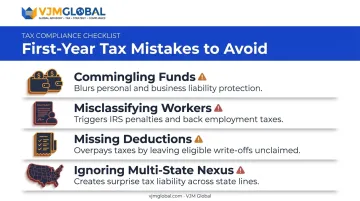
The Costliest Mistakes New Owners Make
- Commingling funds — mixing personal and business accounts, which also weakens your liability shield
- Misclassifying workers — calling someone a contractor when the IRS and Department of Labor would call them an employee
- Missing deductions — home office costs, equipment, mileage, and startup expenses often go unclaimed
- Ignoring multi-state nexus — selling into other states can trigger sales tax obligations you didn't know existed
Good tax planning starts with basics: separate business bank accounts and organized receipts, backed by a depreciation schedule for equipment purchases. Founders operating across multiple states, or planning international expansion, face compounded complexity through apportionment rules and combined reporting, plus treaty considerations.
VJM Global provides CPA-led tax compliance and accounting support that helps US business owners stay audit-ready and avoid the missteps above before they become IRS notices.
Intellectual Property and Common Legal Risks Startups Face
Your brand, your code, and your customer list are assets that need protection before a competitor or a former employee claims them first.
Four protections cover most startup IP:
- Trademarks: protect your brand name, logo, and slogans; USPTO registration takes roughly 9.8 months from filing
- Copyrights: protect original written, visual, or software works; registration through the Copyright Office averages about 4.1 months
- Patents: protect inventions and processes through a longer, more technical examination that typically takes 19–24 months
- Trade secrets and NDAs: protect confidential information with no federal registration, relying instead on reasonable secrecy measures
Registering early through the USPTO or Copyright Office prevents disputes that get expensive fast. It's far cheaper to file a trademark application than to fight someone who registered your brand name first.
Legal Gaps Founders Overlook
Beyond IP, several legal blind spots trip up new businesses:
- Skipping regular corporate compliance check-ups, like annual reports and meeting minutes
- Operating without shareholder or partnership agreements
- Using weak or generic employment contracts
- Failing to keep business and personal assets legally separate
General liability insurance and signed NDAs won't eliminate risk, but they reduce exposure considerably before a dispute reaches a courtroom. VJM Global's corporate governance and legal & regulatory support services help founders close these gaps before they escalate into disputes.
Employment Law and Worker Classification
The moment you bring on your first worker, whether employee or contractor, federal labor law applies.
Getting Classification Right
Misclassifying an employee as a contractor is one of the most expensive mistakes a founder can make. The IRS looks at behavioral and financial control plus the relationship type; the Department of Labor applies a six-factor economic-realities test.
Get it wrong, and you're on the hook for back wages, unpaid overtime, and payroll taxes, sometimes with penalties layered on top. VJM Global's payroll advisory team can review worker classifications before they become compliance issues.
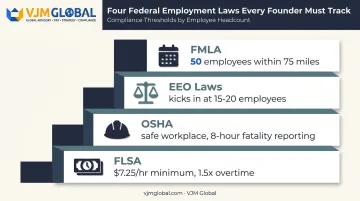
Federal Laws Every Founder Must Know
- FLSA: Sets the $7.25/hour federal minimum wage and overtime at 1.5x pay past 40 hours a week
- OSHA: Requires a workplace free of recognized hazards, with fatalities reported within 8 hours
- EEO laws: Anti-discrimination coverage kicks in at 15 employees for most protections, 20 for age discrimination
- FMLA: Unpaid leave rights apply once you hit 50 employees within 75 miles of a worksite
State laws add another layer entirely. Minimum wage, paid sick leave, and workers' compensation rules vary by state and change often. What's compliant in Texas may not fly in California, so monitor this as you grow, not just at the hiring stage.
Frequently Asked Questions
What are the legal issues of startups?
Most startup legal issues come down to corporate compliance gaps, unregistered IP, missing NDAs or contracts, and commingling business and personal assets. These oversights are cheap to prevent early and expensive to fix later.
What are the biggest tax mistakes business owners make?
Mixing personal and business finances, missing quarterly estimated payments, misclassifying workers as contractors, and ignoring multi-state sales tax nexus rules top the list. Each carries real IRS or state penalties.
Do I need a lawyer or CPA to start a business in the US?
Hiring a lawyer or CPA isn't legally required, but skipping that guidance often costs more than it saves. This is especially true in regulated industries or when structuring for outside investment.
What is the difference between an LLC and a corporation for tax purposes?
LLCs typically use pass-through taxation, meaning profits are taxed once on the owners' personal returns. C-corporations face potential double taxation: once at the corporate level (21%), then again on shareholder dividends.
Do sole proprietors need an EIN?
Not always. A sole proprietor with no employees can often use their Social Security number instead. Most banks and lenders still recommend getting one for credibility and to keep finances separate.
How much does it typically cost to legally register a business in the US?
Costs vary by state and entity type. State filing fees alone range from around $50 to $500, plus registered agent fees and any required licensing costs on top.