But here's the catch. Indonesia's PT (Perseroan Terbatas) structure doesn't map neatly onto India's Companies Act framework. Capital thresholds, director residency questions, and licensing rules work differently, and getting them wrong can delay your launch by months.
This guide breaks down company types, requirements, costs, and the exact registration steps Indian founders need to know.
Key Takeaways
- PT PMA is the foreign-investment vehicle; a local PT is for Indonesian nationals only
- Indian shareholders can hold 100% ownership in most open sectors (KBLI limits still apply)
- Paid-up capital is IDR 2.5 billion from October 2025; plans often exceed IDR 10 billion per KBLI
- Register through Indonesia's OSS system, not an India-style SPICe+ portal
- Indian founders directing operations locally need an Investor KITAS
What is a Private Limited Company (PT) in Indonesia?
A PT is Indonesia's version of a limited liability company, governed by Law No. 40 of 2007, as amended by Law No. 6 of 2023. It's a share-capital legal entity with three governing bodies: the General Meeting of Shareholders, the Board of Directors, and the Board of Commissioners.
Shareholders enjoy limited liability, meaning personal assets stay protected from company debts. The company gains legal personality only once the Ministry of Law and Human Rights issues a ratification decree.
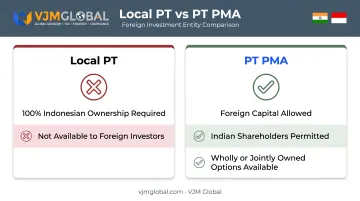
Local PT vs PT PMA
This distinction matters for Indian founders:
- Local PT: Requires 100% Indonesian ownership. Not an option for foreign shareholders.
- PT PMA: Allows foreign capital, including Indian shareholders, either wholly or jointly with Indonesian partners.
If you're an Indian promoter, PT PMA is your vehicle. Full stop. Local PT simply isn't available to you.
Other Business Structures Indian Businesses Should Know
Before committing to a PT PMA, know these options and pitfalls:
- Representative office: Suitable for market research only. You cannot invoice customers or conduct commercial transactions through it.
- Nominee arrangements: Avoid these. Indonesian law doesn't formally recognise nominee shareholding, and Indian investors have lost control of assets this way.
Stick to a legitimate PT PMA instead of nominee structures.
Requirements for Indian Investors Setting Up a PT PMA
Indonesian company law sets clear minimums that differ from India's Companies Act.
Core officer requirements:
- Two shareholders minimum: Indian individuals or an Indian company both qualify
- One director: No blanket Indonesia-resident director rule; foreign directors working in Indonesia need proper immigration authorisation
- One commissioner: A supervisory role with no direct equivalent under Indian company law
Capital and Investment Figures
Get this timeline right, because outdated numbers cause real confusion:
| Period | Paid-up capital | Investment plan |
|---|---|---|
| 2024 – Oct 2025 | IDR 10 billion | Generally >IDR 10 billion per KBLI |
| From Oct 2025 | IDR 2.5 billion | Generally >IDR 10 billion per KBLI (unchanged) |
BKPM Regulation 5/2025 reduced the paid-up capital requirement, but the investment commitment threshold stayed put. Don't confuse the two: capital is money actually paid into the company; the investment plan is a broader commitment tied to your specific KBLI code and project location.
KBLI Codes Decide Your Ownership Cap
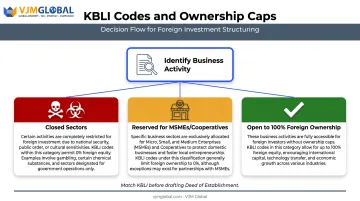
Every business activity in Indonesia maps to a five-digit KBLI (business classification) code. Under Presidential Regulation 10/2021, fields are generally open to 100% foreign ownership unless they're:
- Closed entirely (gambling, controlled substances, certain hazardous chemicals)
- Reserved for Indonesian cooperatives or MSMEs
- Subject to foreign-ownership caps or specific conditions
Match your actual business activity to the correct KBLI before drafting your Deed of Establishment. Getting this wrong means restructuring later.
Documentation checklist:
- Passport copies of all shareholders and directors
- Indian company incorporation documents (if the shareholder is a corporate entity)
- Notarised Deed of Establishment (executed in Indonesian, before an Indonesian notary)
Step-by-Step Process to Register a PT PMA from India
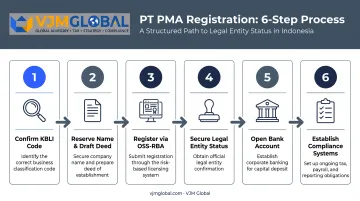
Confirm your KBLI code — Finalise the business classification and verify foreign ownership eligibility for that specific activity before proceeding.
Reserve your company name and draft the deed — Work with an Indonesian notary to prepare the Deed of Establishment in Indonesian.
Register through OSS-RBA — Submit shareholder, address, and KBLI data to obtain your NIB (business identification number). Depending on your risk classification, you may also need a Standard Certificate or additional licences:
| Risk class | Required output |
|---|---|
| Low | NIB only |
| Medium-low | NIB + self-declared Standard Certificate |
| Medium-high | NIB + verified Standard Certificate |
| High | NIB + business licence/permit |
Secure legal entity status — The Ministry of Law and Human Rights issues your ratification decree, granting formal legal personality. Simultaneously, obtain your domicile letter and NPWP (tax ID).
Open a corporate bank account — Deposit your paid-up capital and retain evidence of the funds' source; banks will require this for verification.
Establish ongoing compliance systems — Set up processes for quarterly LKPM reports, annual tax filing, and workforce reporting before you start operating.
Costs and Comparison: Indonesia PT PMA vs Indian Private Limited Company
Indian founders often ask which jurisdiction to structure first. Here's the honest comparison.
Capital requirements diverge sharply:
- India's Private Limited Company has zero minimum paid-up capital
- Indonesia's PT PMA requires IDR 2.5 billion paid-up capital, plus an investment plan generally exceeding IDR 10 billion per KBLI code
Tax treatment favours coordinated planning. Indonesia's standard corporate tax rate sits at 22%, with a 50% reduction available to smaller taxpayers under Article 31E.
For cross-border flows, the India-Indonesia tax treaty caps withholding tax at a uniform 10% on dividends, interest, and royalties paid to Indian entities. That matters if you repatriate profits or license IP into your Indonesian PT PMA.
Compliance filing volume, surprisingly, favours Indonesia:
- Indonesia: roughly 8-12 annual filings (quarterly LKPM, annual tax return, manpower report)
- India: typically 15-25 annual filings under the Companies Act and GST framework
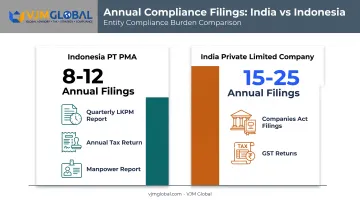
Don't mistake fewer filings for simpler compliance, though. Indonesian filings involve local language requirements and regulatory nuances that trip up foreign investors without local expertise.
This is where coordinated cross-border planning matters. VJM Global works with Indian businesses on entity formation and compliance across markets, handling India-side FEMA and ROC obligations while your Indonesian structure is set up in parallel.
For outbound investments, that means aligning ODI filings, RBI reporting, and Indian tax positions with your Indonesian registration timeline, not treating the two as disconnected processes.
Visa and Immigration Considerations for Indian Founders
If you plan to direct operations or work inside your Indonesian PT PMA, a business visa alone won't cut it.
- Investor KITAS (E28A): Permit for shareholders who also hold a board role
- Shareholding threshold: Roughly IDR 10 billion plus a director or commissioner seat — confirm via Indonesia's immigration eVisa system before filing
- Capital floor difference: That threshold sits above the PT PMA's IDR 2.5 billion minimum capital
- No resident-director mandate: Core company law does not require one, but any foreign director working in Indonesia still needs immigration authorisation
Many Indian founders appoint a trusted local director for day-to-day operations and keep ownership control from India. Others obtain the Investor KITAS themselves when they intend to be hands-on.
Frequently Asked Questions
How much does it cost to register a company in Indonesia?
For a foreign-owned PT PMA, budget roughly IDR 2.5 billion paid-up capital plus an investment commitment generally above IDR 10 billion per KBLI code. Notary, licensing, and compliance fees apply on top.
Can a foreigner own 100% of a business in Indonesia?
Yes, in open sectors under Indonesia's Positive Investment List. Some sectors carry foreign-ownership caps or specific conditions, so check your KBLI code before assuming full ownership applies.
Can Indian citizens get a business visa for Indonesia?
Yes. Indian citizens can apply for business visas, and after PT PMA registration they can pursue an Investor KITAS to direct operations or hold a board role.
What is a PT (private limited) company in Indonesia?
A PT is Indonesia's limited liability company structure under Law No. 40 of 2007. It offers shareholders liability protection and requires a director, commissioner, and minimum two shareholders.
What are the different types of companies in Indonesia?
The main structures are local PT (Indonesian ownership only), PT PMA (foreign-owned), representative office (market research only), and sole proprietorship (UD).
Do I need a local partner to set up a business in Indonesia as an Indian?
Not mandatory for sectors open to 100% foreign ownership. However, you'll still need a director and a commissioner, regardless of ownership percentage.