Introduction
Foreign investment into India keeps climbing. FDI equity inflows hit $18.6 billion between April and June 2025, a 15% jump over the same period last year, according to DPIIT's FDI factsheet.
American and British investors alone have poured over $76 billion and $36 billion respectively into India since 2000.
That kind of money doesn't move without paperwork. The Companies Act, 2013, along with FEMA and RBI regulations, decides who can register a company in India, which structure fits, and what boxes need checking before filing anything.
This guide breaks down the mandatory registration rules, minimum eligibility requirements, the actual filing process, and what happens after incorporation. VJM Global's CA/CS team has walked more than 500 US, 250 UK, and 250 Australian businesses through this exact process, so we know where founders typically get stuck.
Key Takeaways
- Registration isn't mandatory, but it's essential once you need limited liability, funding, or foreign investment
- A private company needs 2 shareholders, 2 directors (one Indian resident), a registered office, and no minimum capital
- SPICe+ on the MCA portal bundles name approval, DIN, incorporation, and PAN/TAN into one filing
- Foreign nationals and NRIs can register companies but must separately meet FEMA/FDI rules, including FC-GPR reporting
- Missed compliances trigger penalties, director disqualification, or the company being struck off
Is Company Registration Mandatory in India? Understanding the Legal Rules
Indian law doesn't force every business owner to incorporate. A sole proprietor can open a shop, invoice clients, and pay tax without ever touching the MCA (Ministry of Corporate Affairs) portal. An unregistered partnership can technically operate too.
But there's a catch. Under the Indian Partnership Act, every partner in an unregistered firm carries unlimited personal liability, and Section 69 of that Act blocks the firm from filing certain lawsuits to enforce contracts. Neither structure creates a separate legal entity, which matters once outside money enters the picture.
Business Structures Recognized Under the Companies Act
Four structures dominate India's registration landscape:
- Private Limited Company — 2 to 200 shareholders, 2 to 15 directors, limited liability, separate legal identity
- Public Limited Company — minimum 7 shareholders, 3 directors, can raise capital from the public
- One Person Company (OPC) — a single-member structure for solo founders who still want limited liability
- Limited Liability Partnership (LLP) — minimum 2 partners, lighter compliance, but automatic-route FDI (Foreign Direct Investment) applies only in sectors with 100% automatic approval and no performance conditions
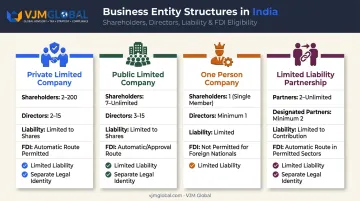
Most foreign investors land on Private Limited. It isn't the sole FDI-eligible structure, but its familiar governance model, straightforward share transfer rules, and broad acceptance across sectors make it the default choice for subsidiaries and joint ventures.
When Registration Becomes Legally Unavoidable
Registration stops being optional the moment any of these apply:
- You want to receive FDI. The Reserve Bank of India (RBI) permits FDI only into companies or qualifying LLPs, not proprietorships or informal partnerships.
- You're raising equity funding. Investors need shares to hold, and shares only exist in a company.
- You need a company bank account. Banks require incorporation documents to open an account in the business's name.
- You're bidding for government or corporate contracts. Most tenders require a registered entity with a PAN (Permanent Account Number) and CIN (Corporate Identification Number).
Unregistered entities also run into practical walls: no company PAN, restricted ability to hold certain licenses in the business's name, and weaker legal standing if a contract dispute lands in court.
VJM Global's business setup team helps US, UK, and Australian clients select the right structure and complete RBI and MCA filings when these triggers apply.
Minimum Requirements for Company Registration in India
Once you decide to incorporate, the Companies Act sets specific conditions around people, capital, address, and paperwork. Miss one, and the Registrar of Companies (ROC) won't approve the filing.
Shareholders and Directors
A Private Limited Company needs:
- Minimum 2 shareholders, maximum 200
- Minimum 2 directors, maximum 15 (extendable by special resolution)
- The same individual can be both a shareholder and a director
- No nationality restriction applies to shareholders
Indian Resident Director Requirement
This is the rule foreign founders trip over most often. Section 149(3) of the Companies Act requires every company to have at least one director who has stayed in India for a minimum of 182 days during the preceding financial year, per the Companies Act's director residency provision.
Newly incorporated companies apply this proportionately based on the incorporation date.
Foreign founders often assume any of their existing directors will qualify. They won't, unless that person genuinely meets the 182-day threshold. VJM Global's nominee director service exists specifically for this gap, giving foreign-owned entities a compliant Indian resident director without disrupting operational control.
Registered Office and Capital Rules
Every company needs a verifiable registered office address capable of receiving official correspondence. If the premises are rented, a No Objection Certificate (NOC) from the owner is mandatory, along with a recent utility bill.
There's no statutory minimum paid-up capital — this requirement was removed by the Companies (Amendment) Act, 2015. Even so, declaring capital sufficient to cover early operating costs (rent, salaries, licenses) avoids awkward cash-flow gaps in month one.
Digital Signature and Documentation Rules
Every director and subscriber needs a Class 3 Digital Signature Certificate (DSC) to sign incorporation filings electronically. Beyond that:
- Indian nationals need PAN plus identity and address proof
- Foreign directors or shareholders need a notarized passport and address proof; documents from Hague Convention countries need an apostille, while others need authentication through an Indian consular officer
Additional Rules for Foreign Nationals, NRIs, and OCIs
Foreign shareholding runs through India's FDI policy, split into an automatic route (no prior approval needed) and a government route (approval required), depending on the sector.
Any share allotment to a foreign shareholder must be reported to the RBI through Form FC-GPR within 30 days of the date of issue, not 30 days from allotment as many first-time filers assume.
NRIs and OCIs cannot register a sole proprietorship or general partnership firm. They can, however, hold shares as promoters or directors in a Private Limited Company or LLP, provided FEMA compliance is maintained.
Step-By-Step Company Registration Process in India
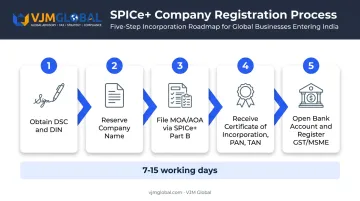
The entire registration runs through the SPICe+ form on the MCA portal. Most straightforward cases clear in roughly 7 to 15 working days once documents are ready and name approval comes through, though timelines stretch when foreign documents need apostille or the Registrar of Companies (ROC) raises queries.
- Obtain DSC and apply for DIN: Every proposed director needs a Class 3 Digital Signature Certificate (DSC). The Director Identification Number (DIN) gets allotted automatically through SPICe+ for first-time directors.
- Reserve a unique company name: Filed via SPICe+ Part A. The name must be distinct from existing companies and trademarks, and it should reflect the business's actual objects.
- Draft MOA (Memorandum of Association) and AOA (Articles of Association), then file SPICe+ Part B: This single filing captures company details, capital structure, registered office proof, and KYC for every director and shareholder.
- Receive the Certificate of Incorporation, PAN, and TAN: Once the ROC approves the application, the company gets its Certificate of Incorporation with a Corporate Identification Number (CIN). PAN and TAN come issued automatically.
- Open a bank account and complete initial registrations: Post-incorporation, the company opens a current account and registers for GST (if turnover crosses the threshold), MSME/Udyam, or any sector-specific license it needs.
Post-Registration Compliance Rules You Cannot Ignore
Incorporation isn't the finish line. Several deadlines start ticking immediately:
- File Form INC-20A (commencement of business) within 180 days of incorporation
- Appoint the first statutory auditor within 30 days of registration
- Hold the first board meeting within 30 days of incorporation
Then come the recurring annual obligations:
- File AOC-4 (financial statements) and MGT-7 (annual return) with the ROC
- File income tax returns
- Maintain statutory registers for shareholders, directors, and charges
Foreign-owned subsidiaries carry an extra layer. Any company with outstanding foreign investment at year-end must file the Annual Return on Foreign Liabilities and Assets (FLA), typically due by July 15, according to the RBI's FLA FAQ guidance. This applies even if the company stayed inactive that year, as long as FDI remained outstanding. Missing any of these deadlines risks penalties or ROC notices, which is why firms like VJM Global track compliance calendars for foreign-owned entities.
Consequences of Not Registering or Not Complying With Company Rules
Skip registration, and you're personally on the hook for business debts. Institutional funding and foreign investment stay out of reach too, since neither channel flows into unincorporated entities.
Non-compliance after incorporation carries its own penalties:
- Missing INC-20A — ₹50,000 penalty on the company, plus ₹1,000 per day (capped at ₹1,00,000) on defaulting officers
- Failing to file AOC-4/MGT-7 for 3 straight years — director disqualification under Section 164 for 5 years
- No business activity for 2 consecutive years — the ROC can strike the company off the register entirely
There's a quieter cost too. Banks, investors, and corporate clients check compliance history before signing anything, and a struck-off company or a disqualified director doesn't inspire confidence during due diligence.
Avoiding that due-diligence risk is exactly where a structured advisory relationship pays off. VJM Global handles entry strategy, FEMA/FDI compliance, and ongoing ROC filings for foreign businesses and NRIs, so incorporation doesn't turn into a compliance headache six months down the line.
Frequently Asked Questions
What is the process for company registration in India?
Registration happens entirely online through the SPICe+ form on the MCA portal, covering DSC and DIN, name reservation, MOA/AOA filing, and issuance of the Certificate of Incorporation with PAN and TAN.
Is company registration mandatory in India?
No, unregistered proprietorships can operate legally. Registration becomes necessary once you want limited liability protection, plan to raise funds, or need to accept foreign investment.
What are the consequences of not registering a company in India?
You carry unlimited personal liability for business debts, lose access to institutional funding and FDI, and face weaker legal enforceability for contracts signed in the business's name.
Can foreign nationals or NRIs register a company in India?
Yes, subject to FDI policy and FEMA reporting requirements like FC-GPR filing within 30 days of share issuance. NRIs, however, cannot register sole proprietorships or partnership firms.
How long does it take to register a company in India?
Typically 7 to 15 working days once documents and name approval are sorted, assuming the ROC doesn't raise queries. Foreign document notarization can add extra time.
Is there a minimum capital requirement for company registration in India?
No legally mandated minimum exists; this requirement was removed in 2015. Even so, declaring adequate capital to cover initial operating costs is a smart practice.