Many Singapore businesses eyeing Indonesia's capital markets get stuck on one question: how does a Public Limited Company, or PT Tbk, actually work? A PT Tbk lets companies raise capital through the Indonesia Stock Exchange (IDX). But it's not the starting point for most Singapore entrants. A privately held PT PMA (foreign-owned limited company) remains the standard first move.
This guide breaks down PT Tbk basics, the requirements, the conversion path from PT PMA, and how Singapore businesses can participate either as investors or issuers.
Key Takeaways
- A PT Tbk is IDX-listed and OJK-regulated—structurally different from a privately held PT
- Singapore businesses usually enter via a PT PMA first, or buy shares in an existing PT Tbk
- Plan for OJK’s 300 shareholders and IDR 3 billion paid-up capital bar; IDX boards use separate admission tests
- Foreign ownership limits follow the KBLI code for your activity—not one blanket percentage
- Oversight from Indonesia’s Ministry of Law, OJK, and IDX makes specialist advisory support essential
What Is a Public Limited Company (PT Tbk) in Indonesia?
A PT Tbk is a Perseroan Terbatas (limited liability company) that offers shares to the public through the Indonesia Stock Exchange (IDX). This contrasts with a privately held PT or PT PMA, where ownership stays closed among founders and shareholders.
The legal framework rests on three pillars:
- Law No. 40/2007 on Limited Liability Companies (the base company law)
- Law No. 8/1995 on Capital Markets, amended by Law No. 4/2023
- OJK (Otoritas Jasa Keuangan) regulations — Indonesia's Financial Services Authority rules, including the current POJK 45/2024 — plus IDX listing rules
Going public means opening ownership to institutional, retail, and foreign investors. In exchange, the company accepts stricter disclosure and governance obligations.
Two regulators split the job:
- OJK supervises the market, reviews prospectuses, and sets public-company thresholds
- IDX operates the exchange, sets board-specific listing tests, and facilitates trading
Here's where confusion often creeps in: being an OJK Public Company and being IDX-listed are two separate tests. A company can meet OJK's public-company criteria without automatically qualifying for exchange admission on a specific board. Treat them as sequential hurdles, not one combined checklist.
PT Tbk vs Private PT/PT PMA: Key Differences
| Attribute | Private PT/PT PMA | PT Tbk (OJK Public Company) |
|---|---|---|
| Minimum shareholders | 2 founders (standard rule) | At least 300 shareholders |
| Capital threshold | Set by investment plan/sector | IDR 3 billion paid-up capital minimum |
| Regulator | Ministry of Law and Human Rights (MOLHR), sector licensors | OJK plus IDX |
| Governance | Standard company organs | Independent commissioners, audit committee required |
| Disclosure | Corporate/tax/shareholder reporting | Annual reports, material disclosure, public AGM rules |
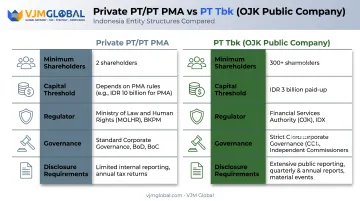
Singapore companies entering Indonesia almost always start with a PT PMA (a privately held, foreign-owned limited company). It's the operating vehicle. PT Tbk is a later-stage capital-raising structure, not an entry point.
Governance is where the real step-up happens. Under POJK 33/2014 and POJK 55/2015, listed issuers must meet higher board and oversight standards:
- At least two directors and two commissioners
- One independent commissioner if the board has only two; at least 30% independent if it has more
- A separate audit committee (mandatory)
Converting to PT Tbk is not a name change with "Tbk" added. You need independent oversight, audit infrastructure, and rapid disclosure systems in place before a prospectus is realistic.
Requirements and Capital Thresholds for Establishing a PT Tbk
Founders need to clear several stages before public status becomes real.
Founder and formation requirements:
- Minimum two founders
- Notarised deed of establishment
- MOLHR approval of the deed
- Articles of Association aligned with both Company Law and OJK/IDX rules
Capital and public-company thresholds:
- IDR 3 billion paid-up capital (OJK's public-company minimum under POJK 45/2024)
- 300 shareholders (OJK threshold, separate from IDX board tests)
Many summaries cite a single 7.5% free-float rule. That rule does not exist. IDX applies board-specific tests instead:
| IDX Board | Free-Float Requirement | Minimum Holders |
|---|---|---|
| Main Board | 15-20% depending on market cap | 1,000 |
| Development Board | 15–20% depending on market cap | 500 |
| Acceleration Board (SME) | 20% | 300 (with SID) |
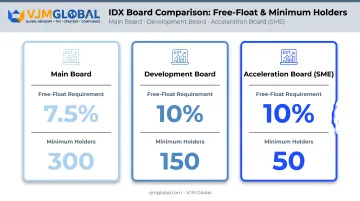
Source: IDX Go Public guidance
Companies converting from PT PMA to PT Tbk need a clean legal and financial history first. Auditors will scrutinise operating history. Main Board applicants generally need:
- 36 months of operations
- Three years of audited financial statements
- Unqualified opinions on at least two of those years
Skipping this preparation is the single most common cause of delayed IPO timelines.
The Path from PT PMA to PT Tbk: IPO Process Overview
The IPO journey follows six broad stages:
- Internal preparation – restructuring shareholding, cleaning up financials, upgrading internal controls
- Assembling the professional team – underwriter, public accountant, notary, legal advisor, appraiser where needed
- Registration documents and prospectus – filing with OJK and IDX in parallel
- Book building – gauging investor demand and pricing
- Public offering – the actual share sale to retail and institutional investors
- IDX listing – shares begin trading
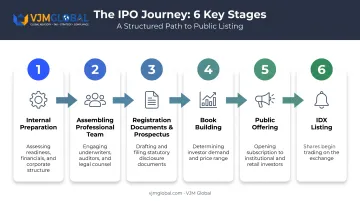
For most Singapore businesses, this journey starts long before stage one. It starts with establishing a PT PMA to operate locally, build a track record, and generate the audited history that later supports a listing application.
How long the path takes depends on how ready that PT PMA is. IDX publishes official stage estimates: 10-12 weeks for the combined IDX/OJK submission review, 1-5 business days for the offering itself, and 5-7 business days to listing.
That is only the regulatory portion. Preparation work such as restructuring, audit remediation, and governance build-out is open-ended and often takes far longer. Treat the commonly cited 6-12 month timeline as a market estimate for the full journey, not an official statutory deadline.
Foreign Investment Considerations for Singapore Businesses
Singapore investors have two distinct routes into Indonesian public markets, and they solve different problems.
Route 1: Buying PT Tbk shares directly. A Singapore investor can acquire listed shares through an Indonesian broker/custodian account without forming a local entity. This is the portfolio-investment route — simpler, but it doesn't grant operating control.
Route 2: Operating through a PT PMA. A Singapore company that wants to actually run a business in Indonesia — not just hold shares — generally still needs a PT PMA.
Foreign ownership caps aren't uniform. Indonesia's Positive Investment List (Presidential Regulations 10/2021 and 49/2021) made most sectors generally open, with exceptions for closed, reserved, or conditionally open activities. The correct approach is to check the specific five-digit KBLI business code for the intended activity, not assume a blanket percentage applies.
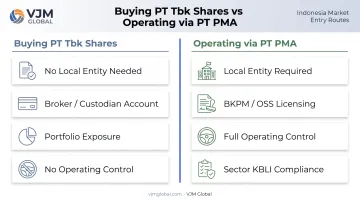
Both routes still require careful sector-specific compliance review, even with strong bilateral ties. Enterprise Singapore reports S$75.70 billion in bilateral goods trade for 2025 — a deep corridor where sector caps and reporting obligations still apply case by case.
Before capital moves, confirm at least the following:
- The five-digit KBLI code and any ownership cap for that activity
- Whether the goal is portfolio exposure (PT Tbk shares) or operating control (PT PMA)
- Broker/custodian, BKPM/OSS, and ongoing reporting obligations for the chosen route
- Tax residency, permanent establishment, and cross-border pricing effects on the Singapore parent
VJM Global works with Singapore businesses on entity structuring, tax planning, bookkeeping, and corporate-governance support as they expand into new markets. The firm delivers entity formation and compliance across 16+ core markets, with Employer of Record coverage in 100+ countries when you need to hire before incorporating. For a PT Tbk vs PT PMA decision, the useful discipline is simple: match the route to control needs, then clear sector caps and disclosure rules before funds move.
Frequently Asked Questions
How much does it cost to register a company in Indonesia?
Costs vary by entity type. A PT PMA involves notary fees, capital deposit, and licensing costs, while a PT Tbk requires substantially higher paid-up capital (minimum IDR 3 billion) plus underwriter, auditor, and legal fees for the listing process.
How can a foreigner open a company in Indonesia?
The typical route is establishing a PT PMA through BKPM/OSS licensing, followed by a notarized deed of establishment and MOLHR approval. Public listing, if pursued, comes later.
Can a foreigner own 100% of a business in Indonesia?
Full foreign ownership is possible in many sectors under the Positive Investment List. Some sectors carry ownership caps or conditional restrictions, so checking the specific KBLI activity code is essential.
What are the different types of companies in Indonesia?
The main types are PT (private limited company), PT PMA (foreign-owned private company), PT Tbk (public company), CV (limited partnership), and Firma (general partnership). Each carries different ownership and capital rules.
What is the Indonesian equivalent of a private limited company (LLC/Pte Ltd)?
A PT, or PT PMA for foreign-owned businesses, is Indonesia's equivalent of Singapore's Pte Ltd or a Western LLC. It's the standard operating vehicle before any public listing is considered.