
What trips people up is everything else: "free" formation offers that aren't actually free, annual costs that don't show up until month twelve, and cross-border filing questions that pop up when the founder isn't based in the US at all.
Kentucky ranks among the cheapest states for LLC formation. But cheap to file and cheap to maintain aren't the same thing. This guide walks through every formation step, the real first-year cost breakdown, and what happens after approval, so both US-based and international entrepreneurs know exactly what they're signing up for.
Key Takeaways
- Kentucky's $40 Articles of Organization fee ranks among the lowest nationwide, confirmed by the Kentucky Secretary of State.
- Every Kentucky LLC needs a registered agent with a physical Kentucky street address. A P.O. box triggers rejection.
- The Limited Liability Entity Tax (LLET) applies regardless of profit, and annual reports are due every year by June 30.
- Factor in the annual report and LLET minimum — first-year costs run well above the $40 filing fee.
- Kentucky imposes no residency or citizenship restriction on LLC organizers, which is good news for non-US founders.
What Is a Kentucky LLC and Why Choose Kentucky?
A Kentucky LLC is a limited liability entity formed under KRS Chapter 275. It separates your personal assets from business liabilities and gives you pass-through taxation, meaning the LLC itself generally doesn't pay federal income tax; profits flow through to the members' personal returns.
Once your Articles of Organization are approved, your LLC gains legal existence in Kentucky. That unlocks the basics every business needs:
- Opening a business bank account
- Signing contracts and leases in the company's name
- Hiring employees and running payroll
- Building liability protection between your personal finances and the business
How Kentucky Stacks Up Against Its Neighbors
Kentucky's $40 filing fee undercuts most nearby states by a wide margin. Compare it to:
| State | Domestic LLC filing fee |
|---|---|
| Kentucky | $40 |
| Ohio | $99 |
| Illinois | $150 |
| Tennessee | $50/member, $300 minimum |
That said, the cheapest state to file isn't automatically the right choice. If your business physically operates in Ohio or Tennessee, forming in Kentucky just to save on the filing fee usually backfires.
You'll still owe foreign qualification fees where you actually operate, on top of Kentucky's recurring costs. Kentucky works best when your business is actually based there, or when you run a remote-first operation with no strong tie to one state.
How to Form a Kentucky LLC: Step-by-Step
Forming a Kentucky LLC comes down to five inputs before you even file: a compliant name, a registered agent, a completed Articles of Organization form, the state filing fee, and a plan for what happens after approval. Here's how each step actually works.
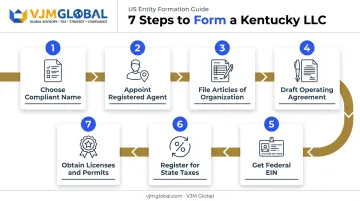
Step 1: Choose a Name That Meets Kentucky's Naming Rules
Your LLC name must include a designator such as "limited liability company," "limited company," "LLC," or "LC." It also has to be distinguishable from every other business name already on file, which you check through the Secretary of State's business entity search.
If you're not ready to file yet but want to lock in a name, Kentucky lets you reserve it for $15 for 120 days. It's optional, but useful if you're still lining up a registered agent or waiting on documents.
Step 2: Appoint a Kentucky Registered Agent
Your registered agent needs a physical Kentucky street address, not a P.O. box. The Secretary of State's own form spells this out explicitly.
You have two paths here:
- Self-serve as your own agent, if you have a real Kentucky street address and are consistently available during business hours
- Hire a third-party registered agent service, which is the more practical option for out-of-state or international founders
Skipping this isn't a minor paperwork issue. If your LLC lacks a registered agent for 60 days or more, the Secretary of State can start administrative dissolution proceedings against your business.
Step 3: File the Articles of Organization
Your Articles of Organization need to include:
- Your compliant LLC name
- Your registered agent's name and Kentucky address
- Your principal office address
- Whether the LLC is member-managed or manager-managed
- The organizer's signature
You can file online through Kentucky Business One Stop or by mail with one copy and the $40 fee. Online filing tends to move faster, though Kentucky doesn't publish a guaranteed turnaround time, so check current processing estimates before you plan around a specific date.
Step 4: Draft an Operating Agreement
Kentucky doesn't require you to file an operating agreement, but skipping one isn't smart. Without it, your LLC defaults to the statutory rules in KRS Chapter 275 for disputes, profit distributions, and dissolution. Those rules may not reflect how you and your co-founders actually want to run things.
Even single-member LLCs benefit from putting one in writing. Banks often ask for it, and it strengthens your liability protection by showing the LLC operates as a distinct entity.
Step 5: Get a Federal EIN
Your Employer Identification Number is free and instant if you apply online at IRS.gov. You'll need it for banking, tax registration, and hiring, even if you're a single-member LLC with zero employees.
One catch for international founders: the online EIN application requires a principal business location in the US. If you're applying from outside the country, the IRS instructions for Form SS-4 allow you to apply by phone, fax, or mail instead, using "foreign" or "N/A" where the form asks for a Social Security number.
International founders don't have to handle this alone. Firms like VJM Global manage the full Kentucky LLC formation process, including EIN applications and registered agent placement, for founders based outside the US.
Step 6: Register for Kentucky State Taxes
This is where several obligations stack up at once:
- LLET (Limited Liability Entity Tax): applies to your LLC regardless of profit
- Individual income tax: profits pass through to members' personal returns
- Sales tax: required if you sell taxable goods or services in Kentucky
- Employer withholding tax: required once you have employees
Verify current rates directly at revenue.ky.gov before filing, since thresholds and rates get updated periodically.
Step 7: Obtain Required Business Licenses and Permits
Kentucky has no single statewide general business license. What you might need instead:
- Industry-specific state licenses, depending on what you do
- Local occupational tax registration, which cities like Louisville and Lexington require based on where you operate
Louisville, for instance, charges an occupational tax on business income, with different rates for residents and nonresidents. Lexington runs a similar system. Check with your specific city or county before assuming you're covered.
Kentucky LLC Costs: What You'll Actually Pay
The $40 Articles of Organization fee is your baseline. It's mandatory, it's low compared to most states, and it's the number everyone quotes when they say Kentucky is cheap to form in.
But that $40 is just the entry ticket. Here's the fuller picture:
| Cost item | Amount | Frequency |
|---|---|---|
| Articles of Organization | $40 | One-time |
| Name reservation (optional) | $15 | One-time, 120 days |
| Annual report | $15 | Every year, due June 30 |
| Minimum LLET | $175 | Every year |
| Reinstatement penalty (if missed) | $100+ | If applicable |
Your Real Year-One Number
Add the mandatory pieces together and you get $215 ($40 Articles + $175 minimum LLET) as your formation-year floor, or $230 if you spring for the optional name reservation. Your first annual report isn't due until the calendar year after formation, so it doesn't hit your bill in year one.
That $215 floor assumes you handle filing yourself. Bring in a registered agent service or professional help drafting your operating agreement, and a service-assisted LLC costs more, trading a higher price for convenience.
How Kentucky Compares
Kentucky's ongoing costs still come out well ahead of pricier states:
- Tennessee: LLCs face a $300 minimum formation fee, a $300 annual report fee, and a $100 minimum franchise tax, pushing a comparable first-year cycle to $700 or more.
- California: first-year costs run around $890, driven largely by California's flat $800 annual LLC tax, which applies regardless of income.
- Delaware: LLCs pay a $90 formation fee plus a flat $300 annual franchise tax due every year regardless of income, totaling $390 in year one.
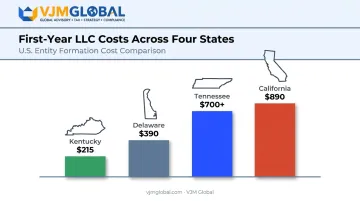
Kentucky's LLET minimum of $175 looks a lot more manageable next to that.
What to Do After Your Kentucky LLC Is Approved
Getting your Articles of Organization approved kicks off a new set of requirements. A few things need to happen right away.
Open a dedicated business bank account. Use your approved Articles, your EIN, and a valid ID. Mixing personal and business funds is one of the fastest ways to undermine the liability protection your LLC is supposed to provide.
Mark June 30 on your calendar. Every year, Kentucky requires an annual report by that date. Miss it, and you risk administrative dissolution plus a reinstatement penalty to get your LLC back in good standing.
Line up ongoing tax and accounting support, especially if you're not based in the US. Founders operating from outside the country often need help beyond the initial filing:
- Following through on EIN-related paperwork
- Registering for LLET and state income tax obligations
- Setting up bookkeeping that works across two tax systems
Firms such as VJM Global work with companies of any origin on US entity formation, plus the accounting, tax compliance, and payroll work that follows. That support matters if you're running a Kentucky LLC without a US-based team handling the details.
Common Mistakes and When to Get Professional Help
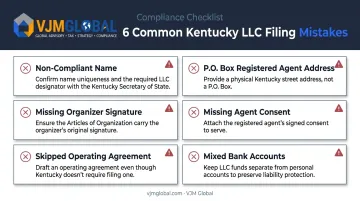
Most rejected filings come down to a short list of avoidable errors:
- Non-compliant name: not distinguishable from an existing Kentucky business on record
- P.O. box registered agent address: the state requires a physical street address, no exceptions
- Missing organizer signature: an easy detail to overlook on the Articles form
- Missing registered agent consent: your agent has to formally accept the role in writing
None of these are catastrophic, but they cost you time and the $40 filing fee doesn't come back if your submission gets bounced.
Beyond filing mechanics, two habits weaken your LLC's protection:
- Skipping the operating agreement entirely
- Mixing personal and business bank accounts
Non-US residents face extra layers. Applying for an EIN requires fax or mail instead of the online process, and US filings must line up with home-country tax treaties. You may also need to determine whether to foreign-qualify in another state, complexity that a straightforward Google search won't fully resolve. This is where a firm with cross-border formation experience, such as VJM Global, helps reduce filing errors and keeps your US entity setup coordinated with whatever tax obligations you're already managing at home.
Frequently Asked Questions
How much does it cost to form an LLC in Kentucky?
Expect at least $215 in year one: the $40 Articles of Organization fee plus the $175 minimum LLET. Add the $15 annual report once it comes due. Confirm current figures at sos.ky.gov and revenue.ky.gov before filing.
How do I start an LLC in Kentucky?
Choose a compliant name, appoint a Kentucky registered agent, and file your Articles of Organization for $40 through Kentucky Business One Stop. After approval, get your free federal EIN and register for state taxes.
Can a non-U.S. resident or foreign owner form a Kentucky LLC?
Yes. Kentucky places no residency or citizenship requirement on organizers or members. You still need a registered agent with a physical Kentucky address, even if you live abroad.
Does a single-member Kentucky LLC get taxed differently than a multi-member LLC?
Federally, a single-member LLC is typically treated like a sole proprietorship, while a multi-member LLC is treated like a partnership, unless you elect corporate treatment. Both remain subject to Kentucky's LLET regardless of that federal classification.
What is the downside of starting an LLC in Kentucky?
You're locked into recurring obligations: the annual report every June 30 and the LLET every year, even in years with no profit. Members also face self-employment tax exposure on their share of business income.
Can I start a Kentucky LLC myself without a formation service?
Yes, self-filing through Kentucky Business One Stop is entirely possible. The main risk is a filing error, such as a disqualified name or a P.O. box address, that gets your Articles rejected without refunding the $40 fee.