But cheap paperwork doesn't mean foolproof paperwork. Many founders assume filing is a one-and-done task, then get tripped up by naming conflicts, registered agent errors, or a missed annual report deadline months later. The outcome you get — real liability protection, clean banking access, good standing with the state — depends on decisions you make before and after that $40 filing.
This guide walks through the exact formation steps, what they cost, how long they take, common mistakes, and when it makes sense to file yourself versus bringing in a professional service.
Key Takeaways
- Articles of Organization cost $40 through the Kentucky Secretary of State — no hidden state surcharge.
- Every LLC needs a registered agent with a physical Kentucky street address (P.O. boxes don't qualify).
- Annual reports are due June 30 ($15), plus a minimum $175 Limited Liability Entity Tax (LLET).
- Kentucky has no residency or citizenship requirement, so foreign founders can form an LLC here.
- Operating agreements and EINs aren't legally mandatory, but skipping them creates real banking and liability headaches.
How to Form an LLC in Kentucky: Step-by-Step Guide
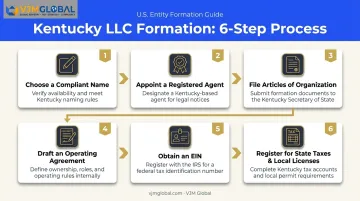
Step 1: Choose a Compliant LLC Name
Your LLC name must include "LLC," "L.L.C.," or "Limited Liability Company," and it has to be distinguishable from any name already on file with the Kentucky Secretary of State. Certain words, like "Bank" or "Attorney," trigger extra regulatory approval before you can use them.
Not ready to file yet? You can reserve a name for 120 days for $15 through the Secretary of State's office. Before you commit, it's worth checking:
- Domain name availability
- Social media handle availability
- Trademark conflicts in your industry
A name that clears the state's database can still be a branding headache if the matching domain is already taken.
Step 2: Appoint a Kentucky Registered Agent
Under KRS 275.055, every Kentucky LLC must maintain a registered agent and registered office in the state. The official filing form requires a Kentucky street address; a P.O. box won't be accepted.
You have two options:
- Serve as your own agent, which is free, but your address becomes public record and you need to be reachable there during standard hours.
- Hire a professional registered agent service, typically $100 to $300 a year, which keeps your personal address private and reduces the risk of missing a legal notice.
Out-of-state and non-US founders almost always need the second option, since Kentucky requires a real in-state presence.
Step 3: File the Articles of Organization
This is the document that legally creates your LLC. It requires:
- LLC name
- Registered agent name and Kentucky address
- Principal office address
- Management structure (member-managed or manager-managed)
- Organizer's signature
You can file online through the Kentucky Business One Stop portal or by mail to the Secretary of State's office in Frankfort. The fee is $40 either way. Online filings generally move faster than mailed paperwork, since there's no transit time and fewer manual data-entry steps on the state's end.
Step 4: Draft an Operating Agreement
Kentucky law doesn't require an operating agreement to form your LLC. That said, skipping it is a common mistake with real consequences:
- Multi-member LLCs need it to settle disputes over profit splits, decision-making, and exit terms.
- Single-member LLCs use it to reinforce the separation between personal and business assets, a key factor if your liability protection is ever challenged in court.
- Banks often ask for one before opening a business account, regardless of what the state requires.
This document works as your LLC's internal rulebook. No one else enforces it, but you'll wish you had one the first time a disagreement comes up.
Step 5: Obtain an EIN from the IRS
An Employer Identification Number is free and issued instantly through IRS.gov if you have a valid SSN or ITIN. It's required for multi-member LLCs and strongly recommended for every LLC, since most banks won't open an account without one.
If you're a non-US founder without an SSN or ITIN, the online application isn't available to you. You'll instead file Form SS-4 by fax or mail, which typically takes about four business days by fax or roughly four weeks by mail, slower but still workable.
Step 6: Register for Kentucky State Taxes and Local Licenses
Once your LLC exists, register with the Kentucky Department of Revenue for:
- Limited Liability Entity Tax (LLET) — applies to most LLCs operating in Kentucky
- Sales and use tax — if you sell taxable goods or services
- Employer withholding tax — if you have Kentucky employees
Kentucky has no statewide general business license. However, individual cities and counties often levy occupational license taxes or require local permits, so check with your specific city or county clerk before assuming you're fully licensed.
Kentucky LLC Costs, Taxes, and Processing Timelines
Here's what a Kentucky LLC actually costs once you look past the initial filing fee:
| Item | Cost |
|---|---|
| Articles of Organization | $40 |
| Optional name reservation (120 days) | $15 |
| Annual report | $15 |
| Paid registered agent (if used) | $100–$300/year |
| LLET | Greater of calculated tax or $175 minimum |
The LLET catches a lot of new owners off guard. It's calculated as the greater of a percentage of gross receipts or gross profits, with a $175 minimum payment even if your LLC barely turned a profit in year one. Rates and thresholds shift periodically, so confirm current figures at revenue.ky.gov before filing.
Kentucky also applies a flat individual income tax rate to pass-through LLC income. Since most LLCs are taxed as pass-through entities, profits flow to your personal return. That rate has been trending downward in recent years, so verify the current-year figure directly with the Department of Revenue rather than relying on last year's number.
Processing Speed and Regional Comparison
Kentucky doesn't publish an official guaranteed turnaround time, but online filings through Business One Stop typically move faster than mailed Articles, since there's no mail transit and less manual re-entry. For context, neighboring Ohio charges $99 for its standard LLC filing, per the Ohio Secretary of State's fee schedule, more than double Kentucky's fee, with expedited processing costing extra on top.
Mark your calendar for June 30. Miss the annual report deadline, and Kentucky can administratively dissolve your LLC, with a $100 reinstatement fee to get back in good standing.
When to Choose an LLC in Kentucky (and Mistakes to Avoid)
Is an LLC the Right Structure for You?
An LLC fits founders who want liability protection without the formalities of a corporation. It works well when you:
- Want to separate personal assets from business debts and lawsuits
- Prefer pass-through taxation over corporate double taxation
- Don't need to issue stock to outside investors
If you're raising venture capital, a corporation may suit your cap table better. If you're a licensed doctor, lawyer, or accountant, Kentucky requires a PLLC instead of a standard LLC, since licensing boards retain oversight over ownership and management.
For a very low-risk, single-owner side business with no employees and minimal liability exposure, a sole proprietorship or DBA might genuinely be enough. An LLC adds cost and paperwork you may not need yet.
Common Filing Mistakes That Cause Delays or Rejection
Once you've confirmed an LLC fits your business, sidestep these common filing errors:
- Choosing a name too similar to an existing entity: the Secretary of State will reject it outright.
- Listing a P.O. box as your registered agent address violates the street-address requirement and stalls your filing.
- Skipping the operating agreement won't block state filing, but it gets costly later during disputes or bank account setup.
- Mixing personal and business finances undermines the liability protection an LLC is supposed to provide.
- Missing the June 30 annual report triggers dissolution and a $100 reinstatement cost.
DIY Filing vs. Professional LLC Formation Support
Filing your own Articles of Organization through Kentucky Business One Stop is the cheapest path — you're only out the $40 state fee. But it carries real rejection risk if your name isn't cleared in advance or a required field is left incomplete, which means resubmitting and losing time.
A professional formation service earns its fee when:
- You're a non-US resident unfamiliar with SSN/ITIN rules, EIN applications, or US tax filing layers
- You're forming entities across multiple states or countries simultaneously
- You'd rather have registered agent, EIN, and annual compliance handled as one coordinated process instead of juggling separate vendors
This is where a firm like VJM Global fits into the picture for foreign companies and non-US resident entrepreneurs. The firm handles cross-border entity formation, EIN assistance, and multi-jurisdiction tax compliance across 100+ countries, which matters if your Kentucky LLC is just one piece of a larger international structure.
VJM Global has already supported 500+ American business owners and maintains a US office in New York. Its broader compliance work spans markets like the UK, UAE, and Canada, useful if your business footprint extends beyond Kentucky's borders.

Conclusion
Kentucky's $40 filing fee and light annual requirements make it one of the more accessible states to launch an LLC, whether you're based in Louisville or filing from across the globe. Most founders run into trouble after filing, not during it:
- Skipping the operating agreement
- Misunderstanding registered agent rules
- Missing the June 30 annual report deadline
Whether you file solo through Business One Stop or bring in support for the trickier parts, staying ahead of Kentucky's tax and compliance calendar keeps your LLC in good standing year after year. VJM Global handles that calendar for US entity formations that want it off their plate.
Frequently Asked Questions
How much does it cost to set up an LLC in Kentucky?
The Articles of Organization fee is $40. Add $15 if you reserve a name in advance, $15 for your annual report, and a $175 minimum LLET payment each year.
How do I form an LLC in Kentucky?
Choose a compliant, distinguishable name, appoint a Kentucky-based registered agent, then file your Articles of Organization with the Secretary of State for $40.
How long does it take to form an LLC in Kentucky?
Online filings through Business One Stop typically process within a few business days. Mailed filings take longer due to transit and manual processing time.
What is the difference between a PLLC and an LLC in Kentucky?
A PLLC is reserved for licensed professionals, such as doctors, lawyers, and accountants, and remains subject to licensing board oversight. A standard LLC has no such professional restriction.
Does a Kentucky LLC need an operating agreement?
Filing one isn't mandatory, but it resolves member disputes and preserves single-member liability protection. Banks also often require one before opening a business account.
Can a non-US resident or foreign company form an LLC in Kentucky?
Yes. Kentucky imposes no residency or citizenship requirement, as long as you appoint a qualifying registered agent with a Kentucky street address.