This isn't a loophole. It's a fully legal, well-established path that state governments and the IRS have accommodated for decades. But the outcome depends heavily on which state you pick, which entity type you form, and which address solution (virtual office, registered agent, mail forwarding) you rely on.
Get any one of those wrong, and you risk a rejected filing, a frozen bank account, or missed legal notices. This guide walks through the exact steps, the documents you'll need, state-by-state quirks, and the mistakes that trip up first-time founders most often.
Key Takeaways
- A personal street address isn't required, but a compliant registered agent address and mailing address are.
- P.O. boxes get rejected as registered agent or principal addresses in most states.
- Registered agent services run $50-$125/year; virtual addresses run roughly $10-$50/month.
- The IRS, banks, and state agencies each set their own address rules, so keep every filing consistent.
- Non-resident founders need a separate plan for EIN and ITIN applications since they lack an SSN.
How to Register a US Business Without a Physical Address (Step-by-Step)
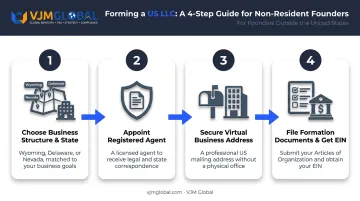
Step 1: Choose Your Business Structure and State of Formation
Your entity type shapes everything downstream, including how much paperwork you file each year. Most non-resident founders default to an LLC because it demands less ongoing formality than a C-Corp, no board meetings, no stock ledger, no corporate minutes.
Three states dominate non-domiciled formations, largely for privacy and cost reasons:
| State | LLC filing fee | Corporation filing fee |
|---|---|---|
| Wyoming | $100 | $100 |
| Delaware | $110 | $109 minimum (varies with authorized shares) |
| Nevada | $75 | $75-$35,000 (based on authorized stock value) |
Nevada also tacks on an annual State Business License fee of $200 for LLCs and $500 for corporations. These figures exclude expedited processing, annual reports, and registered agent costs.
One catch: if you actually conduct business in a state other than your formation state, meaning you have an office, employees, or regular in-state transactions there, you may need to foreign qualify. That means appointing a second registered agent and paying additional fees in that state.
Step 2: Appoint a Registered Agent (Mandatory in Every State)
Every US state legally requires a registered agent with a physical street address in the formation state, available during standard business hours to accept legal documents. According to Wolters Kluwer, that office must be a physical location; a PO box or virtual address alone doesn't satisfy the requirement.
This address is legally separate from your public-facing business or mailing address. Founders often confuse the two, then wonder why their bank rejects the paperwork.
Current market pricing for professional registered agent services:
- Harvard Business Services: $50/year (Delaware only, price locked for the company's life)
- Northwest Registered Agent: $125/year
- InCorp: $125/year standard, as low as $87/year with multi-year prepayment
Budget roughly $50-$125 for a one-year term.
Step 3: Secure a Compliant Virtual Business Address
Your virtual address becomes the principal place of business listed on formation documents, IRS filings, and your website footer. It must be a genuine commercial mail receiving agency (CMRA) address, not a bare PO box, to pass muster with state registrars and banks.
Typical monthly pricing:
- Anytime Mailbox: plans from $9.99/month, some locations as low as $4.99
- Northwest Registered Agent: $20/month mail forwarding, $29/month full virtual office
- Alliance Virtual Offices: locations starting around $48-$50/month
- Regus: from $2/day depending on plan
Combining a registered agent with a virtual address typically runs $170-$725 per year, before postage, scanning overages, or meeting room add-ons.
Step 4: File Formation Documents, Obtain an EIN, and Open a Business Bank Account
Once your addresses are locked in, file your Articles of Organization or Incorporation using the registered agent and business address. Next comes the EIN.
Founders without a Social Security Number can't use the IRS's online EIN tool since it's unavailable to applicants whose principal business is outside the US. Instead, the IRS instructs applicants without an SSN or ITIN to enter "Foreign" on Form SS-4, line 7b, and apply by phone, fax, or mail:
- Phone: 267-941-1099 (international line, weekdays 6 a.m.-11 p.m. Eastern)
- Fax: 304-707-9471, roughly four business days if you include a return fax number
- Mail: IRS, Attn: EIN International Operation, Cincinnati, OH 45999, about four weeks
EIN issuance itself is free. Once you have your EIN, your mail provider will need a completed USPS Form 1583 to legally receive mail on your behalf, and banks will ask for your formation documents plus a signed address service agreement. Some banks handle remote or foreign-founder accounts more smoothly than others, so it pays to check requirements before you pick one.
What You Need Before You Start
Before filing anything, get these pieces in order:
- Business readiness: A cleared business name, finalized entity type, and owner ID (passport, plus SSN/ITIN if you have one)
- Registered agent agreement: Signed and active in your formation state before you submit formation paperwork; these typically renew annually
- Virtual address service agreement: Proof-of-address documentation your bank and state will both want to see
- EIN/ITIN documentation: The non-online SS-4 route for founders without an SSN, plus a separate ITIN application if you have personal US tax obligations
- Ongoing compliance setup: A system for annual reports, tax filings, and bookkeeping once the business is live
That last point trips up a lot of first-time founders. Filing the LLC is the easy part; staying compliant year after year is where things get messy.
This is where firms like VJM Global come in. Having supported over 500 American business owners with cross-border accounting and compliance work, the firm knows the terrain well. It helps founders without a physical US presence manage EIN/ITIN applications and keep their books audit-ready.
Choosing the Right Address Solution: Comparing Your Options
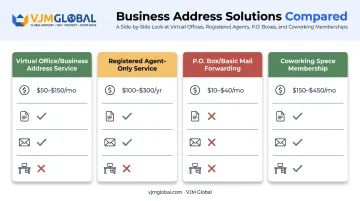
Not every address option does the same job, so here's how the four common choices stack up.
Virtual Office / Business Address Service
Best for founders who need one credible commercial address for registration, banking, and mail handling all at once. Many plans throw in occasional meeting room access, useful if you ever need an in-person client meeting.
Registered Agent-Only Service
This satisfies the legal agent requirement and nothing more. It won't work as your business mailing address, so most founders pair it with a separate virtual address service.
P.O. Box or Basic Mail Forwarding
Cheap, but largely useless for registration purposes, since most states reject a P.O. box as either a registered agent address or principal business address. It's fine for casual correspondence, not for anything official.
Coworking Space Membership
Gives you both an address and a real desk when you need one. The tradeoff: you have to keep paying for membership to keep using the address, unlike a standalone mail service.
Common Mistakes to Avoid
- Using a P.O. box as your registered agent or principal address. Washington and Texas both explicitly reject bare mailbox or answering-service addresses for registered offices.
- Mismatching addresses across filings. If your state filing, EIN application, and bank account list different addresses, expect processing delays or compliance flags.
- Skipping Form 1583. Without it, your mail provider legally can't accept mail on your behalf, meaning missed notices and undeliverable legal mail.
- Assuming one address works everywhere. A virtual address accepted in Delaware may not be accepted in your specific formation state, so confirm before filing.
State-Specific Rules and Compliance Considerations
Address rules genuinely vary state to state, and they change. Washington and Texas, for instance, spell out in writing that a registered office can't be "solely a mailbox service." Wyoming's forms request separate principal-office and mailing-address fields without applying the same physical-address restriction to them.
Before you file anywhere, confirm current requirements directly with that state's Secretary of State office. A few other things worth flagging:
- Registered agent requirements remain separate from your mailing address; most states still require a registered agent with a physical, in-state street address to receive legal notices.
- Local zoning or HOA rules can still restrict home-based operations, even when your public business listing uses a separate virtual address.
- Rules shift. What was accepted last year might not fly this year, so review your state's current policy annually, not just at formation.
Frequently Asked Questions
Can I register an LLC in the US without a physical address?
Yes. You don't need a personal physical address, but you do need a compliant registered agent address in your formation state plus a business address for filings and mail.
Can I use a P.O. Box as my business address for registration?
Generally no. Most states reject P.O. boxes for registered agent or principal business addresses, though they're fine for routine correspondence.
What's the difference between a registered agent and a virtual business address?
A registered agent receives official legal notices on your behalf. A virtual address is your public-facing business and mailing address. Most founders need both.
Can I get an EIN for my US business without an SSN or ITIN?
Yes. Founders without an SSN apply through the IRS's non-online SS-4 process, by phone, fax, or mail, entering "Foreign" on line 7b.
Can I open a US business bank account without a physical US address?
Many banks and fintechs accept a virtual office address with a signed service agreement, but remote-friendliness varies widely from one institution to the next.
Do virtual addresses work in every US state?
No. Acceptance varies by state. Always confirm current rules with your formation state's Secretary of State before relying on a virtual address for registration.