Introduction
Korean companies in Saudi Arabia used to mean one thing: an EPC contract, a trading office, or an export relationship run out of Seoul. That's changing fast.
KOTRA's Riyadh office counted around 70 active Korean legal entities in the Kingdom as of early 2026, according to a Bird & Bird analysis of Korean companies in Saudi Arabia. That's a real shift from project-by-project delivery to permanent, Saudi-based operations.
Here's the catch: there's no single template for how to register. The right entity, license, and timeline depend on your sector, ownership structure, and whether you need access to government procurement.
This guide walks through the entity options, the step-by-step registration process, required documents, realistic costs, and the mistakes that trip up Korean investors most often.
Key Takeaways
- A MISA investor license is mandatory before incorporating any foreign-owned business in Saudi Arabia
- Korean companies typically choose between an LLC, branch office, joint venture, or Regional Headquarters (RHQ)
- Registration spans three phases and takes 1-6 months, depending on entity type and sector approvals
- 100% foreign ownership is possible in most sectors, subject to capital and Saudization requirements
Why Saudi Arabia Is Opening Up to Korean Investors
Vision 2030 changed what Saudi Arabia wants from foreign partners. Rather than buying Korean equipment or hiring Korean contractors for a single project, Saudi Arabia now wants Korean industrial, energy, and digital capability embedded in its domestic economy long-term.
A few signals make this concrete:
- Hyundai Motor and PIF signed a joint venture in October 2023 to build a manufacturing plant in King Abdullah Economic City (KAEC), with PIF holding 70% and Hyundai 30%, targeting 50,000 vehicles annually.
- Naver announced a Middle East regional HQ plan in September 2024, followed by its "Naver Innovation" joint venture with NHC going live in May 2025.
- KEPCO won a cogeneration contract tied to Aramco's Jafurah gas field expansion, reportedly worth around KRW2.1 trillion in expected revenue.
- Bilateral government mechanisms now reinforce this trend, including a joint SME investment fund (roughly USD160 million combined) and a Strategic Partnership Council MOU signed in October 2023.
The upshot: a distributor agreement or an export desk no longer covers what Saudi buyers, especially government-linked ones, expect from Korean partners. A genuine operating structure on Saudi soil is becoming the price of entry.
Legal Entity Options for Registering a Korean Company in KSA
Entity choice shouldn't be a cost or speed decision. It should be driven by your business model, who you're selling to (government versus private buyers), how much procurement exposure you need, and your regional ambitions beyond Saudi Arabia.
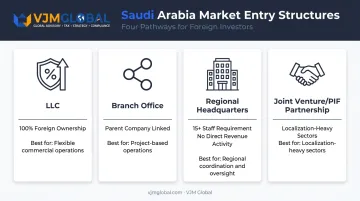
Limited Liability Company (LLC)
The LLC is the default route for most Korean companies entering Saudi Arabia. Under a MISA license, many activities permit up to 100% foreign ownership. It's the most flexible structure for ongoing commercial operations, staff hiring, and building a customer base inside the Kingdom.
MISA's guide lists specific conditions for the "100% Foreign Commercial" route, including minimum capital thresholds and a requirement to demonstrate presence in multiple international markets. A separate Saudi-partner route exists too, with a lower ownership bar but its own capital requirements.
Branch Office
A branch office suits Korean companies executing a defined contract or project for a Saudi client rather than building an ongoing local business. Setting one up requires:
- Backing from the Korean parent company
- Attested Articles of Association
- Sector-specific approval where relevant
There's also a temporary registration category for companies implementing a single government contract, which automatically ends when the contract does.
Regional Headquarters (RHQ)
An RHQ is built for genuine regional management functions, not day-to-day sales. It's particularly relevant for Korean groups pursuing Saudi government contracts, since 2024 rules restrict certain government agencies from contracting with companies that lack a Saudi RHQ.
Two requirements stand out. RHQs must maintain at least 15 full-time staff within a year, including at least three at executive or VP level. Just as important, an RHQ cannot itself run ordinary revenue-generating commercial activity outside its licensed RHQ functions.
That last point matters. Many Korean groups end up establishing both an RHQ and a separate operating LLC, since one handles regional strategy and government relationships while the other handles actual sales.
Joint Venture / PIF-Backed Platform Partnership
In sectors with heavy localization expectations, defense, automotive manufacturing, and mining among them, a Saudi joint venture partner or PIF-linked platform often becomes the practical path forward.
The Hyundai-PIF structure is the clearest reference point, but it's a project-specific choice rather than a blanket legal requirement across every automotive supplier. Still, if you're eyeing strategic sectors, expect Saudi partnership conversations early.
Step-by-Step Process to Register a Korean Company in Saudi Arabia
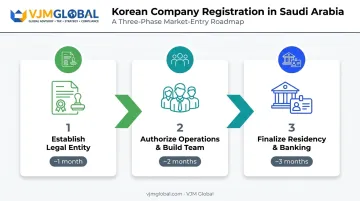
Registration generally moves through three phases: forming the legal entity, building your operational and HR base, then finalizing residency and banking. Sector approvals can stretch any of these.
Phase 1: Establish the Legal Entity
- Obtain a MISA investor license — MISA's own guide estimates roughly 10 working days for investment registration, with fees determined and notified case by case
- Reserve your trade name through the Ministry of Commerce
- Draft Articles of Association in Arabic, reflecting the chosen entity type
- Secure Commercial Registration (CR) through the Saudi Business Center
- Register with the Chamber of Commerce for the required certifications and letters
Documentation from the Korean side must be notarized, apostilled, and translated into Arabic. This typically includes the parent company's commercial register, board resolutions, and last fiscal year's financial statements, with the Saudi Embassy authenticating each document.
Phase 2: Authorize Operations and Build the Team
Once the entity exists on paper, it needs to function:
- Obtain a company seal for official documents
- Register with the Ministry of Labor and GOSI (General Organization for Social Insurance)
- Set up a national address, which is mandatory for all Saudi businesses
- Issue the GM's visa for the incoming Korean representative
- Complete VAT registration with ZATCA if turnover thresholds apply
Phase 3: Finalize Residency and Banking
- Activate the Chamber of Commerce account
- Complete health insurance enrollment and the GM's medical check-up
- Issue the GM's Iqama (residence permit)
- Register across Muqeem, Absher, Qiwa, and Mudad government portals
- Open the corporate bank account
This is a genuinely multi-agency process, and delays usually happen at the handoff points between phases rather than within any single step. VJM Global's cross-border entity formation team works with Korean investors through MISA licensing, documentation prep, and portal registrations specifically to avoid those gaps.
Cost, Timeline & Post-Registration Compliance
What Does It Actually Cost?
There's no single published "all-in" figure for setting up a foreign-owned company in Saudi Arabia, and treat any number you see quoted online with skepticism. MISA's own investor guide confirms its registration fee is "determined and notified" per applicant rather than published as a flat rate.
Your real cost drivers include:
- Minimum capital requirements, which vary by activity, from roughly SAR26.6 million for Saudi-partner commercial routes to SAR30 million for certain 100% foreign commercial activities
- MISA's notified registration fee
- Document authentication, translation, and legal drafting costs
- National address setup, insurance, and payroll system fees
- Sector-specific approval costs (GAMI, SFDA, etc.)
Realistic Timeline
MISA publishes individual step estimates: around 10 working days for investment registration and about 2 working days for establishment-contract documentation. Combined phases realistically run:
| Phase | Typical duration |
|---|---|
| Legal entity setup | ~1 month |
| Team & authorization | ~2 months |
| Residency & banking | ~3 months |
Sector approvals, especially defense or food-related licensing, can extend this well beyond six months.
Ongoing Compliance
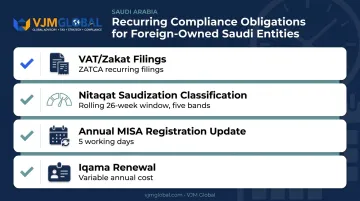
Registration isn't a one-time event. Expect recurring obligations:
- VAT/Zakat filings through ZATCA
- Nitaqat (Saudization) classification via Qiwa, calculated across a rolling 26-week window with five performance bands
- Annual MISA registration updates, estimated at 5 working days
- Iqama renewal for the GM and Korean staff, which requires payment but has no fixed published fee, so budget it as a variable annual cost
VJM Global's Saudi compliance team tracks these ZATCA filings, Nitaqat bands, and Iqama renewal dates for Korean-owned entities, so nothing lapses once the company is registered.
Common Mistakes Korean Companies Make (and How to Avoid Them)
Treating Saudi Arabia as an export market. Many Korean companies still plan around distributor relationships instead of local execution capacity. If your buyer is a government agency or a PIF-linked entity, a real operating presence increasingly matters more than pricing.
This same underestimation of local commitment often extends to workforce planning. Underestimating Saudization timing. Nitaqat compliance isn't something you deal with after mobilization. Waiting until staff are already on-site to plan Saudi hiring and training almost always causes delays and can affect your Nitaqat band.
Staffing isn't the only planning gap; product approvals carry similar risk. Missing sector-specific approvals. MISA registration is necessary but rarely sufficient on its own: defense-related supply requires separate GAMI licensing through its unified military-industries platform, while food and consumer products fall under SFDA registration and import clearance. Skipping these turns a straightforward product-supply plan into a localization project overnight.
VJM Global's multi-jurisdiction compliance team helps Korean businesses navigate MISA licensing, entity structuring, and Saudization requirements end-to-end. This reduces the setup delays that catch most first-time entrants off guard.
Frequently Asked Questions
` since both issues are minor, stylistically defensible, and fixing fewer than 5 total issues does not meet the threshold requiring action per the Issue Prioritization Rules.
There's no fixed official figure. Costs depend heavily on entity type, minimum capital requirements for your activity, and sector approvals, with MISA's own registration fee determined per applicant.
Can a Korean company own 100% of a business in Saudi Arabia?
Yes, in most sectors, under a MISA license and subject to activity-specific conditions like minimum capital and international market presence. Some strategic sectors still favor or require a Saudi partner.
How long does it take to register a Korean company in KSA?
Roughly 1-6 months across the three registration phases: legal entity setup, team authorization, and residency/banking. Sector-specific approvals can extend this timeline considerably.
What is a MISA license and is it mandatory?
MISA (Ministry of Investment Saudi Arabia) registration is the foreign investor licensing step required before Ministry of Commerce incorporation. It's the mandatory starting gate for nearly all foreign-owned entities.
Does a Korean company need a local Saudi partner to register?
Not usually. Full foreign ownership is available for many commercial activities, though joint ventures remain common in localization-heavy sectors like automotive manufacturing and defense.
Is an Iqama required for a Korean company's representative in Saudi Arabia?
Yes. The GM or representative residing in Saudi Arabia needs an employer-sponsored Iqama, which requires health insurance, a medical exam, and associated fees paid through Absher.