But here's what many guides miss. UAE company registration is well documented in general, but the details around Korean document attestation, entity structuring, and ownership rules don't work exactly like the standard playbook. This guide walks through entity options, the registration steps, Korea-specific paperwork, realistic costs, common mistakes, and lighter-touch alternatives to full incorporation.
Key Takeaways
- Four entry options exist: Mainland LLC, Free Zone company, Branch Office, or Representative Office, based on market access needs.
- Korean corporate documents need full legalization, not apostille, since the UAE isn't part of the Hague Convention.
- UAE's 2021 reforms extended 100% foreign ownership to most Mainland activities and nearly all Free Zones.
- Free Zone setups move faster than Mainland LLCs once Korean paperwork is legalized and translated.
- A formation specialist experienced with Korean documentation reduces rejection-driven delays.
How to Register a Korean Company in Dubai, UAE: Step-by-Step Process
Step 1: Choose Your Business Activity and Jurisdiction
Your intended activity decides everything downstream. Trading, consulting, manufacturing, and tech each map to different licensing paths.
Mainland licensing (DED/DET) suits companies needing direct access to UAE retail customers or government contracts. Free Zones such as DMCC, DIFC, or Dubai South suit sector-specific operations: DMCC covers commodities, crypto, and technology, DIFC handles financial and fintech firms, and Dubai South focuses on logistics and aerospace.
Korean applicants should map their existing Korean business registration activity code to the closest UAE-licensed equivalent before filing. Mismatched activity descriptions are one of the most common causes of approval delays.
Step 2: Reserve a Trade Name and Obtain Initial Approval
Trade names get reserved online through Dubai's Invest in Dubai portal or the relevant Free Zone authority. Names can't contain offensive language, religious references, or anything that conflicts with public morals.
Initial approval simply confirms the authority has no objection to you proceeding; it doesn't grant legal status or license you to operate yet.
Step 3: Prepare and Legalize Corporate Documents from Korea
This is the step most Korean founders get wrong, and it's worth slowing down for.
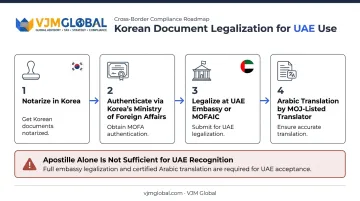
South Korea has been a Hague Apostille Convention member since 2007. Naturally, many assume an apostille from Korea's Ministry of Foreign Affairs will satisfy UAE authorities. It won't. The UAE is not a contracting party to the Apostille Convention, so an apostille alone doesn't replace full legalization for documents headed to Dubai.
What you actually need:
- Notarize the certificate of incorporation, business registration certificate, and board resolution in Korea
- Authenticate through Korea's Ministry of Foreign Affairs
- Legalize the documents at the UAE Embassy (or MOFAIC, depending on current routing) before they're accepted in Dubai
Skipping straight to apostille and assuming you're done is exactly how documents get bounced back weeks into the process. All Korean-language documents also need Arabic translation by a UAE Ministry of Justice-listed legal translator before submission.
Step 4: Draft the Memorandum of Association or Local Service Agent Agreement
Mainland LLCs require a Memorandum of Association (MOA) spelling out shareholding and governance. Some professional licenses instead use a Local Service Agent agreement rather than an MOA.
Following the UAE's 2021 ownership reforms, most Mainland activities now allow 100% foreign ownership, so many Korean companies no longer need a local partner holding equity. A handful of regulated professional licenses still require a Local Service Agent arrangement, though this doesn't mean surrendering ownership.
Free Zone companies skip this complexity entirely. They typically use a standardized Memorandum & Articles template issued directly by the Free Zone authority.
Step 5: Secure Office Space and Submit for Final Licensing
Office requirements diverge sharply between the two paths:
Mainland companies need a physical tenancy contract registered through Ejari, while Free Zone companies often can use a flexi-desk or shared workspace package bundled into the license.
Your final submission bundle should include:
- Approved trade name certificate
- Signed MOA (or LSA agreement)
- Legalized and translated Korean corporate documents
- Passport copies of all signatories and shareholders
- Office lease or flexi-desk agreement
Step 6: Obtain the Trade License and Complete Post-Licensing Registrations
Once license fees clear, the authority issues your trade license. From there, three registrations follow in quick succession:
- Establishment card application with the relevant immigration authority
- Corporate tax registration with the UAE Federal Tax Authority through EmaraTax (free of charge)
- Investor or employee visa applications for founders and staff
The UAE's corporate tax sits at 0% on taxable income up to AED 375,000 and 9% above that threshold, applicable to financial years starting on or after June 1, 2023. Free Zone companies may qualify for preferential treatment on qualifying income, but that status has to be actively claimed and maintained, not assumed.
Choosing the Right Business Structure for Your Korean Company
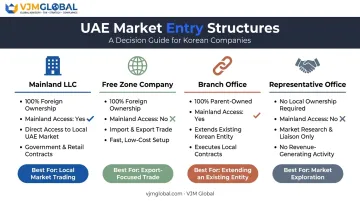
Structure choice comes down to one question: does your Korean company need full UAE market access, Free Zone tax efficiency, or just a presence to test the waters?
| Structure | Ownership | Mainland Access | Best For |
|---|---|---|---|
| Mainland LLC | Up to 100% in most sectors | Yes, direct | Retail, government contracts |
| Free Zone Company | 100% | No (needs distributor/dual license) | Export, trading, tech, regional hubs |
| Branch Office | 100% (parent-owned) | Same activities as parent | Extending existing Korean operations |
| Representative Office | 100% | No revenue generation | Market research, relationship building |
Mainland LLC
A Mainland LLC lets you trade directly with UAE customers and bid on government contracts. It's regulated by the Dubai Economic Department and, since 2021, permits 100% foreign ownership in most sectors. A short list of professional licenses still requires a Local Service Agent, so check your specific activity before assuming you're exempt.
Free Zone Company
Free Zones offer 100% ownership, full profit repatriation, and preferential corporate tax treatment up to a threshold. Korean trading, tech, and export-oriented firms tend to fit well here. The trade-off: you can't sell directly into the UAE mainland without a distributor or a dual license, which makes this structure better suited to regional-hub operations than local retail.
Branch Office
A Branch Office operates under the Korean parent's existing legal name and licensed activities, without forming a separate legal entity. It's 100% foreign-owned by design, but generally still requires a UAE Local Service Agent and gets taxed as if it were a domestic UAE company.
Representative/Liaison Office
If your Korean company just wants to explore the Dubai market or coordinate with the parent before committing to full incorporation, a Representative Office fits. It can't generate revenue or sign local sales contracts, so its use is limited to research and relationship-building, but it's a low-risk way to establish a foothold.
VJM Global's UAE entity-formation specialists match each Korean parent's activity list to these options before filing, so the license fits how the business actually operates in Dubai.
Documents, Costs, and Requirements for Korean Applicants
Requirements shift slightly depending on whether you're an individual Korean investor or an existing Korean corporation expanding operations.
Documents Needed from Korea
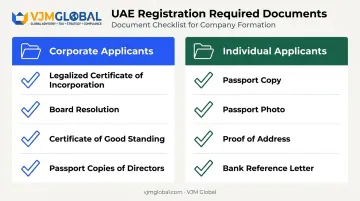
For corporate applicants:
- Legalized certificate of incorporation or business registration certificate
- Board resolution approving the UAE entity and naming authorized signatories
- Legalized certificate of good standing
- Passport copies of all directors and shareholders
For individual applicants:
- Passport copy (valid for at least six months)
- Passport-size photograph
- Proof of address
- Bank reference letter or minimum balance statement (required by certain Free Zones)
Estimated Costs to Budget
Exact figures vary by Free Zone, activity, and office type, and published fee schedules change often, so treat any number as a starting estimate rather than a fixed quote. As a general rule:
- Free Zone packages bundle license, visa allocation, and workspace into a single annual fee
- Mainland licensing adds DED fees plus MOA notarization costs on top of the license itself
- Flexi-desk and small-office rentals vary widely by building and Free Zone
Given how much these figures shift, getting a current quote from a formation specialist before budgeting is far more reliable than relying on last year's numbers. Firms like VJM Global, which handle entity formation and compliance work across 100+ countries including the UAE, can walk Korean applicants through current published fee ranges for their specific activity and jurisdiction before filing.
Visa and Residency Considerations
Once incorporated, a Korean founder becomes eligible for a UAE investor or partner residence visa. The Green Residence visa runs for five years and is renewable, provided the applicant can show proof of investment or partnership along with the relevant licenses.
Some visa quota allocations tie back to office space size or declared capital, so it's worth confirming this with your chosen authority before finalizing your setup.
Common Mistakes Korean Investors Make When Registering in Dubai
Korean investors typically run into the same three problems:
- Underestimating legalisation timelines. Assuming apostille is sufficient (it isn't) or starting document legalisation late routinely adds weeks to the process
- Choosing a Free Zone on price alone. A cheap license that can't eventually support mainland sales access forces a costly restructure later
- Submitting improperly worded Power of Attorney documents. UAE notaries and banks frequently reject POAs issued in Korea that don't match required local wording, stalling account opening
Alternatives to Full Incorporation for Korean Companies
Full incorporation isn't always the right first move, especially if you're testing the market or need just a handful of local hires.
Hiring Through an Employer of Record (EOR)
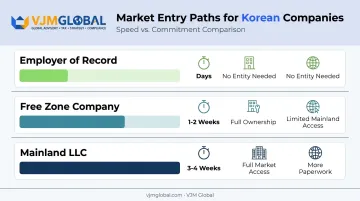
An EOR lets a Korean company hire UAE-based sales, marketing, or operations staff without setting up a legal entity first, compressing market entry from weeks to days.
Trade-offs to weigh:
- Costs more per employee over the long term than direct employment
- Doesn't let you sign local commercial contracts directly
- Works best as a temporary bridge, not a permanent structure
Specialists such as VJM Global offer EOR and payroll support across 100+ countries, including the UAE, making this a practical bridge before committing to incorporation.
Free Zone vs. Mainland as a Lighter-Touch Entry
Choosing between Free Zone and Mainland is the next lighter-touch decision after hiring. A Free Zone entity suits export- or services-focused Korean firms wanting speed and full ownership, while Mainland suits those needing direct access to government contracts or local retail customers.
- Free Zone: Moves faster, skips the Local Service Agent requirement, but restricts direct mainland trading
- Mainland: Offers full market access, though it involves more paperwork and, in some cases, a Local Service Agent requirement
Frequently Asked Questions
How do I verify a Korean company?
Check registration through Korea's Supreme Court e-registry (iros.go.kr) or the National Tax Service business lookup on Hometax. UAE banks and authorities often request a legalized certificate of good standing for the same purpose.
Can a Korean company own 100% of a Dubai business?
Yes, in almost all Free Zones and most Mainland activities following the UAE's 2021 ownership reforms. A short list of strategically restricted sectors, including banking, insurance, and telecommunications, still carries separate ownership rules.
Do I need to travel to Dubai to register my Korean company?
Generally no. A Power of Attorney lets a local UAE agent or consultant complete registration on your behalf. Some banks, however, still require in-person presence for corporate account opening.
How long does it take to register a company in Dubai from Korea?
Free Zone setups typically complete in 1-2 weeks, while Mainland LLCs take 3-4 weeks once documents are legalized and translated. Document preparation from Korea, not the UAE filing itself, is usually the longest lead-time item.
Do Korean corporate documents need UAE embassy attestation?
Yes. Because the UAE hasn't joined the Hague Apostille Convention, a Korean apostille alone isn't sufficient. Documents need full legalization through Korea's MOFA and UAE embassy or MOFAIC channels, confirmed against your specific Free Zone or bank's requirements.
What is the minimum capital required to register a company in Dubai?
Most Free Zones and Mainland activities no longer enforce a strict minimum paid-up capital requirement. Some Free Zones, like DMCC, publish guideline figures, and certain banks or investor visa categories may still expect a declared or deposited amount.