Introduction
UK-Saudi trade reached £13.8 billion in the four quarters to Q4 2025, according to the UK Department for Business and Trade's 2026 factsheet, with over 1,300 UK firms already operating in the Kingdom. Vision 2030 has reshaped the investment landscape — foreign ownership rules have relaxed, new sectors have opened, and the infrastructure for international business has improved markedly.
Yet many UK founders arrive at the setup process underprepared for what it actually costs.
Business setup costs in Saudi Arabia typically range from SAR 45,000 to SAR 150,000+ (roughly £9,000–£30,000+), but that range is almost meaningless without context. Two UK companies in different sectors can face costs that differ by a factor of three or more — before accounting for ongoing annual obligations.
This guide breaks down every cost component you'll encounter: government licensing fees, capital requirements, office costs, staffing obligations, and the hidden recurring costs that rarely appear in initial quotes.
TL;DR: Key Takeaways for UK Businesses
- Total setup costs run SAR 45,000–SAR 150,000+ (approx. £9,000–£30,000+) depending on structure, sector, and office requirements
- The biggest cost drivers are the MISA investment licence, office lease, visa and Iqama fees, and Saudization compliance
- UK nationals can own 100% of a Saudi company in most approved sectors, with no local sponsor required under Vision 2030 reforms
- Costs split into one-time setup fees and recurring annual obligations; budget for both before you begin
- UK-origin documents require FCDO apostille authentication and certified Arabic translation — allow 4–6 weeks in your timeline
How Much Does It Cost to Set Up a Business in Saudi Arabia from the UK?
There is no single fixed number. The range below reflects real variation based on legal structure, sector, staffing headcount, and location. These are practical brackets drawn from actual setup scenarios, not arbitrary tiers.
Entry-Level Setup: SAR 45,000–75,000 (approx. £9,000–£15,000)
Typical costs cover:
- MISA investment licence
- Commercial Registration (CR)
- Chamber of Commerce membership
- Virtual office or registered address
- One investor visa
Best for: UK entrepreneurs testing the Saudi market with a consulting or services business before committing to a physical presence.
Mid-Range Setup: SAR 75,000–120,000 (approx. £15,000–£24,000)
What's typically included:
- MISA licence and CR
- Physical office lease
- Multiple employee visas and Iqamas
- GOSI registration
- Basic accounting and compliance support
Best for: Trading companies or professional services firms with 3–5 staff who need an established local presence to win contracts.
Premium Setup: SAR 120,000–200,000+ (approx. £24,000–£40,000+)
What's typically included:
- Industry-specific regulatory licences (healthcare, F&B, manufacturing)
- Larger office space in Riyadh or Jeddah
- Substantial staffing costs and compliance infrastructure
- Higher capital deposit requirements
Suited for: UK businesses entering regulated industries or establishing a regional headquarters in Saudi Arabia.
Your actual costs will sit somewhere in these ranges depending on sector, staffing plans, and how quickly you need to be operational. The sections below break down each cost component in detail.
Key Factors That Affect Business Setup Costs
Five decisions drive the majority of your setup budget in Saudi Arabia. Understanding each before you register — not after — can prevent expensive corrections down the line.
Business Activity and Industry
Service-based activities — consulting, IT, professional services — attract lower licensing fees than regulated sectors. Industry-specific licences add meaningful cost:
- Food & Beverage (SFDA): A food manufacturing licence costs SAR 1,000 in registration fees, plus annual inspection fees of SAR 1,000–3,000 depending on facility category, per the SFDA investor licensing guide
- Healthcare (MOH): Hospital licences range from SAR 5,000 (up to 50 beds) to SAR 15,000 (over 100 beds); polyclinic licences cost SAR 2,000, per the MOH Healthcare Investor Licensing Guide
- Manufacturing: Industrial licences are issued by the Ministry of Industry and Mineral Resources; costs vary by project size and are not published as a fixed schedule
Legal Structure
| Structure | Registration Cost | Key Characteristic |
|---|---|---|
| LLC | SAR 1,200 (MC statutory fee) + VAT | Most common for foreign investors; limited liability |
| Branch Office | SAR 1,600 (MC statutory fee) + VAT | Extension of parent company; no separate share capital |
| Joint Stock Company | Higher capital and governance requirements | Less common for initial market entry |
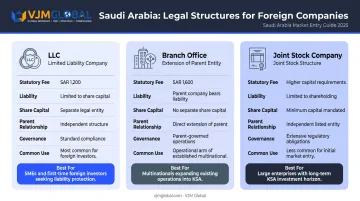
Note: The Ministry of Commerce statutory fees above cover company establishment only. Professional advisory fees and MISA licensing costs are separate and variable.
Foreign Ownership and UK-Specific Documentation
UK investors can hold 100% ownership in most approved sectors — but the MISA investment licence must be secured before any other registration step. The MISA Investor Guide (2025) notes that certain commercial activities retain Saudi participation requirements (minimum 25%) or capital thresholds.
UK-origin documents — Articles of Incorporation, audited accounts — require:
- FCDO apostille authentication (£35–£45 per document via GOV.UK; standard processing up to 25 working days, or 2 working days for e-Apostille)
- Certified Arabic translation by an approved translator
Given standard FCDO processing runs up to 25 working days, initiating authentication before you begin MISA registration avoids the most common cause of delays in the UK-to-Saudi setup timeline.
Location and Office Requirements
City choice has a direct impact on fixed costs. According to CBRE's Q1 2024 Saudi Arabia market review:
- Riyadh Grade A offices: SAR 1,975/sqm/year (up 11.8% year-on-year)
- Jeddah Grade A offices: SAR 1,406/sqm/year (up 13.6% year-on-year)
Saudi authorities require a physical address for most foreign company registrations. Virtual offices are viable for lean consulting operations, but they restrict your ability to hire freely and may not satisfy all regulatory requirements.
Workforce and Saudization Requirements
The Nitaqat programme mandates that businesses hire a defined percentage of Saudi nationals. Falling short of the required ratios triggers immediate penalties:
- Fines of SAR 10,000–20,000 per violation depending on establishment class (HRSD Employer Compliance Guide, 2023)
- Red and Low Green-rated entities cannot apply for new expatriate worker visas
- Red-rated entities also lose work permit renewal rights for existing staff
Saudization ratios scale with headcount, so UK businesses must model their staffing plans against Nitaqat thresholds before registering — not after.
Complete Cost Breakdown: What UK Businesses Will Pay
Setting up in Saudi Arabia involves costs across six distinct categories — licensing, capital, office space, visas, staffing, and compliance. The figures below cover each one.
Government and Licensing Fees
| Cost Item | Amount (SAR) | Frequency | Notes |
|---|---|---|---|
| MISA investment licence | Variable (approved post-application) | Annual | Fee determined upon MISA approval |
| Commercial Registration (LLC) | SAR 1,200 + SAR 500 publication + 15% VAT | One-time | Ministry of Commerce statutory fee |
| Chamber of Commerce membership | SAR 1,000–10,000/year | Annual | Varies by company category; first year may be free |
| Municipality (Balady) licence | Calculated via Balady fee calculator | Annual | Varies by activity and location |
Capital Requirements
No single minimum applies across all foreign-owned LLCs. The MISA Investor Guide sets activity-based thresholds:
- 100% foreign commercial activity: SAR 30,000,000 minimum capital
- Commercial activity with 25%+ Saudi partner: SAR 26,666,667
- Land transportation: SAR 10,000,000
Service and consulting operations carry lower thresholds, confirmed case by case. Verify your specific requirement directly with MISA before opening any bank accounts.
Office and Infrastructure Costs
| Option | Annual Cost (SAR) | Best Suited For |
|---|---|---|
| Virtual office / registered address | SAR 5,000–15,000 | Solo consultants, initial market testing |
| Co-working space | SAR 20,000–30,000 | Small teams, flexible working model |
| Dedicated commercial office (Riyadh/Jeddah) | SAR 60,000–120,000+ | Established teams, client-facing operations |
| Utilities and internet | SAR 500–2,000/month | All office types |
Visa and Staffing Costs
These costs grow with team size — budget them across your first 12 months:
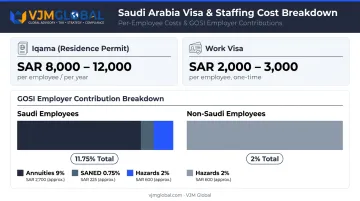
- Investor/employee Iqama: SAR 8,000–12,000/year per person (including mandatory medical insurance)
- Work visa issuance: SAR 2,000–3,000 per employee
- GOSI employer contributions (Saudi employees): 9% annuities + 0.75% SANED unemployment insurance + 2% occupational hazards = approximately 11.75% of monthly salary
- GOSI employer contributions (non-Saudi employees): 2% occupational hazards contribution only
Professional and Compliance Fees
| Service | Cost (SAR) | Frequency |
|---|---|---|
| FCDO apostille + certified Arabic translation | SAR 2,000–5,000 | One-time |
| Full-service setup consultancy | SAR 20,000–50,000 | One-time |
| Accounting and bookkeeping | SAR 10,000–30,000/year | Annual |
| VAT and ZATCA compliance support | SAR 5,000–15,000/year | Annual |
| Qiwa and Muqeem portal subscriptions | SAR 2,000–4,000/year | Annual |
Hidden and Ongoing Costs UK Businesses Often Miss
These costs won't appear in most initial setup quotes — but they will appear on your invoices once you're operational.
| Cost Item | Typical Annual Cost | Key Risk |
|---|---|---|
| Licence renewals (CR, Chamber, municipality) | SAR 6,000–10,000 | Late renewal blocks visa issuance |
| ZATCA e-invoicing software | Varies by vendor | Phase 2 integration deadline: 30 June 2026 |
| Saudization non-compliance fines | SAR 10,000–20,000 per violation | Compounds fast without upfront staffing plan |
| Qiwa + Muqeem portal subscriptions | SAR 2,000–4,000 | Required for any business with employees |
Licence renewals cover the Commercial Registration (CR), Chamber of Commerce membership, and municipality permit. Missing renewal deadlines triggers fines and can suspend your ability to issue visas or carry out regulated activities.
ZATCA e-invoicing is mandatory for all VAT-registered businesses in Saudi Arabia. Phase 2 integration is rolling out in batches — KPMG confirmed the 24th wave targets businesses by 30 June 2026. Get vendor quotes early; integration costs vary significantly by software provider.
Saudization penalties are among the largest financial risks UK businesses face. Fines of SAR 10,000–20,000 per violation compound quickly when Nitaqat hiring ratios aren't built into the staffing plan from day one.
Portal subscriptions for Qiwa (workforce management) and Muqeem (expatriate tracking) run SAR 2,000–4,000/year combined — unavoidable once you have employees on the ground.
How to Plan Your Saudi Arabia Business Setup Budget from the UK
The Fit-Over-Price Principle
Choosing the cheapest setup configuration rarely saves money. Misalignment between your chosen structure and your actual business activity typically forces amendments within 12 months — amendments that cost more than getting it right initially. Choose the structure that fits the intended activity, not the lowest invoice.
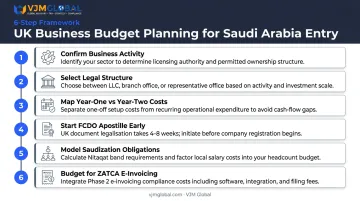
UK-Specific Budget Planning Steps
Work through these before filing any registration documents:
- Confirm your business activity — this determines which MISA licence category applies and whether sector-specific licences are needed
- Select the right legal structure — LLC, branch office, or joint stock company each carry different cost profiles and ownership implications
- Map year-one costs separately from year-two recurring costs — the ongoing compliance burden often exceeds the initial setup cost
- Start FCDO apostille authentication early — standard processing takes up to 25 working days; this step delays everything downstream if left late
- Model Saudization obligations before registering — headcount plans need to account for Nitaqat ratios from day one, not after hiring decisions are made
- Budget for ZATCA e-invoicing compliance — if your business will be VAT-registered, compliant software is a non-negotiable operational cost
Working with an Advisory Firm
VJM Global has supported 250+ UK businesses with cross-border financial operations and compliance planning. The firm's core expertise covers India market entry — business setup, FEMA compliance, international tax planning, and cross-border accounting. Through its membership in EAI International — a globally recognised network of independent accounting and tax firms — the firm can connect UK businesses with vetted local professionals across international jurisdictions, including Saudi Arabia.
For UK businesses planning Saudi Arabia market entry, a structured pre-entry cost assessment covering both setup and year-two obligations reduces the risk of budget overruns and avoidable compliance penalties. To clarify what support is available for your specific entry, reach VJM Global at vjmglobal.com.
Frequently Asked Questions
How much does it cost to set up a business in Saudi Arabia?
Total setup costs typically range from SAR 45,000 to SAR 150,000+ (approximately £9,000–£30,000+) depending on legal structure, business activity, and whether a physical office is required. Budget annual compliance costs separately: licences, Iqamas, accounting, and ZATCA filings recur every year from the point of registration.
Can a British citizen do business in Saudi Arabia?
Yes. British citizens can own and operate a business in Saudi Arabia, including 100% foreign ownership in most approved sectors, provided they obtain a MISA investment licence. No local Saudi sponsor is required under Vision 2030 reforms, though certain restricted or regulated sectors may still require a Saudi partner.
How much is a 1-year Iqama in Saudi Arabia?
An Iqama (residency permit) typically costs SAR 8,000–12,000 per year, including mandatory medical insurance. The exact figure varies by nationality and employment category — investor permits are priced differently from standard employee permits.
Do UK businesses need a local Saudi sponsor to register a company?
Local sponsorship is no longer required for most business activities. UK investors can hold 100% ownership through a MISA-licensed LLC, with no Saudi partner needed. Restricted sectors such as certain commercial activities and communications are exceptions — these may require minimum Saudi participation.
What is the minimum capital required for a foreign-owned company in Saudi Arabia?
Capital requirements are activity-specific. The MISA Investor Guide sets SAR 30,000,000 for 100% foreign-owned commercial activities and SAR 26,666,667 where a Saudi partner is involved. Service and consulting businesses typically face lower thresholds, confirmed during the MISA application review.
How long does the company registration process take from the UK?
The end-to-end process typically takes 8–12 weeks from initial document preparation to bank account activation. FCDO apostille processing and certified Arabic translation for UK-origin documents are the most common causes of delay — starting these steps before any other registration work is strongly recommended.