Here's the catch: costs, timelines, and paperwork requirements shift depending on whether you file online or by mail, and whether you DIY it or bring in professional help. Many founders struggle with figuring out which route actually saves time and money.
This guide walks through the exact steps, real costs, and the mistakes that trip up first-time filers in Massachusetts.
Key Takeaways
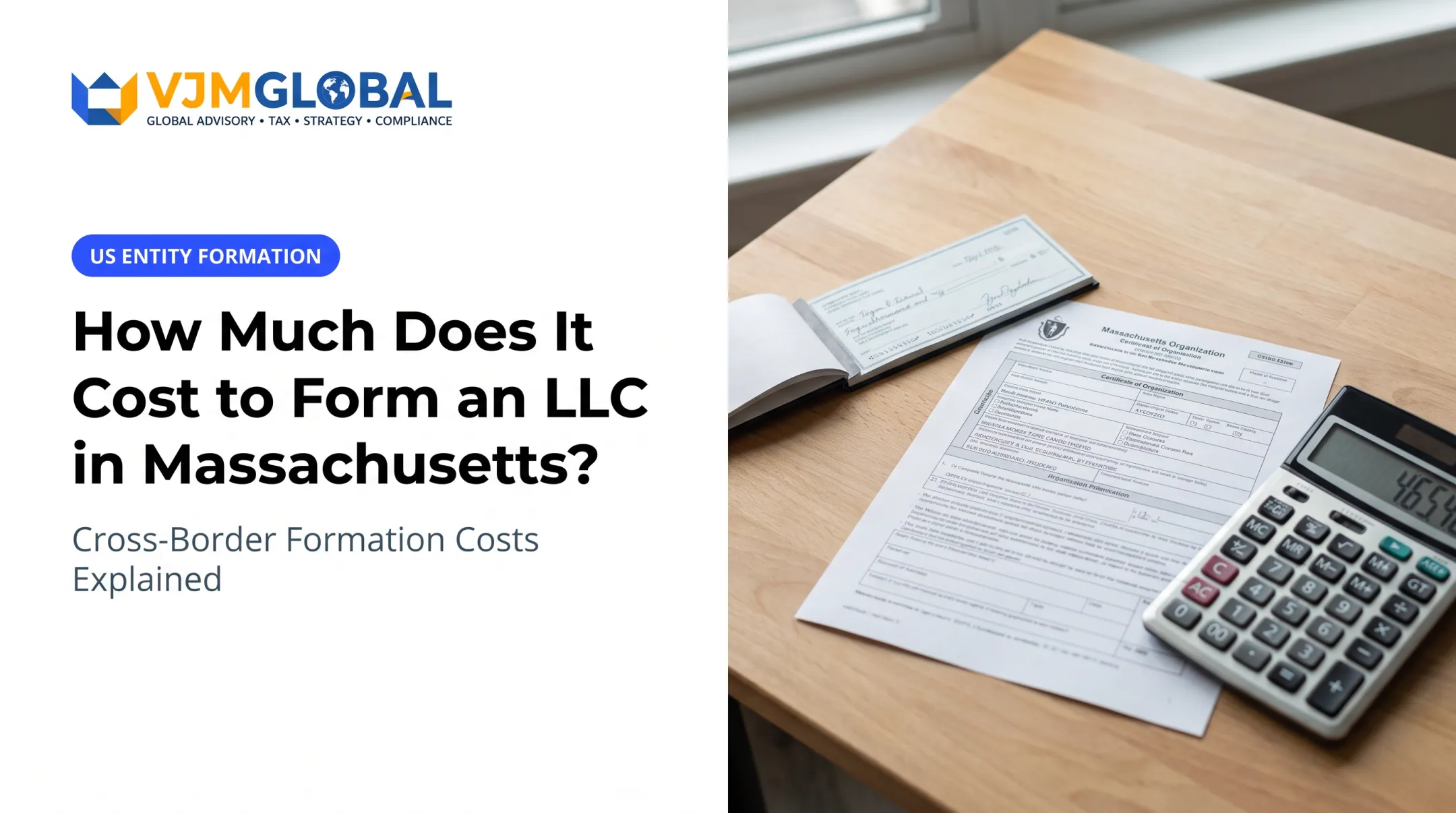
- Filing your Certificate of Organization costs $500 by mail or $520 online, with the same fee due each year on the annual report
- Every Massachusetts LLC needs a resident agent with a physical MA street address (no P.O. boxes)
- An operating agreement isn't required, but without one you default to Massachusetts statutory rules
- Non-residents and foreign nationals can form a Massachusetts LLC without ever setting foot in the state
- VJM Global can handle MA formation, EIN setup, and ongoing compliance for non-resident founders
How to Form an LLC in Massachusetts: Step-by-Step
Step 1: Choose a Name for Your LLC
Your LLC name has to be distinguishable from any corporation, LP, or LLC already registered in Massachusetts. Check availability using the Secretary of the Commonwealth's business entity search tool before you fall in love with a name.
Your name also needs a designator:
- "LLC" or "L.L.C."
- "Limited Liability Company"
- "LC" or "L.C." (less common variants)
Not ready to file yet? You can reserve a name for 60 days for $30, with an option to extend another 60 days for another $30.
Step 2: Appoint a Massachusetts Registered/Resident Agent
Massachusetts calls this a "resident agent," and the requirements are strict. The agent must:
- Have a physical Massachusetts street address (P.O. boxes don't qualify)
- Be available during normal business hours to accept legal documents
- Be an individual MA resident, a domestic corporation, or a foreign corporation already authorized to do business in Massachusetts
One detail that catches foreign founders off guard: if your LLC isn't yet registered in Massachusetts, it can't serve as its own resident agent. You'll need a member with a qualifying address, or a professional registered agent service instead.
Step 3: File the Certificate of Organization
This is the document that legally creates your LLC. You have two filing options:
| Filing Method | Cost | Processing Time |
|---|---|---|
| Online (corp.sec.state.ma.us) | $520 | 1-2 business days |
| $500 | About one week |

Your Certificate needs to include:
- The LLC name and its designator
- A Massachusetts address where records will be kept
- Resident agent name, address, and written consent
- Management structure (member-managed or manager-managed)
- At least one person authorized to sign filings if you have no managers

There's no expedited option, so build the timeline into your launch plan.
Step 4: Draft an Operating Agreement
Massachusetts doesn't legally require an operating agreement, but skipping this step is riskier than it looks. Without one, state default rules kick in automatically:
- Members owning more than 50% of unreturned contributions control major decisions
- Profits and losses split based on each member's contribution value, not equal shares
- If you name a manager, that manager runs the company unless your agreement says otherwise
A written agreement lets you set your own terms for voting, profit splits, and what happens if a member wants out. Banks also frequently ask for one before opening a business account, so draft it early rather than scrambling later.
Step 5: Obtain an EIN and Register for State Taxes
Your Employer Identification Number is free and comes straight from the IRS website. You'll need it for banking, hiring, and tax filing. Form your LLC with the state first, though. Applying for an EIN before your state filing is complete can cause delays.
Next, register with the Massachusetts Department of Revenue through MassTaxConnect if your business involves:
- Sales and use tax
- Payroll withholding
- Meals tax (for food service businesses)
Non-US founders take note: you may need an ITIN as part of this process, and cross-border compliance gets complicated fast. VJM Global helps foreign founders with EIN applications and Massachusetts tax registration as part of cross-border US entity setup.
When Should You Form an LLC in Massachusetts?
Massachusetts makes sense if you need access to skilled talent, the state's tech and life sciences ecosystem, or the Boston-area customer base directly. The state concentrates biotech, research, and technical talent in a way few other markets match.
That said, it's not always the right call:
- Very small side businesses may struggle to justify $500+ upfront plus another $500+ every year
- Multi-state operators should confirm most activity sits in Massachusetts before making it their home base
If your business genuinely operates in Massachusetts, the fees pay for themselves through market access. If you're just testing an idea, form in a lower-cost state first.
What You Need Before Forming a Massachusetts LLC
Preparation prevents rejected filings and wasted fees. Before you start, confirm:
- An available LLC name, checked against the Secretary of the Commonwealth's database
- A registered agent with a Massachusetts street address who has consented in writing
- Budget of $500-$520 for filing, plus the same amount again for next year's annual report
- Your management structure (member-managed or manager-managed), since this determines who has signing authority
Missing any one of these is the fastest way to get your filing bounced back.
Massachusetts LLC Costs and Requirements
Massachusetts LLC formation has a clear fee schedule, plus recurring obligations after you file. First-year and ongoing costs typically look like this:
| Item | Cost |
|---|---|
| Certificate of Organization (mail) | $500 |
| Certificate of Organization (online) | $520 |
| Annual Report | $500–$520 |
| Name reservation (optional) | $30 |
| Registered agent service (optional) | $100–$300/year |
| Local licenses | Varies by municipality |

After formation, Massachusetts requires an annual report every year. The deadline follows your formation anniversary, not a fixed calendar date, so track it from the day you file.
Miss the report for two consecutive years, and the Secretary of the Commonwealth can move toward administrative dissolution. Budget for the $500–$520 report fee each year, along with any local licenses your municipality requires.
Common Mistakes to Avoid
Small errors here cause real delays. Watch for:
- Listing a P.O. box as your registered agent address instead of a physical MA street address
- Forgetting written consent from your resident agent before filing the Certificate
- Assuming the annual report updates your agent — it doesn't; that requires a separate filing
- Missing the annual report deadline, risking penalties or eventual dissolution
Each of these is preventable with a five-minute double-check before you submit.
Alternatives to Forming an LLC Yourself
DIY filing saves money, but it demands time and precision. Here's how the options compare.
DIY Filing
Better for: Simple, single-member LLCs with a straightforward structure and no urgent deadline.
Trade-offs: Time-intensive, and mistakes on the Certificate can bounce your filing back, costing you weeks.
Professional Formation Services
Better for: Multi-member LLCs, non-resident founders, or anyone wanting fast, error-free filing.
Trade-offs: You'll pay a service fee on top of the state's own charges.
Cross-Border Entity Formation Support
Better for: Foreign companies or founders entering the US market who need EIN applications, tax registration, and ongoing compliance handled without guessing at unfamiliar rules.
VJM Global provides US entity formation and compliance support for founders managing the process from outside the country.
Trade-offs: Pick a provider with genuine multi-jurisdiction experience, not just domestic filing knowledge.
Frequently Asked Questions
How much does it cost to form an LLC in Massachusetts?
Filing your Certificate of Organization costs $500 by mail or $520 online. On top of that, you'll pay a recurring $500-$520 annual report fee every year.
How long does it take to get an LLC approved in Massachusetts?
Online filings typically process in 1-2 business days. Mail filings take about a week. Massachusetts doesn't offer an expedited option.
What are the requirements for starting an LLC in Massachusetts?
You need a distinguishable name with the correct designator, a registered agent with a Massachusetts street address, a filed Certificate of Organization, and payment of the applicable fees.
What are the key differences between a PLLC and an LLC in Massachusetts?
A PLLC is for licensed professionals like attorneys or CPAs and requires proof of licensure attached to your filing. A standard LLC has no such restriction.
Do I need to renew my LLC every year in Massachusetts?
Yes. You must file and pay for an annual report each year, due on your LLC's formation anniversary, to stay in good standing.
Does Massachusetts require LLCs to have an operating agreement?
No, it's not legally required. It's strongly recommended, though, for liability protection and to avoid falling back on the state's default management and profit-split rules.