For US residents, that track record is compelling. For international founders — NRIs, OCIs, Indian entrepreneurs, and non-US citizens building US-facing businesses — Delaware offers something even more valuable: the ability to form a legitimate US legal entity without ever setting foot on American soil.
This guide walks through every step of Delaware LLC formation, from choosing a name to staying compliant year after year. It also addresses the specific complications non-US founders face, particularly around EIN acquisition and banking, that most generic formation guides overlook entirely.
Key Takeaways
- Delaware allows anyone worldwide to form an LLC — no US citizenship, residency, or physical presence required
- The state filing fee is $110; the annual franchise tax is currently $400 (due June 1 each year)
- You must appoint a Delaware registered agent with a physical in-state address before filing
- Standard processing takes 10–15 business days; expedited same-day service costs an additional $100
- Non-US founders must obtain an EIN via fax using IRS Form SS-4, since the online application requires a US SSN or ITIN
What Is a Delaware LLC?
A Delaware LLC is a business entity formed under the Delaware Limited Liability Company Act (Title 6, Chapter 18 of the Delaware Code). It combines personal liability protection — members are not personally responsible for the LLC's debts — with flexible management structure and pass-through taxation.
Delaware's real advantage comes down to three structural features:
- No member or manager disclosure — the Certificate of Formation requires only the LLC name, registered agent details, and an organizer's signature. Member names never appear in public filings.
- No annual report requirement — unlike most states, Delaware LLCs have no annual report obligation, only a franchise tax payment.
- Open to anyone worldwide — there is no residency, citizenship, or presence requirement to form or own a Delaware LLC.
The typical Delaware LLC founder fits one of these profiles:
- US-based startup building investor credibility before a funding round
- International founder accessing US markets and banking infrastructure
- Real estate investor using an LLC as a holding vehicle for assets
- Multinational structuring an intermediate holding entity for US operations
Why Form an LLC in Delaware?
The Court of Chancery Advantage
Delaware's Court of Chancery is a dedicated business court staffed by judges who specialize exclusively in corporate and commercial law. With 1 Chancellor, 6 Vice Chancellors, and 7 Magistrates in Chancery, it handled 5,021 total filings in FY2024. Business disputes get decided by judges who understand LLC agreements, not general-jurisdiction judges handling everything from traffic tickets to contract disputes. That specialization translates directly into more predictable outcomes when disputes arise over ownership, management rights, or exit terms.
Tax Position for Non-Operating Entities
Delaware's tax obligations are tied to conducting business in Delaware. If your LLC is formed there but operates entirely in another state or country, you are not subject to Delaware income tax on that out-of-state activity. The primary ongoing cost is the annual franchise tax — currently $400 under Delaware Code § 18-1105, due June 1 each year.
Note: The Division of Corporations payment page still reflects $300 — a known source conflict. The current statutory amount under the Delaware Code is $400, which took effect January 1, 2026.
Privacy Protection
Delaware does not require member or manager names in the Certificate of Formation. Only the registered agent's information becomes publicly visible. For founders who want operational discretion — particularly those with privacy concerns in their home country — this is a practical structural advantage.
Accessibility for International Founders
Delaware places no citizenship or residency restrictions on LLC formation. The entire process can be completed remotely — no travel to Delaware required. For founders based in India, Europe, or anywhere outside the US, this means:
- No citizenship or residency requirement to form or own an LLC
- No obligation to visit Delaware or conduct any business there
- Formation completed entirely online, typically within 1–2 business days
- No requirement to have a US bank account at the point of filing
What to Know Before Starting a Delaware LLC
Before you file, three realities are worth understanding — because most checklists skip them entirely.
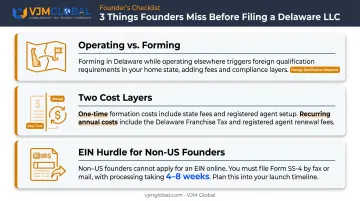
Forming in Delaware doesn't mean operating there. If your LLC has employees, a physical office, or regular sales in New York, California, or any other state, you'll likely need to register as a foreign LLC in that state too. That means additional filing fees and ongoing compliance requirements in each operating state.
Two separate cost layers apply. Formation is a one-time expense — the state filing fee plus any optional services. Maintenance costs recur every year: Delaware's $300 annual franchise tax, registered agent renewal fees, and any foreign qualification fees in states where you operate. Budget for both before you start.
Non-US founders hit an extra hurdle. Getting an EIN without a US Social Security Number or ITIN requires mailing or faxing Form SS-4 directly to the IRS — the online application isn't available. This process typically takes 4–8 weeks, which delays business bank account opening until it's complete.
How to Start an LLC in Delaware: Step by Step
The steps below follow a deliberate sequence. Skipping or rushing steps — particularly registered agent appointment or EIN acquisition — creates problems downstream for banking, contracts, and tax compliance.
Step 1: Choose and Verify Your LLC Name
Under Delaware Code Title 6 § 18-102, your LLC name must:
- Be distinguishable from all other registered entities in Delaware
- Include "Limited Liability Company," "LLC," or "L.L.C."
Search name availability using the Delaware Division of Corporations Entity Search before proceeding. If your preferred name is available but you're not ready to file immediately, you can reserve it for 120 days under § 18-103 for a $75 fee.
Step 2: Appoint a Delaware Registered Agent
Delaware law requires every LLC to maintain a registered agent with a physical street address in the state (PO boxes are not accepted). The agent receives legal notices, service of process, and official government correspondence on the LLC's behalf during business hours.
Who can serve as registered agent:
- An individual Delaware resident
- A domestic entity registered in Delaware
- A professional registered agent service
Most founders use professional services. Verified provider fees range from $50 to $125 per year based on current provider listings. This is an annual recurring cost, not a one-time expense.
Step 3: File the Certificate of Formation
The Certificate of Formation is the document that legally creates your Delaware LLC. It requires only three things:
- The LLC name
- The registered agent's name and Delaware address
- The organizer's signature
Member and manager information is not required. File online through the Division's Document Filing Service, or by mail or fax to the Delaware Division of Corporations.
Filing fee and processing times:
| Option | State Fee | Turnaround |
|---|---|---|
| Standard filing | $110 | 10–15 business days (up to 3–4 weeks during peak periods) |
| 24-hour expedited | $110 + $50 | ~24 hours |
| Same-day expedited | $110 + $100 | Same business day |
| 2-hour expedited | $110 + $500 | 2 hours |
| 1-hour expedited | $110 + $1,000 | 1 hour |
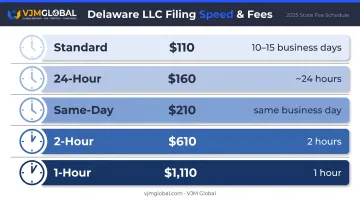
Fees per the Division's August 2024 fee schedule. Verify current fees at corp.delaware.gov before filing.
Step 4: Create an Operating Agreement
Delaware does not legally require an operating agreement. Skipping it is a real risk: without one, the state's default LLC rules fill the gaps, and those defaults rarely match what members actually intended.
A well-drafted operating agreement should cover:
- Member percentage interests
- Management structure (member-managed vs. manager-managed)
- Profit and loss distribution
- Voting procedures and quorum requirements
- Buyout provisions and what happens when a member exits or dies
For single-member LLCs, an operating agreement still matters: it strengthens the liability protection argument and is typically required by banks when opening a business account.
Step 5: Obtain an EIN from the IRS
An Employer Identification Number (EIN) is the LLC's federal tax ID. You need one for:
- Opening a US business bank account
- Hiring employees
- Filing federal tax returns
- Multi-member LLCs (required by default)
For US-based applicants: Apply online through the IRS — it's free and issues the EIN immediately.
For non-US founders: The online application requires a US SSN or ITIN. Without one, you must complete IRS Form SS-4 and submit it by fax. On line 7b, enter "foreign" or "N/A" — the IRS instructions explicitly require an entry here; do not leave it blank.
Processing via fax typically takes 4 business days; mail takes approximately 4 weeks.
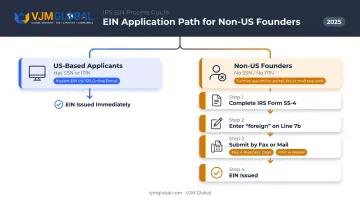
This step often surprises international founders. Build the timeline into your planning before assuming a bank account is days away.
Step 6: Register for State Taxes and Business Licenses
Once your federal EIN is in hand, the next question is whether Delaware itself requires anything further. This step applies only if your LLC conducts business in Delaware — meaning physical presence, employees, or Delaware-source income. If you operate exclusively in other states, you likely skip this step.
If it does apply:
- Obtain a Delaware business license from the Division of Revenue using Form CRA, with a base fee of $75 for a first location
- Note that Delaware imposes a gross receipts tax rather than a state sales tax
- LLCs with Delaware employees must also register for withholding tax and unemployment insurance
Step 7: Fulfill Ongoing Compliance Requirements
Delaware's ongoing compliance for LLCs is lighter than most states, but two items are non-negotiable:
Annual franchise tax: $400 due to the Division of Corporations by June 1 each year. Late payment triggers a $200 penalty plus 1.5% monthly interest under Delaware Code § 18-1105. There is no annual report required — just the payment.
Foreign qualifications: If your LLC operates in other states, stay current on those states' foreign qualification annual reports and fees. California, New York, and other high-activity states have their own filing calendars and penalties. A compliance calendar or professional service reduces the risk of missed deadlines.
Delaware LLC Costs and Timeline
One-Time Formation Costs
| Item | Cost |
|---|---|
| Certificate of Formation (state fee) | $110 |
| Name reservation (optional, 120 days) | $75 |
| 24-hour expedited processing (optional) | +$50 |
| Same-day expedited processing (optional) | +$100 |
| EIN application | Free |
Annual Recurring Costs
| Item | Estimated Cost |
|---|---|
| Delaware annual franchise tax | $400 |
| Registered agent service renewal | $50–$125/year |
| Foreign qualification fees (if operating in other states) | Varies by state |
Formation is a one-time expense. The ongoing costs add up faster: $400 in annual franchise tax, plus registered agent renewal, adds up to roughly $450–$525 per year for a basic LLC operating outside Delaware with no employees — before any professional service fees.
International founders juggling EIN applications, operating agreements, and multi-state compliance often benefit from working with an advisory team that understands cross-border structures. VJM Global works with foreign investors and international entrepreneurs on cross-border business compliance — visit vjmglobal.com to discuss your situation.
Frequently Asked Questions
Can non-US citizens or non-residents form a Delaware LLC?
Yes. Delaware imposes no citizenship or residency requirement on LLC formation. Anyone worldwide can form and own a Delaware LLC without visiting the state. Non-US founders who lack a US SSN or ITIN must apply for an EIN by faxing IRS Form SS-4 rather than using the online application.
How much does Delaware LLC formation cost?
The mandatory state filing fee is $110. Optional name reservation adds $75. Expedited processing adds $50–$1,000 depending on speed. On top of formation, budget for registered agent fees ($50–$125/year) and the annual $400 franchise tax.
Do I need to be physically present in Delaware to form an LLC?
No physical presence is required. The entire process can be completed remotely — online, by mail, or by fax. The one non-negotiable physical requirement is that your registered agent must maintain a street address in Delaware, though that requirement falls on the agent, not you.
Does a Delaware LLC need to file an annual report?
Delaware LLCs are not required to file annual reports — unlike Delaware corporations, which must file by March 1. LLCs must still pay the $400 annual franchise tax to the Division of Corporations by June 1 each year or face penalties.
What taxes does a Delaware LLC need to pay?
Every Delaware LLC owes the $400 annual franchise tax regardless of where it operates. If the LLC conducts no business in Delaware, it owes no Delaware income tax — only taxes in the states where it actually operates, plus federal taxes based on its elected tax classification.
What is the difference between a Delaware LLC and a Delaware C-Corporation?
An LLC offers pass-through taxation and fewer administrative formalities, while a C-Corp is taxed at the entity level (creating double taxation on dividends). That said, most venture capital investors and accelerators — including Y Combinator — require Delaware C-Corps for equity financing rounds, making the C-Corp the default choice for VC-backed startups.