Forming an LLC here looks simple on paper. But Connecticut has its own naming rules, its own registered agent requirements, and its own filing quirks that differ from what you might have seen in Delaware or Texas. That matters even more if you're managing the business remotely, or from outside the US entirely.
This guide walks through the exact steps, real costs, realistic timelines, and the ongoing compliance work that keeps your LLC in good standing. We'll also flag the mistakes that trip up first-time filers most often.
Key Takeaways
- File a Certificate of Organization with the CT Secretary of State and appoint a registered agent
- Budget $120 for formation, plus optional fees for name reservation and registered agent services
- Connecticut doesn't require an operating agreement, but skipping one weakens your liability protection
- File annual reports and tax registrations on time, or risk administrative dissolution of your LLC
How to Form an LLC in Connecticut: Step-by-Step
Step 1: Choose a Distinguishable LLC Name
Your LLC name must be distinguishable from every other active business entity on file with Connecticut SOTS, and it needs an approved designator: "LLC," "L.L.C.," "Limited Liability Company," or a few close variants.
Before you fall in love with a name, run it through the Connecticut business name search tool. This single step saves more headaches than any other part of the process.
Not ready to file yet? Connecticut allows you to reserve a name for 120 days for a $60 fee, giving you breathing room to finish your paperwork without risking someone else grabbing it first.
Step 2: Appoint a Connecticut Registered Agent
Every Connecticut LLC needs a registered agent, a designated person or entity who accepts legal and tax documents on the company's behalf. The address must be a physical Connecticut street address. P.O. boxes don't qualify.
Your options include:
- A Connecticut resident (yourself, a co-founder, or a manager)
- A qualifying business entity already registered with SOTS
- A professional registered agent service, which is often the practical choice for founders based outside Connecticut or outside the US entirely
Skipping a valid registered agent isn't a minor paperwork issue. It puts your LLC's good standing at risk, since the state relies on this contact to deliver official notices.
Step 3: File the Certificate of Organization
This is the document that legally creates your LLC. You'll need to provide:
- LLC name and principal office address (no P.O. boxes)
- Mailing address, if different
- Registered agent name, address, and signed acceptance
- At least one member or manager, with business and residence addresses
- Management structure (member-managed or manager-managed)
- A six-digit NAICS code and an optional entity email address
The filing fee is $120, submitted directly to Connecticut SOTS. Filing online tends to move faster than mailing a paper form, since SOTS describes mail and hand delivery as the slowest submission methods.
If you're in a hurry, an expedited option exists for an extra $50. The state doesn't publish a guaranteed turnaround window for it, though, so don't count on a same-day certificate.
Step 4: Draft an LLC Operating Agreement
Connecticut doesn't require you to file an operating agreement, and the Certificate of Organization doesn't ask for one. That said, treating it as optional is a mistake many new LLC owners regret later.
An operating agreement protects your liability status, prevents disputes between members, and gives banks and investors confidence that your business is run properly. At minimum, yours should cover:
- Ownership percentages for each member
- Management structure and decision-making authority
- Voting rights on major business decisions
- Profit and loss distribution rules
Without one, Connecticut's default LLC statute governs your business, and those default rules rarely match what founders actually intended.
Step 5: Obtain a Federal EIN
Your Employer Identification Number is required if your LLC has more than one member, has employees, or elects corporate tax treatment. Single-member LLCs with no employees can technically use the owner's Social Security number instead, but most banks will still ask for an EIN to open a business account.
The good news: getting one costs nothing. Applying directly through the IRS website is free, and most online applicants receive approval instantly.
Step 6: Register for State Taxes and Business Licenses
If your LLC sells taxable goods or services, you'll need to register for a sales and use tax permit through myconneCT before you start collecting. If you have employees, you'll also register for employer withholding tax.
Connecticut doesn't issue one general statewide business license. Instead, licensing depends on your industry and location — a restaurant, a contractor, and a consulting firm each face entirely different permit requirements. Check with your specific municipality and industry board before assuming you're in the clear.
Connecticut LLC Costs, Fees & Timeline
Here's the real cost breakdown, based on current Connecticut SOTS fee schedules:
| Item | Cost | Notes |
|---|---|---|
| Certificate of Organization | $120 | Required, one-time |
| Name reservation (optional) | $60 | Valid for 120 days |
| Annual report | $80 | Recurring, every year |
| Expedited processing | +$50 | Online filings only |
Beyond state fees, many founders add costs for a professional registered agent service (typically $100 to $300 per year) or an attorney or formation service to handle the paperwork. Neither is required, but both save time if you're juggling other priorities.
On timeline: Connecticut doesn't publish exact processing days for standard online or mailed filings. What the state does confirm is that online filing moves faster than paper submissions, and mail or hand-delivered filings are the slowest option available. Since fees and processing times can change, always verify current fees and expected turnaround directly on the Business.CT.gov portal before you file.
How Connecticut compares to neighbors:
| State | Formation Cost | Annual Report | Processing Time |
|---|---|---|---|
| Connecticut | $120 | $80 | Not officially published |
| Massachusetts | $500 | $500 | Not specified |
| Rhode Island | $150 | $50 | 1-3 business days |
Connecticut lands solidly in the middle—cheaper than Massachusetts for long-term maintenance, though Rhode Island edges it out on published processing speed.
Ongoing Compliance & Maintenance for Your Connecticut LLC
Forming the LLC is just the starting line. Connecticut requires an annual report filed online every year between January 1 and March 31, starting the year after formation. Miss the window, and the state issues a Notice of Intent, giving you 90 days to catch up before pursuing administrative dissolution.
Beyond the annual report, ongoing obligations typically include:
- Sales tax filings (monthly, quarterly, or annually, depending on your assigned schedule)
- Employer withholding remittances and quarterly reconciliations, if you have staff
- Pass-through entity tax filings, if your LLC has Connecticut-source income
None of this matters much if your books are a mess. Keeping a separate business bank account and clean records preserves your liability shield if a lawsuit ever tests it, since courts look for that separation.
Here's where a lot of founders get stuck: tracking state annual report deadlines, federal tax filings, and payroll obligations across multiple agencies is a lot to hold in your head. This gets even harder for first-time owners or founders managing a US LLC from overseas.
VJM Global has worked with over 500 American business owners on outsourced accounting, bookkeeping, and tax compliance support. This gives founders a way to stay on top of recurring requirements without hiring a full internal finance team.

Common Mistakes to Avoid When Forming a Connecticut LLC
Most Connecticut LLC problems trace back to one of five avoidable errors:
- Skipping the name search: filing a name that's already taken leads to rejection and wasted processing time
- Using a P.O. Box for your registered agent address: Connecticut requires a physical street address, no exceptions
- Treating the operating agreement as optional: this leaves you exposed to member disputes and weaker liability protection
- Missing tax registrations or the annual report deadline: both can trigger penalties or involuntary dissolution
- Mixing personal and business finances: this quickly erodes the liability protection an LLC is meant to provide
Conclusion
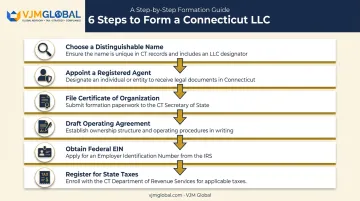
Forming a Connecticut LLC comes down to a clear sequence. Pick a distinguishable name, appoint a registered agent, file your Certificate of Organization, draft an operating agreement, get your EIN, and register for applicable state taxes.
Getting the paperwork filed is only half the job, though. Staying compliant year after year is what actually protects your liability status and keeps your business in good standing with the state. If tracking annual reports, tax registrations, and bookkeeping across state and federal lines feels like more than you want to manage alone, VJM Global's accounting and tax compliance support can take that burden off your plate. That frees you up to focus on running the business itself.
Frequently Asked Questions
How much does it cost to set up an LLC in Connecticut?
The Certificate of Organization filing fee is $120. Optional costs include a $60 name reservation and registered agent service fees. Confirm current pricing on Business.CT.gov before filing, since fees can change.
How do I form an LLC in Connecticut?
Choose a distinguishable name, appoint a Connecticut registered agent, and file the Certificate of Organization with the Connecticut Secretary of the State (SOTS). Afterward, complete post-formation steps like drafting an operating agreement and obtaining an EIN.
How long does it take to form an LLC in Connecticut?
Connecticut doesn't publish a guaranteed processing window, but online filing is consistently faster than mailed submissions. An expedited option is available for an extra $50 if you need faster handling.
Does Connecticut require an operating agreement for an LLC?
No, it's not legally required. It is, however, strongly recommended to protect your liability status and prevent disagreements between members down the road.
Can a non-US resident or foreign-owned business form an LLC in Connecticut?
Yes. Connecticut's filing requirements don't restrict ownership by citizenship or residency. You'll still need a Connecticut registered agent and, in most cases, a federal EIN.
What ongoing filings does a Connecticut LLC need to stay compliant?
You'll need to file an annual report each year between January 1 and March 31, plus any applicable state tax registrations like sales tax or employer withholding. Missing these can lead to administrative dissolution.