But moving into Mexico isn't as simple as shipping a product or hiring a freelancer. Many UK businesses struggle with an unfamiliar tax authority, a labour code that punishes informal hiring, and a trade framework that's genuinely misunderstood even by experienced exporters.
This guide walks through the trade context, the entry routes available, the compliance basics, and the localisation work needed to actually gain traction with Mexican buyers.
Key Takeaways
- North American supply-chain access requires a compliant Mexican entity or an Employer of Record (EOR)
- UK-Mexico Trade Continuity Agreement and CPTPP preferences set most tariff treatment today
- Subsidiary, JV, distributor and EOR routes trade off cost, control and risk differently
- Mexican Spanish and local business etiquette strongly shape buyer trust
Why Mexico Appeals to UK Businesses
Mexico's economy reached USD 1.83 trillion in GDP in 2025, with a population of nearly 132 million, making it the second-largest economy in Latin America. That's a substantial domestic market before you even consider its proximity to the United States.
Nearshoring is the real driver of current interest. Mexico recorded USD 40.87 billion in foreign direct investment in 2025, up 10.8% year-on-year, with new investment projects jumping to USD 7.38 billion. Automotive remains the clearest proof point: the sector contributes 4.5% of GDP and roughly USD 104.8 billion in vehicle exports.
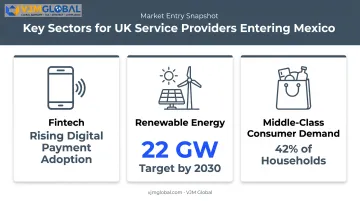
Beyond manufacturing, three sectors stand out for UK service providers:
- Fintech - rising digital payments adoption, though precise country-level growth figures remain limited
- Renewable energy - Mexico's Plan Mexico targets 22 GW of new generating capacity by 2030
- Middle-class consumer demand - roughly 42% of households were classified as middle class in the latest available data
The opportunity is real, but it's uneven. The OECD has flagged persistent gaps in digital connectivity, water availability and regulatory consistency across Mexican states. Treat national statistics as a starting point, not a guarantee for your specific location or sector.
UK-Mexico Trade and Regulatory Landscape
Current Trade Framework
The UK-Mexico Trade Continuity Agreement (TCA) took effect on 1 June 2021. It's a continuity instrument, not a freshly negotiated bilateral deal. It carries forward the trade terms Mexico previously had with the EU. It covers goods, services, intellectual property, tariff-rate quotas and government procurement.
Separately, the UK has now joined CPTPP, and Mexico ratified UK accession, meaning CPTPP preferences now apply between the two countries, running alongside the TCA rather than replacing it.
Practical implication: these two agreements have different rules of origin. You need to check which one gives your specific product the better tariff treatment, transaction by transaction. Don't assume UK origin alone unlocks duty-free access under either agreement.
Regulatory and Compliance Basics
UK businesses entering Mexico will deal with three core bodies:
- SAT (Servicio de Administración Tributaria) - the federal tax authority handling registration and filings
- IMSS (Instituto Mexicano del Seguro Social) - administers mandatory social insurance; employers must register and report worker changes within five working days
- RNIE (Registro Nacional de Inversiones Extranjeras) - foreign investment registry required for foreign-owned entities operating in Mexico
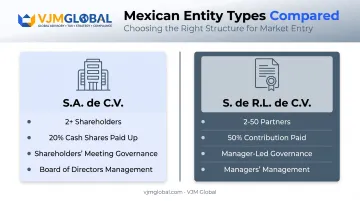
Two entity types dominate for foreign investors:
| Feature | S.A. de C.V. | S. de R.L. de C.V. |
|---|---|---|
| Owners | 2+ shareholders | 2–50 partners |
| Initial capital payment | At least 20% of cash shares paid up | At least 50% of each partner's contribution paid |
| Governance | Shareholders' meeting is supreme body | Managers administer, partner meeting oversees |
Mexico applies a standard 16% VAT (IVA) on most sales and imports, separate from any customs duty relief under the TCA or CPTPP. Basic foods and medicines are zero-rated, but most goods and services are not.
Choosing the Right Market Entry Strategy
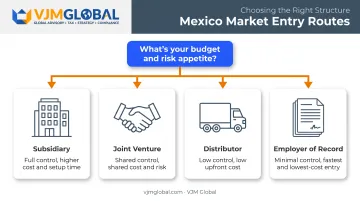
Four routes dominate UK-to-Mexico expansion. Each suits a different risk appetite and budget.
1. Wholly-owned subsidiary Maximum control over operations, contracts and staff. The trade-off is a longer setup process and ongoing compliance obligations with SAT, IMSS and corporate governance requirements from day one.
2. Joint venture with a local partner Shares risk and brings local market knowledge, distribution networks and regulatory familiarity to the table. The downside: divergent goals between partners and exposure of intellectual property if the relationship sours.
3. Distributor or local manufacturer contract The lightest-touch way to test demand without setting up a Mexican entity. You give up direct control over pricing, customer relationships and brand experience in exchange for speed.
4. Employer of Record (EOR) Lets you hire staff in Mexico and test the market without incorporating locally.
Mexican labour law prohibits personnel subcontracting for a client's core business activity, so an EOR only works within specific, legally compliant structures. Get this checked before you commit.
VJM Global supports this staged path with Employer of Record and entity formation services in 100+ countries, so UK businesses can get a compliant foothold without incorporating on day one.
Quick decision framework:
- Testing demand on a limited budget? Start with a distributor or EOR
- Have a committed long-term plan and capital? Move toward a subsidiary
- Need local expertise and shared investment? Consider a joint venture, with clear exit terms agreed upfront
Tax, Payroll and Ongoing Compliance
Once you're operating in Mexico, three obligations recur every filing cycle.
Corporate tax: the general rate is 30% of taxable profit under Mexican tax law. Permanent establishment risk and withholding rules need separate review depending on your structure.
VAT registration: the standard 16% IVA rate applies to most taxable sales, services and imports. There's no general small-business turnover exemption comparable to the UK's VAT threshold, so registration obligations start early.
Payroll and labour law essentials:
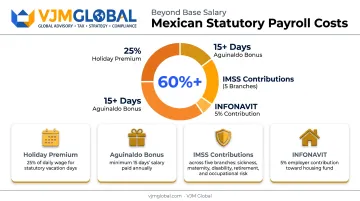
- Minimum 12 days' holiday in year one, with a 25% holiday premium
- Aguinaldo (Christmas bonus) of at least 15 days' salary
- IMSS contributions across five insurance branches, varying by salary and risk classification
- INFONAVIT employer contribution of 5% of integrated daily salary
Payroll cost in Mexico regularly runs well above headline salary once these statutory costs are added. Ongoing accounting, tax filings and payroll reporting are best handled by a multi-jurisdiction compliance partner, so your team stays on commercial priorities rather than statutory deadlines.
Localisation, Culture and Risk Mitigation
Marketing in neutral or European Spanish does not land the same way as Mexican Spanish. Local-language creative tends to build stronger brand trust with Mexican audiences than English taglines, so copy, UI and sales materials should be adapted for Mexico—not simply translated from Spain or left in English.
Cultural factors that matter in practice:
- Business relationships are built face-to-face; pre-meeting social conversation isn't optional small talk, it's part of the deal
- Negotiations run longer than UK buyers typically expect; aggressive tactics are seen as rude
- Punctuality still matters, particularly for government and formal business meetings
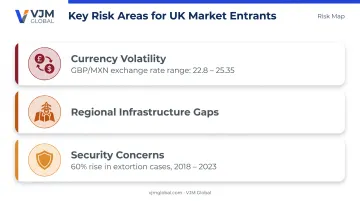
Common risk areas for UK entrants:
- Currency volatility - GBP/MXN has swung within a 22.8 to 25.35 range over a recent 52-week period, so build FX review triggers into your pricing
- Regional infrastructure gaps - connectivity, water and power availability vary sharply by state
- Security concerns - registered extortion cases rose nearly 60% between 2018 and 2023, making local due diligence on site selection worthwhile
Practical mitigations for UK entrants:
- Pilot through a distributor or local partner before a full subsidiary commitment
- Price with a currency buffer and predefined FX review triggers
- Site operations in states with an established industrial base (for example automotive clusters), not untested regions
Frequently Asked Questions
Which industry is booming in Mexico?
Automotive manufacturing leads, contributing 4.5% of GDP and around USD 104.8 billion in exports. Fintech and renewable energy are also growing, driven by nearshoring investment and government targets.
How long does it take to enter the Mexican market?
Entity setup can take several weeks depending on the structure chosen, but building genuine market traction typically takes 3-6 months. There's no single official benchmark, so get a location-specific quote before planning around fixed dates.
Do UK companies need a local entity to do business in Mexico?
Not necessarily. Distributors and compliant EOR arrangements let you operate without full incorporation, though EOR structures must satisfy specific Mexican labour law conditions to stay legal.
What trade agreement currently governs UK-Mexico trade?
The UK-Mexico Trade Continuity Agreement remains in force, running alongside CPTPP preferences now available between the two countries. Check both for the better tariff treatment on your specific goods.
Is Spanish-language localisation really necessary for UK businesses?
Yes. Research shows Mexican Spanish materially improves buyer trust and brand attitudes compared with English-language marketing, even for well-known global brands.
What are the biggest risks of entering the Mexican market?
Regulatory complexity around tax and labour law, cultural misalignment in negotiation style, and currency volatility between GBP and MXN top the list. All three are manageable with proper local guidance and staged entry.