But here's the catch: incorporation rules vary drastically by country. What works in the US, UK, or India will not translate directly into Brazilian, Mexican, or Colombian requirements.
This guide breaks down the essential steps, entity types, and compliance considerations foreign businesses need to know before incorporating anywhere in the region.
Key Takeaways
- FDI into Latin America reached $188.96 billion in 2024, led by Brazil (38%) and Mexico (24%)
- Incorporation timelines range from 4 days in Chile to 17 days in Brazil, plus added time for foreign-owner documentation
- Entity choice (SAS, SRL, SA, or branch) directly affects liability, tax treatment, and investor appeal
- Apostilles, notarization, and sworn translations are three separate, mandatory requirements
- Local tax IDs, bank accounts, and UBO disclosures are mandatory across virtually every jurisdiction
Why Latin America Is a Magnet for Global Business Expansion
Consumer markets across the region are expanding fast, particularly in digital sectors. Fintech companies in Latin America grew from 703 in 2017 to 3,069 in 2023 — a jump of more than 340%, according to the Inter-American Development Bank. Brazil, Mexico, and Colombia now hold 57% of that fintech base.
E-commerce is following a similar trajectory. Colombia's e-commerce contribution to GDP rose from 1.9% in 2018 to 3.6% in 2021, according to World Bank data. This growth reflects a broader shift toward digital-first commerce across the region.
Trade connectivity is another draw. The Pacific Alliance (Chile, Colombia, Mexico, Peru) and MERCOSUR (Argentina, Brazil, Paraguay, Uruguay, and now Bolivia) together represent more than 80% of the region's foreign trade.
Nearshoring adds further momentum, with companies relocating supply chains closer to North America. Mexico alone pulled in roughly $29 billion in FDI during H1 2023, though Reuters cautioned that headline FDI figures don't always confirm genuine new nearshoring projects.
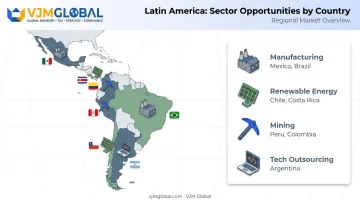
These regional advantages translate into distinct sector opportunities depending on where a company sets up:
- Manufacturing — concentrated in Mexico and Brazil, largely nearshoring-driven
- Renewable energy — Chile (solar) and Costa Rica are gaining traction
- Mining — Peru and Colombia maintain active investment pipelines
- Tech outsourcing — Argentina's knowledge-economy service exports reached $39.7 billion in 2024
Key Steps for Company Incorporation in Latin America
Procedures differ by country, but most jurisdictions follow a broadly similar sequence. Historical World Bank benchmarks show formation timelines ranging from 4 days in Chile to 17 days in Brazil for a standardized domestic entity. Foreign shareholders should expect additional time for document authentication and banking.
Step 1: Choose the Right Country and Define Market Entry Objectives
Before picking a jurisdiction, weigh:
- Political and regulatory stability — check current OECD governance indicators, not just historical rankings
- Tax incentives and rates — Mexico's corporate rate sits at 30%, Colombia's at 35%, Chile's general regime at 27%
- Currency stability — Ecuador, Panama, and El Salvador all use the US dollar as official currency, removing exchange-rate risk
- Ease of doing business — historically strongest in Chile, though the World Bank retired this ranking in 2021
Your objective should shape your entity choice. Testing the market with direct sales? A representative office might suffice short-term. Planning manufacturing or a regional headquarters? You'll need a full subsidiary.
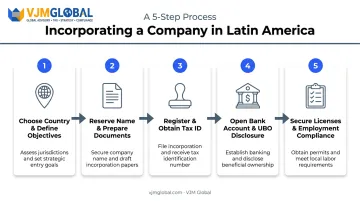
Step 2: Reserve a Company Name and Prepare Documentation
Most countries require a similar documentation package:
- Shareholder and director identification
- Proof of address
- Articles of incorporation
- Power of attorney for foreign shareholders (if not physically present)
Apostille certification and notarization are two different things, and neither replaces the other. Countries including Argentina, Brazil, Chile, Colombia, Mexico, and Peru are all Apostille Convention members, per the Hague Conference status table.
An apostille only replaces consular legalization. It doesn't validate document content, and it doesn't eliminate the need for sworn local-language translation. Brazil, for example, requires foreign documents to be translated into Portuguese by a certified sworn translator, even after apostille certification.
Step 3: Register with Local Authorities and Obtain a Tax ID
Once documentation is in order, you'll register with the local commerce or corporate registry and apply for a tax identification number. These go by different names across the region:
| Country | Tax ID Name |
|---|---|
| Mexico | RFC |
| Colombia | NIT (via RUT) |
| Peru | RUC |
| Ecuador | RUC |
| Brazil | CNPJ |
Some Southern Cone countries still require official gazette publication as part of the process. Argentina's General Companies Law requires formation notices to be published for SRLs and share-capital companies, while Uruguay mandates publication in the Official Gazette plus another newspaper within 60 days of registry filing.
Step 4: Open a Corporate Bank Account and Complete UBO Disclosure
Banking is its own process, and it rarely moves as fast as registration. Standard requirements include:
- Certificate of incorporation
- Local tax ID
- Beneficial ownership (UBO) disclosure
- Full KYC documentation
Foreign investors frequently face longer onboarding timelines here than locals do — banks scrutinize ownership chains, source of funds, and representative residency status more closely for non-domestic shareholders. Some businesses turn to digital or fintech banking alternatives to shorten this gap while traditional accounts are still in process.
Step 5: Secure Industry Licenses and Set Up Employment Compliance
Regulated sectors need extra approval before operations can start:
- Finance — Brazil's Central Bank may require a full business plan for authorization
- Healthcare — Mexico's COFEPRIS issues sanitary licenses only once conditions are verified
- Telecom — Colombia requires registration in the Registro Único de TIC
You'll also need to build out HR compliance from day one. Mexico's 2024 minimum wage sits at MXN 248.93 per day (higher in the northern border zone), with mandatory aguinaldo, vacation premiums, and severance obligations for unjustified dismissal. Colombia enforces similar minimum-wage and social-benefit provisioning through its Labor Ministry.
Choosing the Right Legal Entity Structure
Entity selection isn't a formality — it directly shapes your liability exposure, tax treatment, and how investors perceive your business down the line.
The Main Structures Available
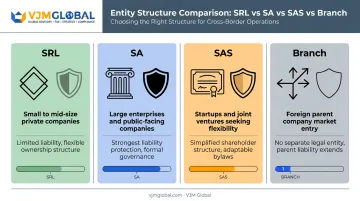
Specific rules vary by country, but four structures appear across most Latin American markets:
| Structure | Similar To | Liability | Best For |
|---|---|---|---|
| SRL (Sociedad de Responsabilidad Limitada) | LLC | Limited to capital contributions | SMEs not raising outside equity quickly |
| SA (Sociedad Anónima) | Public limited company | Limited to share issue price | Businesses planning future fundraising or public listing |
| SAS (Sociedad de Acciones Simplificada) | Simplified stock company | Limited to contributions | Smaller ventures or single-founder startups |
| Branch (Sucursal) | Foreign extension, no separate entity | Parent bears direct liability | Companies testing a market without incorporating locally |
Mexico's SRL allows 2 to 50 partners, with ownership held in quotas rather than freely tradable shares. Brazil's SA framework caps shareholder liability at the issue price of shares, while Colombia's SAS law permits a single owner and lets subscribed capital be paid over up to two years — a board of directors is optional unless the bylaws specify otherwise.
Branches face higher compliance scrutiny than local entities since the parent company bears direct liability for the branch's obligations.
Layered Structures for Venture-Backed Startups
Startups planning to raise international venture capital sometimes use layered structures, pairing a foreign holding company (often in the Cayman Islands) with a local operating entity in the target LatAm market. Cooley's analysis notes this approach can better align with non-US investor expectations and simplify cross-border financing rounds, though it adds governance, tax, and restructuring costs worth weighing against the benefit.
Common Challenges Foreign Investors Face During Incorporation
Language barriers show up everywhere — contracts, registry filings, and bank documentation typically need professional translation into Spanish or Portuguese. Sworn translators aren't optional in most jurisdictions; they're a filing requirement.
Once translation is sorted, the next hurdle is regulatory complexity, which compounds quickly across 17+ distinct jurisdictions. Each one has its own:
- Documentation standards
- Licensing timelines
- Frequency of regulatory change
Governance reviews of the region have repeatedly flagged weaknesses in regulatory consistency and conflict-of-interest controls, so factor this into your compliance planning from day one.
Beyond navigating local regulators, cross-border tax issues are often underestimated by first-time investors. Watch for:
- Double taxation risk if your home country lacks a treaty with the target jurisdiction
- Transfer pricing documentation requirements (most countries follow OECD-aligned rules)
- Profit repatriation restrictions and withholding tax on outbound dividends
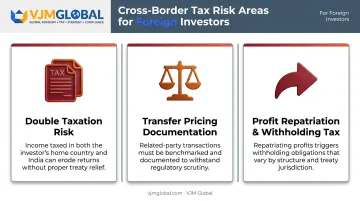
Getting tax structuring advice before you incorporate, not after, tends to save significant cost and rework later.
Why Partner with Experienced Global Business Advisors
Incorporating across unfamiliar legal systems gets much smoother with advisors who've done it before. Entity selection, tax structuring, banking, and compliance filings each carry country-specific nuances that are easy to miss without local expertise.
Many businesses evaluate multiple expansion destinations at once, weighing Latin America against markets like India. In these cases, a single advisory partner who operates across geographies can simplify entity setup, tax compliance, and back-office support. Instead of managing five separate country-specific vendors, you get one point of contact who understands your broader expansion strategy.
Frequently Asked Questions
Can a foreigner incorporate a company in Latin America?
Yes. Foreign nationals can incorporate under local laws in nearly every LatAm jurisdiction, but must comply with country-specific rules such as appointing a legal representative or meeting minimum capital and documentation requirements.
Which Latin American country is easiest for starting a business?
Chile and Costa Rica are generally considered the most business-friendly, thanks to faster historical registration timelines and clearer regulatory frameworks compared to regional peers.
How long does it take to register a company in Latin America?
Timelines range from about 4-11 days in fast-track jurisdictions like Chile to several weeks or months in more complex regulatory environments like Brazil, especially once foreign-document authentication is factored in.
Is a local director or representative required for incorporation?
Several countries do require this. Chile, for example, mandates that the tax representative be an adult natural person residing in Chile. Requirements vary by jurisdiction.
What taxes apply to foreign-owned companies in Latin America?
Common taxes include corporate income tax (27-35% depending on the country), VAT/IVA (16-19%), payroll taxes, withholding tax on outbound payments, and customs duties on imports.
Is a local bank account mandatory for a company operating in Latin America?
Generally, yes. A local corporate bank account is required for tax payments, payroll processing, and routine day-to-day business transactions in virtually every jurisdiction.