Most companies don't have that luxury of trial and error. Picking the wrong entry mode, or underestimating a target country's regulatory demands, leads to stalled launches, wasted capital, and sometimes outright legal exposure. A joint venture signed without proper due diligence, or a subsidiary opened without understanding local tax filing obligations, can derail an expansion before it starts.
This guide breaks down what a market entry strategy actually is, compares the six main entry modes, explains the factors that determine the right fit, and walks through a step-by-step framework for building your own plan — plus how to manage the compliance risk that trips up so many expansions.
Key Takeaways
- Entry strategy covers mode selection, localization, compliance, and financial planning, not just how you'll sell abroad
- Six entry modes exist: exporting, licensing/franchising, joint ventures, M&A, subsidiaries, and Employer of Record
- Capital, control needs, speed to market, and regulatory complexity determine the right mode
- A phased framework (research, feasibility, viability, execution) cuts the risk of expensive missteps
What Is an International Market Entry Strategy?
An international market entry strategy is a company's structured plan for introducing products, services, or operations into a new country. It's broader than picking a sales channel. A real strategy encompasses:
- Entry mode and distribution approach
- Localization of product and marketing
- Legal and regulatory compliance
- Financial planning and capital allocation
- Timeline and risk management
A generic, copy-paste approach rarely survives contact with a new market. Legal frameworks, cultural expectations, economic conditions, and competitive dynamics all shift simultaneously when you cross a border, and none of them shift in predictable, uniform ways.
That difficulty shows up in the numbers. McKinsey's analysis of market entry decisions found that business history has produced roughly four failures for every successful market entry, driven largely by inflated market-size assumptions, underestimated competitive response, and overly optimistic cost projections.
That's a general market-entry benchmark, not an international-only figure, but the underlying pattern applies directly to cross-border expansion.
The Framework Behind a Market Entry Strategy
Any credible entry framework needs to answer the same core questions, regardless of industry:
- Market research and value proposition: Does the product fit local demand, and does the company have the capabilities to deliver it?
- Entry mode and distribution: Export, license, partner, acquire, or incorporate?
- Localization and marketing: What changes for language, pricing, and positioning?
- Legal and regulatory compliance: What licenses, registrations, and filings are mandatory from day one?
- Financial planning: What's the capital outlay, and what's the break-even timeline?
- Timelines, milestones, and exit strategy: What does success look like, and what's the off-ramp if it fails?
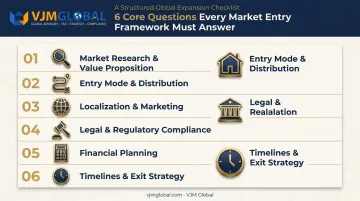
This mirrors the structure behind most consulting case-interview methodologies: market sizing, feasibility testing, and entry mode selection. It's the sequence that prevents costly mistakes.
5 Common International Market Entry Strategies (Plus a Modern Alternative)
Entry modes sit on a spectrum. Exporting sits at the low-control, low-risk end. Wholly-owned subsidiaries sit at the high-control, high-risk end. Where your company should land depends on goals, capital, and appetite for risk, not on whichever mode a competitor happened to choose.
Exporting
Exporting is the lowest-commitment way to test demand for physical goods abroad. There are two paths:
- Indirect exporting — An intermediary, such as an export management company, finds buyers, manages shipping, and handles payment. Lower resource commitment, less control.
- Direct exporting — The producer deals directly with foreign buyers, agents, or distributors, per the U.S. International Trade Administration. More control and closer buyer relationships, but it demands more time, staff, and management attention.
Best suited for companies validating demand before committing further capital.
Licensing and Franchising
Licensing grants a foreign partner rights to your IP or brand; franchising licenses your entire business model, including operations and marketing systems. Both allow faster entry with lower capital outlay than building from scratch.
McDonald's is the textbook case: with 95% of its restaurants franchised, the company expanded into dozens of markets while pushing most capital investment and day-to-day operating risk onto local franchisees.
Joint Ventures and Strategic Alliances
A joint venture pairs your company with a local partner to share cost, risk, and market knowledge. It's often the only viable path where foreign ownership rules restrict full control.
The trade-off is real: negotiating deal terms, aligning incentives, and managing cultural fit between two organizations is genuinely difficult. Misaligned partners frequently drag down performance well after launch.
Mergers and Acquisitions
M&A buys speed. Acquiring an established local company gives you an existing customer base, distribution network, and often regulatory licenses already in place, skipping years of market-building.
But speed comes with exposure. In Deloitte's 2024 cross-border M&A survey of more than 500 executives, executives flagged clear gaps heading into their next deal:
- 33% said they'd push for more comprehensive pre- and post-deal planning
- 31% wanted deeper research into target-market potential and culture before signing
Labor rules, antitrust review, and legal-entity complexity are common places where cross-border deals stall.
Wholly-Owned Subsidiaries
This mode gives maximum control and brand consistency, but it demands the highest capital commitment and the deepest regulatory obligation. Setting one up typically involves:
- Choosing an entity type and reserving a company name with the local registrar
- Drafting constitutional documents (Memorandum and Articles of Association)
- Filing for incorporation and obtaining a certificate of incorporation
- Registering for local tax identifiers, VAT/GST, and payroll tax
- Opening a corporate bank account and completing post-incorporation declarations
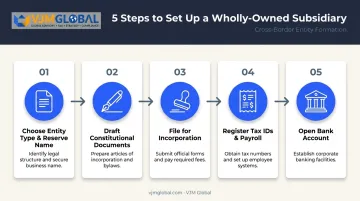
VJM Global handles this exact sequence for clients across markets like Singapore, Germany, Ghana, and the UAE, using each country's own registrar and tax authority rather than a templated, one-size-fits-all process.
Employer of Record (EOR): The Low-Risk Way to Test a Market
EOR has emerged as a practical sixth option. An Employer of Record becomes the legal employer of your staff in a target country, handling payroll, tax withholding, and statutory compliance, all without you incorporating a local entity.
This matters because entity formation often takes months. EOR lets a company hire and pay staff compliantly within days, test the market with a small local team, and only commit to a subsidiary once demand is proven. VJM Global's EOR coverage spans 100+ countries, giving companies a genuine bridge between "not in this market yet" and "fully incorporated."
| Entry Mode | Investment | Risk | Control | Speed | Best Fit |
|---|---|---|---|---|---|
| Exporting | Low | Low | Low | Fast | Testing demand for physical goods |
| Licensing/Franchising | Low-Medium | Medium | Low-Medium | Fast | Scaling a proven brand/model |
| Joint Venture | Medium | Medium-High | Shared | Medium | Regulated or partner-dependent markets |
| M&A | High | High | High | Fast (post-deal) | Immediate market access |
| Wholly-Owned Subsidiary | High | Medium-High | High | Slow | Long-term, brand-critical presence |
| Employer of Record | Low | Low | Medium | Very Fast | Market testing before incorporation |
Key Factors That Determine the Right Entry Strategy
There's no universal "best" entry mode. The right choice depends on a handful of variables that pull in different directions:
- Control and brand consistency needs: Regulated products (pharmaceuticals, financial services) and premium brands typically push companies toward higher-control modes, such as subsidiaries or tightly managed franchise agreements, since reputational risk from a bad local partner is too costly.
- Capital availability and risk tolerance: Low-commitment modes like exporting and licensing suit companies conserving cash or still validating demand, while M&A and subsidiaries suit companies with capital to deploy and a long-term commitment to the market.
- Regulatory complexity and speed requirements: Heavy foreign-ownership restrictions can force a joint venture regardless of preference. When speed matters more than control (for example, a competitor is already moving), EOR or exporting narrows the field fast.
- Existing distribution structures: Some markets have entrenched local distribution networks that are nearly impossible to replicate quickly. In those cases, licensing or M&A often beats building from zero.
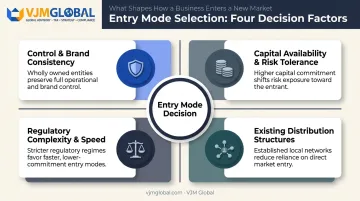
These variables often conflict, which is why many companies work through them with advisors familiar with local regulatory and entity-formation rules.
Step-by-Step Framework to Build Your Market Entry Plan
A phased, research-backed process reduces guesswork at every stage.
Appraise target markets. Research market size, growth potential, competitive saturation, and customer segments before shortlisting countries. McKinsey's outside-view approach recommends building a reference class of at least five prior entry decisions, including failures, before drawing conclusions.
Determine feasibility. Assess entry costs, available capital, internal capabilities, and regulatory barriers. Can the company realistically serve this market, or is it stretching resources too thin?
Study investment viability. Evaluate timing and seasonal factors, then weigh each entry mode's pros and cons against company goals and risk appetite.
Build the execution blueprint. Define phases (research, localization, legal compliance, distribution setup, launch), assign ownership, set KPIs, and build in buffer time for regulatory delays.
Timelines vary widely by jurisdiction:
| Jurisdiction | Registration Body | Formation Timeline |
|---|---|---|
| UK | Companies House | 24 hours online; 8–10 days by post |
| Dubai, UAE | DMCC | 10 working days, plus 2–3 days for e-license |
| Delaware, US | Division of Corporations | Same-day to one-hour (expedited, fee-based) |
These are formation timelines only. Statutory registrations, tax IDs, and bank account setup typically add several more weeks on top.
Common Risks and Compliance Challenges in Market Entry
Compliance risk is the part companies most often underestimate. Every target market has its own regulators, entity types, and filing calendar, and none of it defers to where your company happens to be headquartered.
The most common risk areas include:
- Entity registration delays from incomplete documentation or unfamiliar registrar requirements
- Statutory tax and payroll obligations that differ entirely by country: VAT/GST thresholds, withholding tax, and pension contributions all vary
- Currency fluctuations that erode margins for companies without a pricing or hedging strategy in place
- Cultural and communication missteps in contract negotiation, hiring, or marketing
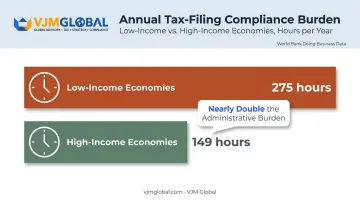
The scale of this burden is measurable. The World Bank's Doing Business 2020 report found that annual tax-filing compliance took an average of 275 hours in low-income economies versus 149 hours in high-income ones. That gap represents nearly double the administrative burden, depending purely on where you're operating.
VJM Global works inside this complexity directly, managing entity formation, tax registration, payroll, and audit compliance through each market's own regulator. A few examples:
- Singapore: ACRA and IRAS
- South Africa: CIPC and SARS
- Nigeria: CAC and FIRS
- Ghana: Registrar General's Department and GRA
That local grounding helps clients avoid the filing delays and tax missteps that commonly derail expansion in the first year.
Frequently Asked Questions
What are the five international market entry strategies?
The five classic modes are exporting, licensing/franchising, joint ventures, mergers and acquisitions, and wholly-owned subsidiaries. Employer of Record has since emerged as a widely used sixth option for low-risk market testing.
What is the framework for market entry strategy?
A four-stage process: market research and appraisal, feasibility assessment, investment viability study, and building an execution blueprint with clear milestones and contingencies.
How do I choose the right market entry strategy for my business?
It depends on capital availability, desired control, risk tolerance, speed to market, and local regulatory complexity. There's no single formula — the right mode balances all five factors against your goals.
Is Employer of Record a market entry strategy?
Yes. EOR lets companies hire and pay staff compliantly in a new country without incorporating a local entity, making it a practical, low-risk way to test demand before committing further.
How long does it take to execute an international market entry strategy?
It ranges from days for exporting or EOR to several months for subsidiary incorporation, especially where regulatory approval or foreign-ownership review is required.
What are common mistakes companies make when entering foreign markets?
Underestimating tax and compliance obligations tops the list, closely followed by skipping localization. Many also default to an entry mode that doesn't match their available capital or actual risk tolerance.