For US entrepreneurs and small business owners planning to operate in Minnesota, getting this right from the start matters. The formation steps determine your liability protection, how the IRS and Minnesota tax authorities classify your business, and whether you stay in good standing long-term. A missed detail — wrong address format, skipped renewal, no operating agreement — can unravel protections you counted on.
This guide walks through each step with accurate, verified information so you can file with confidence.
Key Takeaways
- State filing fee: $135 by mail or $155 online/in person
- Processing time: Online filings typically take 2–5 business days; mail filings are non-expedited with no guaranteed timeline
- Registered office: A physical Minnesota street address is required; a registered agent is optional
- Operating agreement is not filed with the state but governs your LLC internally and is often required by banks
- Annual renewal costs $0 and must be filed by December 31 each year; late filing triggers automatic dissolution
What Is a Minnesota LLC and Why Form One?
A Minnesota LLC is a business entity formed under Chapter 322C of the Minnesota Statutes — the Minnesota Revised Uniform Limited Liability Company Act. It's legally distinct from its members, which is the foundation of its core benefit: personal liability protection.
Under Section 322C.0304, a member is not personally liable for the LLC's debts, obligations, or liabilities simply by being a member.
How It Compares to Other Structures
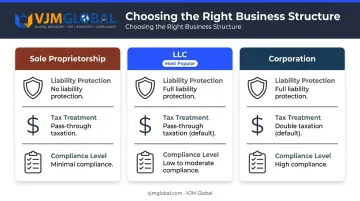
| Structure | Liability Protection | Tax Treatment | Compliance Complexity |
|---|---|---|---|
| Sole Proprietorship | None | Pass-through | Minimal |
| LLC | Yes | Pass-through (default) | Low to moderate |
| Corporation | Yes | Double taxation (C-Corp default) | High |
A sole proprietorship offers no separation between personal and business assets. A corporation provides protection but comes with strict formality requirements — board meetings, bylaws, and more complex tax treatment. For most small to mid-sized US businesses, that compliance overhead isn't worth the tradeoff — which is why the LLC is the most common structure chosen at formation.
That flexibility extends to taxes as well. By default, the IRS treats a single-member LLC as a disregarded entity and a multi-member LLC as a partnership — so profits flow directly to members' personal tax returns. This is a federal default, not a permanent election. LLCs can choose corporate tax treatment if the situation calls for it.
Chapter 322C also allows flexible management: member-managed, manager-managed, or board-managed structures are all permitted through the operating agreement.
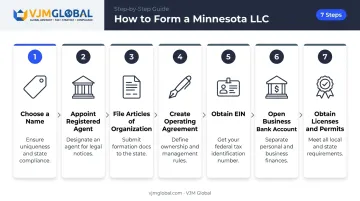
7 Steps to Form an LLC in Minnesota
Step 1: Choose a Name for Your Minnesota LLC
Your LLC name must meet specific requirements under Section 322C.0108:
- Must include "Limited Liability Company" or "LLC" (the dotted form "L.L.C." is not confirmed as an accepted variant in the statute)
- Cannot contain "corporation," "incorporated," or their abbreviations
- Must be distinguishable from existing registered entities, reserved names, and registered foreign entities on the Secretary of State's records
Before filing, check availability using the Minnesota Business Entity Search portal. This search is free and takes a few minutes.
If you want to secure a name while preparing your filing, you can reserve it for one year. Reservation fees: $35 by mail or $55 online/in person.
Step 2: Appoint a Registered Agent (and Designate a Registered Office)
Under Section 322C.0113, every domestic Minnesota LLC must continuously maintain a registered office. Appointing a registered agent is optional but is standard practice for most business owners.
What's required:
- A complete Minnesota street address or rural-route address (P.O. boxes are not acceptable on their own)
- The registered office must be maintained continuously (if it lapses, you're non-compliant)
Your options:
- Use your own address : acceptable if it's a valid Minnesota street address
- Use a commercial registered agent service : costs typically range from $125 to $249/year based on providers like Northwest Registered Agent ($125) and LegalZoom ($249)
Most business owners choose a commercial service for one reason: privacy. Your registered office address becomes public record, so a service address keeps your home or personal office out of the filing.
Step 3: File the Articles of Organization
The Articles of Organization is the official document that creates your LLC. Filed with the Minnesota Secretary of State, it requires:
- LLC name
- Minnesota registered office address
- Registered agent name (only if you're appointing one)
- At least one organizer's name, address, signature, and signing date
- Optional fields: contact/email, Minnesota Business Snapshot
Filing options:
| Method | Fee | Processing |
|---|---|---|
| Online | $155 | Typically 2–5 business days |
| By mail | $135 | Non-expedited, first come, first served |
File online at the Minnesota Secretary of State's Business Filings portal. An online account is required. The mail option is cheaper but carries no stated completion timeline , so factor that into your timeline before choosing it.
Step 4: Create an Operating Agreement
Once your Articles are filed, your next priority is the operating agreement — the internal document that actually governs how your LLC runs.
Minnesota does not require an operating agreement to be filed with the state. Under Section 322C.0110, it's the governing document for everything internal: member relations, management structure, profit distribution, and how amendments get made.
Why you should have one regardless:
- Banks commonly request formation documents and ownership agreements when opening a business account
- Courts look to the operating agreement when member disputes arise
- Single-member LLCs benefit from the written record , since it reinforces the LLC's status as a separate legal entity
Keep it as an internal document. Update it when ownership or management changes.
Step 5: Obtain an EIN (and Minnesota Tax ID if Required)
An Employer Identification Number (EIN) is issued free by the IRS. Apply at IRS.gov — issuance takes minutes. Note: The application session expires after 15 minutes of inactivity, so complete it in one sitting.
When you need an EIN:
- You have employees
- You're required to file excise taxes
- A bank requires one to open a business account
A single-member LLC with no employees and no excise-tax obligations does not legally require an EIN. That said, obtaining one lets you avoid using your Social Security Number for business purposes , which most owners prefer.
Minnesota Tax ID
Not every LLC needs one. You'll need a Minnesota Tax ID if your LLC:
- Makes taxable Minnesota sales or provides taxable services
- Has employees subject to Minnesota withholding
- Files certain Minnesota business returns
Register at the Minnesota Department of Revenue.
Step 6: Open a Business Bank Account
Mixing business and personal finances undermines your LLC's liability protection. Commingling funds is one of the fastest ways to expose yourself to personal liability, so open a dedicated business account as soon as your LLC is formed.
What banks typically request:
- EIN (or SSN if applicable)
- Government-issued ID
- Articles of Organization or state-issued Certificate of Organization
- Operating agreement
- Any applicable business license
Requirements vary by institution. Some banks require an in-person branch visit; others offer fully online business accounts with no minimum balance. It's worth researching your options before filing. Some entrepreneurs confirm bank requirements before formation is complete, which prevents delays later.
Step 7: Obtain Required Licenses and Permits
Minnesota does not have a single statewide general business license. What you need depends on your business activity and location.
Common license and permit triggers:
- Food service or restaurant operations
- Construction or contractor work
- Retail sales (requires Sales and Use Tax registration)
- Professional services (healthcare, real estate, childcare)
Use the Minnesota DEED licensing and permits page and the License Minnesota search tool to identify what applies to your LLC.
Sales tax: If your LLC sells taxable goods or services in Minnesota, register for a Minnesota Sales and Use Tax account through the Department of Revenue before your first taxable sale. Local county and city requirements are separate , so check those independently.
Minnesota LLC Formation Costs and Timeline
Cost Breakdown
| Item | Cost |
|---|---|
| Name reservation (optional) | $35 mail / $55 online |
| Articles of Organization | $135 mail / $155 online |
| Registered agent service (optional, annual) | $125–$249/year (typical range) |
| EIN application | Free (IRS.gov) |
| Annual renewal | $0 (due December 31) |
Processing Timeline
- Online filings: Typically processed within 2–5 business days
- Mail filings: Non-expedited, no stated completion time — build in extra lead time
If your LLC misses the December 31 annual renewal, it faces statutory dissolution. Reinstatement requires a current annual filing, an available business name, and a reinstatement fee. The Secretary of State's fee schedule shows conflicting figures across pages — verify the current amount directly at sos.mn.gov before filing.
Tax Obligations
Pass-through taxation is the default for most LLCs. Members report their share of profits on personal returns and pay Minnesota individual income tax at graduated rates based on income level:
- 5.35% — lowest bracket
- 6.80% — second bracket
- 7.85% — third bracket
- 9.85% — highest bracket
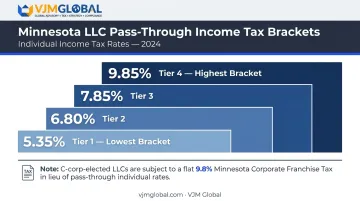
LLCs electing C-corporation treatment are subject to Minnesota's corporate franchise tax at a flat 9.8% rate.
Post-Formation Requirements for Your Minnesota LLC
Forming the LLC is just the beginning — ongoing compliance keeps it in good standing.
Annual renewal: File by December 31 each year. The cost is $0. Missing the deadline triggers administrative termination — your LLC loses good standing and legal protections until reinstated. Mark your calendar in October to avoid a last-minute scramble.
Ongoing compliance tasks:
- Keep your registered office address current (changes cost $35 by mail / $55 online)
- Update the operating agreement when membership or management changes
- File Articles of Amendment for any structural changes to the LLC
- Maintain strict separation between business and personal finances
- File applicable state and federal tax returns based on your LLC's tax classification
If your LLC has US-India cross-border activity, tax compliance gets more complex. VJM Global supports international business owners with bookkeeping outsourcing, US tax filing, and cloud accounting through QuickBooks and Xero — all delivered remotely.
Common Mistakes to Avoid When Forming a Minnesota LLC
Name conflicts: Submitting Articles with a name already registered or insufficiently distinguishable from an existing entity results in rejection. Always search the Secretary of State database before filing.
Address errors: A P.O. box alone is not acceptable for the registered office. The address must be a complete Minnesota street address. A personal home address is compliant, but it becomes public record — consider a commercial registered agent service if you'd rather keep it private.
Skipping the operating agreement: Banks commonly request ownership agreements before opening a business account. Without one, you may face delays or outright refusals. Courts also use it to evaluate governance disputes, and its absence leaves critical questions unanswered.
Missing the annual renewal: This one catches owners off guard because the filing is free. The $0 cost makes it easy to overlook, but missing the December 31 deadline means dissolution. Reinstatement requires a separate filing, a reinstatement fee, and additional processing time — all avoidable with one calendar reminder set each year.
Frequently Asked Questions
How much does it cost to set up an LLC in Minnesota?
The state filing fee is $135 by mail or $155 online. Optional costs include registered agent services ($125–$249/year), and an EIN is free through the IRS. Name reservation adds $35 by mail or $55 online if needed.
How long does it take to get an LLC approved in Minnesota?
Online filings are typically processed within 2–5 business days. Mail filings are non-expedited with no guaranteed timeline — plan for several weeks when accounting for transit time.
Do I need a registered agent for my Minnesota LLC?
A registered agent is optional under Chapter 322C, but a registered office with a valid Minnesota street address is required. Most owners use a commercial registered agent service for convenience and to keep their personal address off the public record.
What is an LLC Operating Agreement and is it required in Minnesota?
An Operating Agreement isn't filed with the state, but it serves as your LLC's internal governing document — covering ownership, management, and profit distribution. Banks often request it to open accounts, and it strengthens your liability protection.
Does a Minnesota LLC need an EIN?
Not always — a single-member LLC with no employees and no excise-tax obligations can operate without one. Most owners get one anyway to avoid using a personal Social Security Number for business purposes and to satisfy bank requirements — it's free and takes minutes at IRS.gov.
What are the ongoing requirements after forming a Minnesota LLC?
Core ongoing requirements include:
- File the $0 annual renewal with the Secretary of State by December 31 each year
- Maintain a current registered office address on file
- File state and federal taxes based on your LLC's tax classification
- Keep business and personal finances separate at all times