Bangladesh sits right next door and offers real advantages for Indian textile players, sourcing agents and service exporters. But before any of that market potential matters, you need the right legal entity. Entity structure is usually the first decision Indian businesses face, and getting it wrong means costly restructuring later.
This guide breaks down what an OPC actually is, whether Indian nationals or companies can realistically register one, the step-by-step process, the costs involved, and the practical alternative that most Indian entrepreneurs end up using instead.
Key Takeaways
- OPC is a single-shareholder structure under the Companies Act 1994 (amended 2020), regulated by the RJSC
- A practical NID-based barrier blocks most Indian entrepreneurs from registering an OPC as foreign nationals
- Private limited companies with foreign shareholding remain fully open to Indian investors
- Paid-up capital of BDT 25 lakh to 5 crore and a mandatory nominee apply to every OPC
- TIN, trade licence and VAT/BIN registration apply to both structures after incorporation
What Is a One Person Company (OPC) in Bangladesh?
Under Section 2 of the Companies Act 1994, as amended by the Companies (Second Amendment) Act 2020, an OPC is a company owned by exactly one natural person, who also serves as its sole director. The Companies (Second Amendment) Act 2020 came into force on 26 November 2020, formally creating this category for the first time in Bangladeshi law.
An OPC gives a solo founder limited liability and a separate legal identity, benefits previously reserved for companies with two or more shareholders. Before this amendment, a single entrepreneur in Bangladesh had only one real option: a sole proprietorship, which offers no liability protection at all.
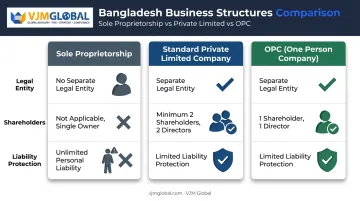
How an OPC differs from other structures:
- Sole proprietorship — no separate legal entity, owner bears unlimited personal liability for business debts
- Standard private limited company — requires a minimum of two shareholders and two directors
- OPC — one shareholder and one director, with the legal protections of a company
The Nominee Requirement
Every OPC must name a nominee at incorporation. If the sole shareholder dies or becomes incapable of managing the company, the nominee automatically becomes the shareholder. That succession keeps the business running instead of freezing ownership.
RJSC began accepting OPC registrations on 23 May 2021. The company name must end with "OPC" or "One Person Company"; the registrar enforces this suffix at registration.
Can Indian Businesses Actually Register an OPC in Bangladesh?
This is the question most generic guides skip entirely, and it's the one that matters most if you're an Indian entrepreneur weighing your options.
The legal text itself doesn't ban foreigners. Bangladesh's OPC law refers only to "one natural person" as shareholder. It does not say "Bangladeshi citizen." That's actually a looser standard than India's own OPC rules, which explicitly restrict eligibility to resident Indian citizens only.
So on paper, an Indian individual isn't legally excluded. In practice, though, a documentation problem gets in the way.
The NID Barrier
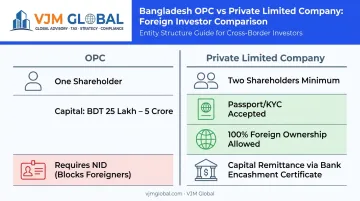
RJSC's prescribed forms under Schedule 9A require a National ID (NID) card for the shareholder and nominee. NIDs are issued only to Bangladeshi citizens. A passport number is not accepted as a substitute at the registration stage.
The Business Standard's analysis of Bangladesh OPCs highlights the conflict between the Act's broad "natural person" language and the narrower NID-based paperwork RJSC actually enforces. Foreign investors cannot practically incorporate an OPC even though the statute doesn't explicitly forbid it.
Share transfer rules tell a different story. They accommodate foreign nominees or transferees when the transfer deed and supporting affidavit are attested by an authorised embassy officer. The law clearly anticipates foreign involvement after incorporation—it just doesn't build a path for foreigners at incorporation.
What this means for your planning:
- An Indian company can never be an OPC shareholder — it's not a natural person, full stop
- An Indian individual is not expressly barred by statute, but RJSC's NID requirement makes registration impractical
- Treat OPC as effectively unavailable for initial registration and plan around a private limited company instead
How to Register an OPC in Bangladesh: Step-by-Step Process
OPC is not a realistic route for most Indian founders. The process still matters if you structure a joint venture with a Bangladeshi national as sole shareholder, and it shows exactly where foreign ownership is blocked.
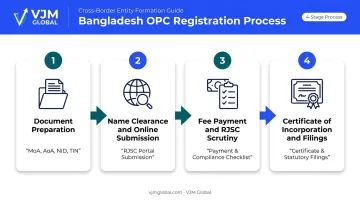
At a high level, registration covers:
- Document preparation
- Name clearance with unified online submission via the RJSC portal
- Fee payment and RJSC scrutiny
- Certificate issuance
This path applies primarily to Bangladeshi nationals. Indian businesses use an analogous but distinct private limited company process, covered later in this guide.
Step 1: Document Preparation
Before submission, you'll need to assemble:
- Memorandum of Association (MoA) and Articles of Association (AoA)
- Form IX (director's consent)
- Subscriber Page and Form I
- NID and TIN of both the shareholder and nominee
- Photographs of the shareholder and nominee
Step 2: Name Clearance and Online Submission
The proposed name must end in "OPC" or "One Person Company." Name clearance and full document submission happen together in one unified RJSC application, not as two separate stages.
Step 3: Fee Payment and RJSC Scrutiny
Registration fees scale with authorised capital and are paid through RJSC's online payment channels. Once payment clears, RJSC scrutinises the application for name availability and document compliance, and may request corrections before proceeding.
Step 4: Certificate of Incorporation and Immediate Filings
On approval, RJSC issues a digitally signed Certificate of Incorporation, plus the certified MoA/AoA and Form XII. The company must then apply for an e-TIN, a trade licence, and VAT/BIN registration where applicable. These are the same post-incorporation filings that apply to any Bangladeshi company.
Costs, Capital Requirements and Compliance Obligations
An OPC in Bangladesh operates within defined capital and turnover bands set by the 2020 amendment:
| Requirement | Threshold |
|---|---|
| Paid-up capital | BDT 25 lakh minimum, BDT 5 crore maximum |
| Annual turnover | BDT 1 crore minimum, BDT 50 crore maximum |
| Financial statement filing | Within 180 days of financial year-end |
RJSC registration fees and stamp duty are tied to authorised capital, and the schedule is revised periodically. Confirm the current slab on the RJSC portal before you budget; published figures go stale quickly.
Financial statements, signed by the director, must reach the Registrar within 180 days of year-end. Miss that window and you risk penalties plus complications at the next filing cycle.
Bangladesh's corporate tax rate for OPCs has shifted across recent budgets. The National Board of Revenue (NBR) sets the applicable rate through the annual Finance Act, so verify the current rate with NBR before finalising any cost projection.
The Practical Alternative for Indian Investors: Private Limited Company Formation in Bangladesh
Since OPC isn't a workable path, most Indian entrepreneurs and companies entering Bangladesh register a private limited company with 100% foreign shareholding instead. This is the standard, RJSC-sanctioned route, and it comes with no NID barrier.
A Bangladeshi private limited company needs:
- A minimum of two shareholders (individuals or corporate entities)
- A minimum of two directors, who must be natural persons
- Passport copies and standard KYC documents for foreign shareholders, in place of an NID
Structural guidance from OGR Legal confirms this format supports up to 50 shareholders and full foreign ownership in most sectors. That makes it a natural fit for an Indian parent company or a pair of Indian founders.
The Capital Remittance Step
Foreign shareholders face one requirement Bangladeshi founders do not. Before RJSC completes registration, you must:
- Open a Bangladeshi bank account in the proposed company's name
- Remit the share capital from abroad through proper banking channels
- Obtain a Bank Encashment Certificate
That certificate proves the foreign capital arrived and was converted into local currency. RJSC will not complete registration without it.
Lighter-Footprint Options
If full incorporation feels premature, Indian businesses can seek Bangladesh Investment Development Authority (BIDA) approval for a lighter presence:
- Liaison Office: Market research and coordination only; no revenue-generating activity
- Branch Office: Can invoice locally within its approved scope
Neither creates a separate legal entity the way a private limited company does.
Choosing among a private limited company, branch, or liaison office—and lining up the right documents for each—is easier with cross-border formation experience. VJM Global helps Indian businesses pick the right Bangladesh structure, handle entity formation and tax setup, and stay compliant after the entity is live.
Confirm the structure before you file. Assuming OPC eligibility and hitting the NID barrier mid-registration costs months of delay and a full restart under a different entity type.
Frequently Asked Questions
What are the requirements for registering a One Person Company (OPC) in Bangladesh?
You need one natural person as sole shareholder, a mandatory nominee, an MoA and AoA, and NID/TIN papers for both parties. Paid-up capital must sit between BDT 25 lakh and BDT 5 crore.
Can a single person register a private limited (PVT Ltd) company in Bangladesh?
No. A private limited company requires a minimum of two shareholders and two directors. A genuinely single-person entity must use the OPC route or bring in a second nominal shareholder.
How much does it cost to register a one person company in Bangladesh?
Budget for RJSC registration fees and stamp duty based on authorised capital, plus any professional advisory fees. Check current RJSC fee slabs before you finalise numbers—they are revised from time to time.
Can a foreigner or Indian national register an OPC in Bangladesh?
No. RJSC forms require a Bangladeshi NID, which Indian nationals do not hold, and passports are not accepted instead. Use a private limited company with foreign shareholding.
What is the minimum capital required for an OPC in Bangladesh?
Paid-up capital must be at least BDT 25 lakh, with a ceiling of BDT 5 crore. Annual turnover must also fall between BDT 1 crore and BDT 50 crore.
How long does OPC registration take in Bangladesh?
After name approval and a complete filing, RJSC scrutiny and certificate issuance depend mainly on document accuracy. Clean files move faster; correction rounds add time whenever RJSC raises queries.