This guide is written for Indian companies, exporters, and individual promoters evaluating Bangladesh's RJSC registration process. Getting the capital rules, FEMA/RBI compliance, and RJSC procedure right before you commit capital across the border matters more than most guides admit.
Here's the trap: Indian investors often assume Bangladesh's headline "BDT 1 minimum capital" rule applies to them. In practice, foreign-owned entities face a different set of requirements that most Bangladesh-focused guides never explain from the Indian investor's side.
This article covers what a Bangladesh Pvt Ltd actually is, the step-by-step registration process from India, capital and document requirements, post-registration compliance on both sides of the border, and the mistakes that trip up Indian promoters most often.
TL;DR
- Indian investors can own 100% of a Bangladesh Private Limited Company in most sectors; remit paid-up capital (commonly ~USD 50,000) via proper banking channels to unlock work permits
- Registration runs through the Registrar of Joint Stock Companies and Firms (RJSC) and typically takes several weeks for foreign-owned entities
- Indian companies must also meet RBI's Overseas Investment (ODI) framework, in addition to Bangladesh's RJSC process, not instead of it
- Post-incorporation, you'll need a Trade License, TIN, and VAT/BIN registration before you can legally invoice in Bangladesh
- The India-Bangladesh DTAA reduces withholding tax on dividends, interest, and royalties when repatriating profits
What Is a Private Limited Company in Bangladesh?
Under the Companies Act 1994, a Private Limited Company in Bangladesh is a separate legal entity with limited shareholder liability, restricted share transfer rights, and between 2 and 50 shareholders. It cannot invite the public to subscribe for shares.
This structure lets a business operate fully in Bangladesh: signing contracts, hiring staff, and earning revenue directly, rather than merely representing a foreign parent.
Indian companies often weigh two other entry routes:
- Liaison Office: cannot earn any local income; purely representative
- Branch Office: can earn revenue, but only within the parent company's approved existing business scope
For most Indian promoters, the Private Limited Company is the practical default. Choose a liaison or branch office only if you need a representative presence or must stay within the parent's existing approved scope.
Why Indian Businesses Choose Bangladesh for Expansion
Indian promoters expand into Bangladesh for practical reasons:
- A shared land border that keeps logistics and travel simple
- Deep, established garment and RMG sourcing relationships
- Manufacturing labour costs that remain lower than India's in several sectors
Indian FDI stock in Bangladesh stood at USD 922.92 million as of December 2025, with a net inflow of USD 88.10 million during that calendar year, according to Bangladesh Bank's FDI survey. That is a meaningful footprint, and it is still growing.
What Local Incorporation Solves That Exporting Doesn't
A Bangladesh entity offers advantages pure exporting from India cannot:
- A physical manufacturing presence near your sourcing partners
- EPZ/EZ incentives, where applicable (tax holiday terms have shifted recently—verify current rules before you rely on them)
- Duty-free access to certain export markets under Bangladesh's LDC trade preferences
These are commercial choices, not regulatory requirements. If your Bangladesh footprint is limited to occasional sourcing, a distributor relationship or direct export may be simpler than incorporating a company at all.
How to Register a Private Limited Company in Bangladesh from India: Step-by-Step
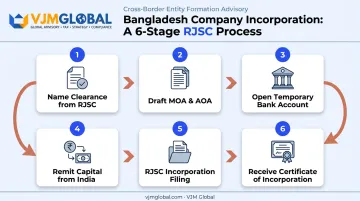
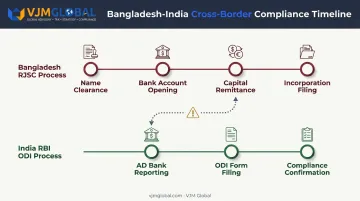
The end-to-end flow moves through six stages:
- Name clearance from the Registrar of Joint Stock Companies and Firms (RJSC)
- Drafting constitutional documents
- Opening a temporary bank account
- Remitting capital from India
- RJSC incorporation filing
- Receiving the Certificate of Incorporation
Here's the part most Bangladesh-side guides skip entirely: capital remitted from an Indian entity must also satisfy India's outbound investment rules under RBI's Overseas Investment framework. This isn't optional paperwork you handle later. It typically needs to run alongside, or ahead of, the Bangladesh-side remittance.
Each stage changes your legal standing. You start with an unregistered proposed name and end with a fully incorporated, tax-registered entity that can open permanent bank accounts and hire staff.
Step 1: Obtain Name Clearance from RJSC
Submit your proposed company name online through RJSC for approval before anything else moves forward. RJSC publishes name-clearance fee schedules on the RJSC fee portal. Figures reported across sources vary, so confirm the live fee at the time of filing rather than relying on a fixed number.
Step 2: Draft the Memorandum and Articles of Association
Indian promoters, along with any local co-shareholders, sign two founding documents:
- Memorandum of Association (MOA): sets out objectives and capital structure
- Articles of Association (AOA): governs internal rules
Bangladesh law requires a minimum of 2 directors and 2-50 shareholders, so structure your cap table with that in mind before drafting.
Step 3: Open a Temporary Bank Account and Remit Capital from India
Once the name clearance certificate is in hand, open a temporary bank account in Bangladesh. The Indian shareholder then remits the subscribed paid-up capital through proper banking channels.
This is where the RBI ODI compliance step on the Indian side needs to run in parallel. The remittance itself is subject to India's outbound investment reporting requirements, covered in detail below.
Step 4: Obtain the Encashment Certificate
Once the Bangladeshi bank credits and converts the remitted funds, it issues an encashment certificate. This document proves the investment actually landed and converted, and RJSC requires it for incorporation filing.
Step 5: File Incorporation Documents with RJSC
Submit the complete document set:
- MOA and AOA
- Forms IX, X, and XII
- Encashment certificate
- Power of attorney (where a representative files on your behalf)
RJSC reviews the filing and issues the Certificate of Incorporation once satisfied.
Step 6: Complete Post-Incorporation Registrations
Incorporation alone doesn't authorise you to trade. Before commercial operations begin, obtain:
- TIN (Tax Identification Number)
- Trade License from the relevant local authority
- VAT/BIN registration
- BIDA registration, where your activity requires it (not needed for pure trading operations)
Capital, Documents & Costs Indian Investors Must Prepare
There's no statutory minimum paid-up capital written into Bangladeshi law for a foreign-owned private company. In practice, a figure around USD 50,000 shows up repeatedly. BIDA typically expects an encashment certificate reflecting at least this amount for foreign-owned companies seeking work permits or hiring benefits for expatriate staff.
Always verify the current figure with RJSC or BIDA before filing. Advisory benchmarks shift, and relying on outdated numbers is a common, avoidable mistake.
Documents Required from the Indian Side
- Passport copies of Indian directors and shareholders
- Board resolution from the Indian parent company (if incorporating as a subsidiary)
- Proof of address for each Indian promoter
Cost Components to Budget For
RJSC's published fee schedule includes several line items tied to authorised capital:
| Item | Typical Cost Basis |
|---|---|
| Name clearance | Government fee (verify current rate) |
| MOA stamp duty | Fixed fee tier |
| AOA stamp duty | Scales with authorised capital |
| Incorporation document filing | Fixed fee for the document set |
| Authorised capital registration fee | Scales per BDT 100,000 above BDT 1 million |
Add professional fees for a foreign-owned entity on top of statutory charges. These vary by advisor and scope.
Realistic Timelines
Expect several weeks, not days, for a foreign-owned entity. Bank encashment certificate turnaround and RJSC processing both add time that domestic Bangladeshi incorporations don't face. This runs noticeably slower than India's own incorporation timeline, where domestic private companies often complete registration within roughly two weeks.
The RBI Side Most Investors Underestimate
The Indian remitting entity carries a separate compliance obligation under RBI's Overseas Investment framework. Reporting to the Authorised Dealer (AD) bank must happen before or alongside the outward remittance, not after the fact.
Sequencing across both jurisdictions is where delays usually start. VJM Global handles FEMA and FDI advisory for Indian entities investing abroad, including ODI reporting, so the RBI filing can line up with the Bangladesh-side remittance timeline and one side does not stall the other.
Post-Registration Compliance and Common Mistakes Indian Investors Make
Incorporation only gets the entity on the register. Ongoing compliance runs on both sides of the border, and missing either side creates real exposure.
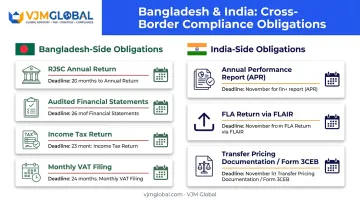
Bangladesh-Side Obligations
- RJSC annual return filing after the AGM
- Audited financial statements and profit-and-loss accounts
- Income tax return (company tax day generally falls on the 15th day of the seventh month after year-end)
- Monthly VAT filings, due by the 15th of the following month
India-Side Obligations Investors Often Miss
- Annual Performance Report (APR) for the ODI, filed with RBI, normally due by 31 December
- FLA return through RBI's FLAIR system, typically due by 15 July
- Transfer pricing documentation for transactions between the Indian parent and Bangladesh subsidiary, including Form 3CEB where applicable
Claiming the DTAA Benefit
Reduced withholding on dividends, interest, and royalties repatriated from Bangladesh isn't automatic. Treaty rates cap dividend withholding at 10% for qualifying corporate shareholders holding at least 10% of capital, and 10% on interest and royalties, per the India-Bangladesh tax treaty text.
To claim it, you need a Tax Residency Certificate and the prescribed supplementary filing on the Indian side. Skip this step, and the deductor withholds tax at the full domestic rate. Many investors simply overpay because they never obtain the certificate in time.
Two Mistakes to Avoid
- Assuming LDC trade preferences last indefinitely. Bangladesh's LDC graduation is currently scheduled around 2026, with a proposed extension to 2029 still pending final UN approval. Don't build a permanent sourcing strategy on preferences that carry an expiry date.
- Treating RJSC and RBI filings as sequential, unrelated tasks. Most delays Indian promoters hit come from poor coordination between Bangladesh incorporation and India-side FEMA/ODI reporting, not from either process being hard on its own. A firm experienced in both jurisdictions, such as VJM Global, helps get the dual filing calendar right from day one.
Frequently Asked Questions
How to set up a private limited company in Bangladesh?
Secure name clearance from RJSC, draft the MOA and AOA, open a temporary bank account, remit paid-up capital, obtain an encashment certificate, and file incorporation documents with RJSC. See the step-by-step section above for full detail.
What is a private limited company in Bangladesh?
It's a separate legal entity under the Companies Act 1994, with limited shareholder liability and between 2 and 50 shareholders. It cannot raise capital from the public.
Can an Indian company or individual own 100% of a Bangladesh Private Limited Company?
Yes, 100% foreign ownership is permitted in most sectors. It's subject to proper capital remittance through banking channels and BIDA registration where your business activity requires it.
Does an Indian company need RBI approval to invest in a Bangladesh company?
Most outbound investments do not need prior RBI approval; they fall under RBI's Overseas Investment framework and must be reported through an Authorised Dealer bank, generally before or alongside the outward remittance.
How long does it take to register a private limited company in Bangladesh from India?
Plan for roughly 3–6 weeks for a foreign-owned entity. Bank encashment certificate turnaround and RJSC processing are the main factors that extend the timeline.
What is the minimum capital required for Indian-owned companies in Bangladesh?
There's no statutory legal minimum, but a practical threshold around USD 50,000 commonly applies for foreign-owned companies seeking work permit and hiring benefits. Confirm the current figure with RJSC or BIDA before filing.