Introduction
India's growing economy attracts UK investors, but registering a Private Limited Company there involves more than most international guides acknowledge. The UK ranks 6th among FDI source countries in India, with cumulative equity inflows of USD 34.81 billion as of December 2023 — and India's FDI policy fully allows foreign nationals to participate as shareholders and directors.
The incorporation process is fully digital through the Ministry of Corporate Affairs (MCA) portal. However, UK investors face requirements that standard guides — written for Indian entrepreneurs — rarely cover: foreign national documentation, FEMA compliance, and director residency rules that can create unexpected delays.
With bilateral UK-India trade reaching GBP 43 billion in 2024 and the UK-India Comprehensive Economic and Trade Agreement (CETA) before Parliament, the regulatory environment is shifting in investors' favour. This guide walks through every step of the registration process — from eligibility and documentation to post-incorporation compliance — specifically for UK nationals.
Key Takeaways
- A Private Limited Company in India allows UK investors to hold foreign equity, hire staff, and operate as a distinct legal entity governed by the Companies Act, 2013
- Most sectors permit 100% FDI under the automatic route, requiring no prior government approval for UK investors
- Registration requires a DSC, DIN, SPICe+ form filing, and apostilled documents — the full process takes 10–15 working days
- At least one director must have resided in India for 182+ days in the prior financial year
- Post-registration obligations cover ROC filings, RBI reporting, GST registration, and corporate tax compliance
Why UK Investors Are Setting Up Private Limited Companies in India
India presents compelling opportunities for UK investors in scale and sector diversity. The UK is the 6th largest source of FDI into India, accounting for 5.22% of total foreign equity inflows, with cumulative investment of USD 34.81 billion from January 2000 to December 2023. UK capital has concentrated in chemicals (17% of UK FDI), services (15%), pharmaceuticals (13%), and food processing (9%).
The bilateral trade relationship continues to strengthen. Total UK-India trade reached GBP 43 billion in 2024, and the UK-India CETA—described by Parliament's Business and Trade Committee as the UK's biggest bilateral trade deal since Brexit—projects an additional GBP 25.5 billion in annual trade and up to GBP 3.2 billion in long-term duty savings for UK exporters.
Why the Private Limited Company structure?
UK investors typically evaluate four business structures when entering India:
| Structure | What It Allows | Key Limitation |
|---|---|---|
| Liaison Office | Communication and market research only | No revenue-generating activities |
| Branch Office | Exporting, importing, consultancy | Requires RBI approval; ongoing FEMA compliance |
| LLP | Professional services, partnerships | Harder to raise equity capital |
| Private Limited Company | Full commercial operations | Most compliance requirements, but greatest flexibility |

For most UK investors pursuing full commercial operations, the Private Limited Company is the clear frontrunner. Having supported 250+ UK businesses through India entry, VJM Global consistently sees the same reasons driving that choice:
- Shareholders' personal assets stay separate from company liabilities
- Shares can be issued to investors — an option LLPs don't provide
- Dividends can be repatriated to foreign shareholders under FEMA guidelines
- The structure carries recognised credibility with Indian banks, partners, and regulators
Functional comparison to UK Ltd
Both Indian and UK Private Limited Companies share core characteristics—separate legal identity, limited liability, and restrictions on public share trading. However, governance differs:
- Indian companies file with the Registrar of Companies (ROC) via the MCA portal, while UK companies use Companies House
- At least one director must meet India's 182-day residency requirement
- Annual compliance includes both ROC filings and RBI reporting for foreign-invested companies
- Corporate tax rates sit at 22–25% for domestic companies, with mandatory arm's-length pricing for intra-group transactions under India's transfer pricing rules
What UK Investors Must Know Before Registering: Eligibility and FDI Rules
FDI Policy Framework
UK nationals can register and hold shares in an Indian Private Limited Company under the Foreign Direct Investment policy governed by the Foreign Exchange Management Act (FEMA), 1999 and administered by the Reserve Bank of India.
Two routes exist:
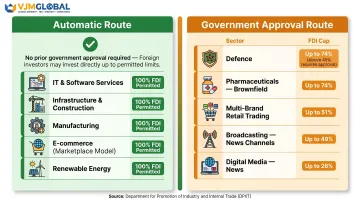
Automatic Route: Most sectors permit 100% FDI under this route — no pre-clearance from the Government of India or RBI is required.
Government Approval Route: Mandatory for specific sectors where FDI caps or sensitivity thresholds apply:
| Sector | FDI Cap | Approval Trigger |
|---|---|---|
| Defence | 100% | Beyond 74% |
| Pharmaceuticals (Brownfield) | 100% | Beyond 74% |
| Multi-Brand Retail | 51% | Up to 51% |
| Broadcasting (News & Current Affairs) | 49% | Up to 49% |
| Digital Media (News) | 26% | Up to 26% |
Prohibited sectors include lottery, gambling, chit funds, real estate business (excluding permitted categories), manufacturing of tobacco products, and atomic energy not open to the private sector.
UK investors should verify their intended business activity against the DPIIT Consolidated FDI Policy to confirm eligibility and applicable FDI caps.
Structural Requirements
Minimum incorporation requirements:
- 2 directors minimum (maximum 15, extendable by special resolution)
- 2 shareholders minimum (maximum 200)
- At least one director must be a resident of India—defined under Section 149(3) of the Companies Act, 2013 as having stayed in India for a minimum of 182 days during the preceding financial year
- No minimum paid-up capital (earlier requirement of ₹1 lakh was removed)
The residency rule presents a practical challenge for UK investors. Most UK investors resolve this through one of three approaches:
- Appointing an Indian resident as director
- Engaging a professional nominee director service (VJM Global provides compliant nominee director solutions)
- Having one UK director relocate to India for at least 182 days
Foreign National Director Requirements
Once the residency requirement is met, a UK investor can serve as both shareholder and director. That role requires the following documentation:
- Valid passport as primary identity document (Aadhaar is not applicable to foreign nationals)
- Director Identification Number (DIN) obtained during incorporation
- Indian PAN card obtained after incorporation (not required at the DIN application stage)
- Apostilled copies of all personal documents
FEMA Compliance at Equity Infusion
Once funds are received from a UK investor, three compliance steps must be completed in sequence:
- Allot shares within 60 days of receiving foreign investment
- Obtain a valuation certificate before filing
- File Form FC-GPR within 30 days of allotment via the FIRMS (Foreign Investment Reporting and Management System) portal
This is the most commonly missed step among first-time foreign investors. Missing the 30-day window constitutes a FEMA violation subject to compounding penalties. VJM Global consistently sees this as the most common post-incorporation error among UK clients — remediation typically requires RBI compounding proceedings.
Step-by-Step: How to Register a Pvt Ltd Company as a UK Investor
The entire incorporation process is digital and managed through the MCA portal at mca.gov.in. UK investors can complete most steps remotely, though original documents must be apostilled in the UK and submitted digitally or couriered to India. The typical end-to-end timeline is 10–15 working days under normal processing conditions.
Step 1: Obtain a Digital Signature Certificate (DSC)
A Class 3 DSC is mandatory for all directors to digitally sign incorporation forms and subsequent MCA filings. Class 2 DSCs were discontinued in 2021.
For UK-based directors:
- DSC is issued by government-approved Indian Certifying Authorities licensed by the Controller of Certifying Authorities under the Information Technology Act, 2000
- Requires valid passport, address proof, and recent photograph
- Video-based verification (Video KYC) became mandatory in July 2024, allowing foreign nationals to complete identity verification remotely from the UK
- Typical turnaround: 2–3 business days once documents are submitted
VJM Global works with approved certifying authorities to streamline DSC issuance for UK directors, ensuring all verification requirements are met without the need for travel to India.
Step 2: Apply for a Director Identification Number (DIN)
DIN is a unique lifetime identifier for company directors in India. For new companies, DIN for up to three directors is applied for within the SPICe+ form itself.
For UK nationals:
- Identity proof (passport) and address proof must be apostilled by the UK Foreign, Commonwealth & Development Office before submission
- Processing: 1 day after SPICe+ form acceptance
- Existing DIN holders do not need to re-apply
Step 3: Reserve the Company Name
Company name reservation is done through SPICe+ Part A on the MCA portal. Processing typically takes 3–5 days. Once approved, the name is reserved for 20 days — SPICe+ Part B must be filed within that window to proceed to incorporation.
Name approval requirements:
- Must comply with the Companies (Incorporation) Rules, 2014
- Cannot resemble existing registered company names or trademarks
- Cannot contain prohibited words or suggest government affiliation without approval
- Reservation lapses if SPICe+ Part B is not filed within the 20-day window
Step 4: File the SPICe+ Form (INC-32) with MOA and AOA
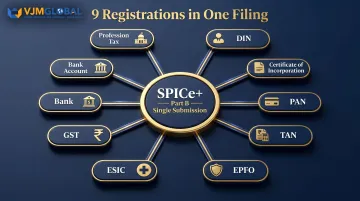
SPICe+ Part B is the integrated incorporation form that consolidates nine registrations into a single submission:
- Director Identification Number (DIN)
- Company incorporation (Certificate of Incorporation)
- PAN (Permanent Account Number)
- TAN (Tax Deduction and Collection Account Number)
- EPFO registration
- ESIC registration
- GST registration
- Bank account opening facilitation
- Profession tax (Maharashtra only)
Four linked forms are filed at the same time as SPICe+ Part B:
- INC-33: e-Memorandum of Association specifying company objectives and authorised capital
- INC-34: e-Articles of Association governing internal management
- INC-9: Declaration by first subscribers and directors
- DIR-2: Consent to act as director
Critical requirement for UK investors: All documents signed by UK-based directors must carry apostille certification. A Chartered Accountant or Company Secretary must digitally certify the SPICe+ form before submission.
The Memorandum of Association must clearly specify business objects that fall within permitted FDI sectors under the automatic route or approved sectors if government clearance has been obtained.
Step 5: Pay Government Fees and Await Approval
Government fees are determined by authorised capital:
- Up to ₹10 lakh authorised capital: Nil registration fee
- Above ₹10 lakh: ₹36,000 base fee plus additional fees per slab
- State-specific stamp duty applies
The Registrar of Companies reviews the application and supporting documents. Upon approval, the ROC issues:
- Certificate of Incorporation (COI) containing the Corporate Identification Number (CIN)
- PAN and TAN auto-generated and emailed with the COI
Processing time: Typically 5–7 working days after complete filing. Once the COI arrives, post-incorporation steps must begin immediately — several carry strict deadlines.
Step 6: Complete Post-Incorporation Registrations
Immediately after receiving the COI, UK investors must complete the following:
- Open a business bank account — banks require the COI, PAN card, MOA/AOA, board resolution, and director KYC documents
- File Form FC-GPR with the RBI within 30 days of receiving funds and allotting shares to report foreign equity infusion (mandatory under FEMA)
- Register for GST if turnover thresholds are met or if the company conducts inter-state supply
- Hold the first board meeting within 30 days of incorporation to appoint key managerial personnel, confirm the registered office, and adopt initial governance policies
Documents Required for UK Nationals Registering a Pvt Ltd Company in India
UK National Director/Shareholder Documents
All UK investors must provide:
- Valid passport (identity proof)
- Recent bank statement or utility bill as address proof (not older than 2 months)
- Passport-size photograph
- Specimen signature
Critical distinction: All documents originating in the UK must be apostilled by the UK Foreign, Commonwealth & Development Office (FCDO), not merely notarised by a UK solicitor.
Both India and the UK are signatories to the Hague Apostille Convention (India acceded in 2004). Apostille certification confirms authenticity for overseas use. The process involves:
- Document notarised/certified by a UK solicitor or notary public
- Apostille attached by the FCDO Legalisation Office
FCDO apostille fees effective January 2024:
| Service Type | Fee (per document) |
|---|---|
| Digital e-Apostille | £35 |
| Standard service | £45 |
| Urgent service | £100 |
Notarisation alone is insufficient and is the single most common documentation error VJM Global encounters with UK clients.
Once personal documents are in order, you'll also need to establish a registered office address in India.
Registered Office Documents
The company must have a physical registered office address in India. Required documents:
- Proof of address: Rental agreement or sale deed
- No Objection Certificate (NOC) from property owner if rented
- Utility bills for the premises (not older than 2 months)
UK investors without an existing India presence often use a registered office address service. VJM Global offers this across Noida, Delhi, Mumbai, Bangalore, Chennai, and Hyderabad.
Company Documents
Your legal or compliance advisor prepares and files these digitally:
- Draft Memorandum of Association (MOA) specifying permitted business objects
- Draft Articles of Association (AOA) governing internal rules
- Declaration from directors and subscribers (INC-9)
- Consent to act as director (DIR-2)
What UK Investors Do NOT Need
- Aadhaar card: Only required for Indian nationals
- Indian PAN at filing stage: Required post-incorporation but not during DIN application
- Physical presence in India: Entire process can be completed remotely with apostilled documents
Post-Registration Compliance for UK-Owned Companies in India
Annual ROC Filings
UK-owned Indian companies must file with the Registrar of Companies annually:
| Form | Purpose | Deadline |
|---|---|---|
| MGT-7 | Annual Return | Within 60 days of AGM |
| AOC-4 | Financial Statements | Within 30 days of AGM |
Companies must conduct an Annual General Meeting within six months of the financial year-end. Non-compliance attracts penalties under the Companies Act and can result in director disqualification.
FEMA and RBI Compliance
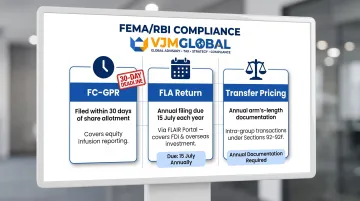
Three filings apply to most UK-owned Indian companies under FEMA and RBI rules:
- FC-GPR: Filed within 30 days of receiving foreign investment and allotting shares. Covers initial capitalisation and all subsequent equity issuances.
- FLA Return: Annual return for companies that have received FDI or made overseas direct investment. Deadline: 15 July each year, filed via the FLAIR portal. Provisional filing is permitted if audited accounts are unavailable.
- Transfer pricing: Sections 92–92F of the Income Tax Act require all transactions between the UK parent and Indian subsidiary — goods, services, loans — to be conducted at arm's length. Supporting documentation includes benchmarking studies, intercompany agreements, and annual master file/local file preparation.
Tax and GST Obligations
Key tax obligations for UK-owned subsidiaries include:
- Corporate tax: Section 115BAA offers a concessional base rate of 22%, with an effective rate of approximately 25.17% including surcharge and cess. This requires forgoing certain deductions but delivers competitive treatment for foreign-invested companies.
- GST registration and filing: Required based on turnover thresholds or inter-state supply, with monthly or quarterly return filing.
- TDS: Tax Deducted at Source applies to salaries, professional fees, rent, and other specified payments.
Managing obligations across MCA, RBI, and CBDT simultaneously is one of the more demanding aspects of running an India subsidiary from the UK. VJM Global has supported 250+ UK businesses through exactly this landscape — from first FC-GPR filing through to annual transfer pricing documentation and ROC compliance.
Common Mistakes UK Investors Make During Registration
Documentation: Notarisation vs. Apostille
The most frequent error is submitting documents that are notarised by a UK solicitor but not apostilled by the FCDO. Since India is a signatory to the Hague Apostille Convention, documents originating in the UK must bear an apostille from the FCDO Legalisation Office—solicitor notarisation alone is insufficient.
Missing apostille certification is among the most common reasons UK investor applications are rejected by the ROC, causing 2–4 week delays while documents make the round trip for proper authentication. To avoid this:
- Engage the FCDO Legalisation Office early in the process
- Use the digital e-Apostille service (£35 per document) for faster turnaround
- Verify that both identity proof (passport) and address proof carry apostille certification
Structural: Director Residency Planning
Many UK investors assume both directors can be UK-based — then discover the 182-day Indian residency requirement only when SPICe+ filing is underway. Identifying and appointing a compliant resident director at that stage causes avoidable delays.
Best practice: Identify the Indian-resident director solution before initiating incorporation. Options include:
- Appointing a trusted Indian business contact
- Engaging a professional nominee director service (VJM Global provides compliant nominee arrangements with proper governance documentation)
- Planning for one UK director to establish Indian residency
Compliance: FEMA Reporting Deadlines
UK investors often complete incorporation correctly but fail to report initial equity infusion to the RBI within the mandatory 30-day window via Form FC-GPR. This constitutes a compoundable FEMA violation.
In VJM Global's experience working with 250+ UK businesses, FC-GPR non-filing is the most common post-incorporation compliance failure among first-time foreign investors. The filing requires:
- Valuation certificate
- Board resolution approving share allotment
- Bank certificate confirming fund receipt
- Filing through the FIRMS portal
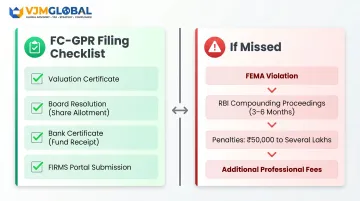
Missed deadlines require remediation through RBI compounding proceedings. The process typically takes 3–6 months and can result in penalties from ₹50,000 to several lakhs (hundreds of thousands of rupees), depending on the violation's severity and duration — plus additional professional fees.
Prevention: Engage a FEMA compliance advisor before transferring funds to India. VJM Global's post-incorporation compliance service includes FC-GPR preparation and filing to ensure the 30-day deadline is met.
Frequently Asked Questions
Who can register a private limited company in India?
Any individual including UK nationals can become a director or shareholder in an Indian Private Limited Company, subject to sectoral FDI limits. Minimum requirements are 2 directors and 2 shareholders (can overlap), with at least one director meeting the 182-day Indian residency requirement.
How much does it cost to register a private limited company in India?
Government MCA fees are nil for authorised capital up to ₹10 lakh. Additional costs include DSC issuance, UK FCDO apostille fees (£35–£100 per document), and professional advisory fees. Total costs typically range from £800–£2,000 for UK investors, depending on complexity.
What is the difference between LLC and Pvt Ltd in India?
India does not have an LLC structure. The closest equivalent to a UK Private Limited Company is an Indian Private Limited Company (Pvt Ltd). Both offer limited liability and separate legal identity, but governance, compliance requirements, and share transfer rules differ under the Companies Act, 2013 versus UK Companies Act.
How to get Pvt Ltd company registration in India?
Obtain DSC and DIN for directors, reserve your company name via SPICe+ Part A, then file SPICe+ Part B with MOA/AOA and apostilled supporting documents on the MCA portal. The Certificate of Incorporation is typically issued within 10–15 working days of submitting complete documents.
Does a UK investor need to be physically present in India to register a company?
Physical presence is not required. UK investors can complete the entire process remotely, provided all documents are properly apostilled and submitted digitally. However, appointing a local representative or advisor is strongly recommended to manage document submission, registered office requirements, and post-incorporation compliance.
What is the FDI policy for UK investors setting up a company in India?
Most sectors permit 100% FDI from UK investors under the automatic route, requiring no prior government approval. Sensitive sectors such as defence beyond 74%, broadcasting, and multi-brand retail have caps or require government approval. Verify your sector under the DPIIT Consolidated FDI Policy before proceeding.
Ready to establish your Indian Private Limited Company? VJM Global has supported 250+ UK businesses through compliant India market entry, providing end-to-end incorporation, nominee director services, FEMA compliance, and ongoing accounting and tax support. Contact our team at [email protected] or call +91 9213397070 to discuss your India business setup requirements.