But "easy to incorporate" doesn't mean "easy to get right." Outcomes hinge on entity choice, documentation quality, banking checks, and whether you follow through on compliance after the certificate lands in your inbox.
This guide walks through whether Mauritius actually suits your business, the exact registration steps, what you need before you start, and the mistakes that trip up UK founders most often.
TL;DR
- Mauritius allows substantial foreign ownership, but you still need at least one Mauritius-resident director
- Registration covers name approval, CBRD incorporation, a registered office, and a bank account
- UK founders must check whether central management and control could make the company UK tax resident
- Choose a domestic company for local trade, or a Global Business Licence for pure cross-border activity
- Nail KYC, banking, and annual filings first time to avoid the delays that stall most applicants
How to Register a Private Limited Company in Mauritius from the UK
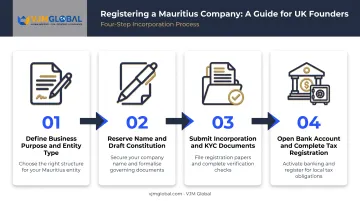
Step 1: Define Business Purpose and Entity Type
Start by asking what the company will actually do.
- Trading with Mauritius residents? You need a domestic company
- Operating purely cross-border (holding, treasury, investment)? A Global Business Licence route may fit better
- Structure check: a private company permits 1 to 25 shareholders and cannot make public share offers
One point gets glossed over constantly: Mauritius requires at least one director ordinarily resident in Mauritius for a domestic company. Foreign shareholders can hold the equity, but you can't run the whole board from London and skip local governance entirely.
If the company is genuinely managed and controlled from the UK, HMRC may still treat it as UK tax resident regardless of where it's incorporated. More on that below.
Step 2: Reserve Company Name and Prepare Constitutional Documents
Submit your proposed name to the CBRD. It can't be identical to, or misleadingly close to, an existing name.
A domestic company limited by shares doesn't strictly need a bespoke constitution to incorporate. The Companies Act allows it to proceed without one. That said, most founders adopt one anyway to set out:
- Share structure and classes
- Director powers and limits
- Transfer restrictions on shares
You'll also need a registered office address in Mauritius. This is non-negotiable for every incorporated entity and doubles as the address for legal service and official correspondence.
Step 3: Submit Incorporation Application and KYC Documents
This is where most delays originate. Prepare:
- Certified proof of identity and address for all shareholders and directors
- A clear, specific description of the business activity, expected clients, and how the business will be funded
- Subscriber details — each subscriber needs at least one share, with occupation and address recorded
File with the Registrar of Companies under the Companies Act 2001. Once the application complies with the Act, the Registrar issues the Certificate of Incorporation along with a unique company number.
Don't expect a guaranteed same-day turnaround. Timing depends on how complete your filing is. Vague or inconsistent business descriptions are the single biggest cause of back-and-forth queries.

Step 4: Open a Corporate Bank Account and Complete Post-Incorporation Steps
Approach a Mauritius bank or licensed payment provider with your incorporation documents, a business plan, and full beneficial ownership details.
Under Bank of Mauritius guidance, banks must verify directors, significant shareholders, and the natural persons who ultimately control the company, not just the entity on paper.
Then handle the tax side:
- Register with the Mauritius Revenue Authority (MRA) for your Tax Account Number
- Register for VAT if turnover exceeds the compulsory threshold — this was reduced from MUR 6 million to MUR 3 million under the Finance Act 2025
- Set up bookkeeping from day one, since annual returns and financial statements are mandatory filings
VJM Global supports UK businesses through exactly this sequence when they expand into a new market, helping structure the entity, prepare the documentation package, and get bank-ready before submission rather than after a rejection.
When Should a UK Founder Register a Private Limited Company in Mauritius?
Mauritius fits founders who want a stable, common-law-adjacent jurisdiction with genuine treaty access and links to African and Asian markets.
The World Bank ranked Mauritius 13th of 190 economies in its final 2020 Doing Business report. That ranking is a historical marker, not a current league-table position, but it still shows regulatory maturity.
Typical use cases:
- Regional holding companies with African or Asian operating subsidiaries
- Export or trading businesses with real Mauritius-based clients or suppliers
- Investment vehicles requiring a credible jurisdiction
- Companies actively serving customers across Africa and Asia
It stops making sense when your business has no operational or client link to Mauritius and you only want a nominal registration. A domestic company then becomes an administrative burden with no real payoff.
For large-scale international treaty planning, a Global Business Licence with proper substance requirements usually fits better than stretching a domestic company beyond its purpose.
What You Need Before Registering in Mauritius
UK founders who assemble these items before filing avoid Mauritius registration rejections and bank onboarding delays.
Documentation Requirements
- Certified passport copies for all shareholders and directors
- Recent proof of address (utility bills or bank statements, ideally within 2-3 months)
- Notarised and translated documents for any non-English originals
Business and Financial Details
- A specific, unambiguous description of the business activity; generic wording triggers follow-up queries
- Expected transaction volumes and typical client profile
- Source-of-funds evidence for shareholders contributing capital
Local Presence Requirements
- A registered office address in Mauritius
- A resident director
- A licensed registered agent or management company when local governance support is required
Key Factors That Affect Your Mauritius Company Setup
Outcomes vary considerably based on structural decisions made at formation, not after the fact.
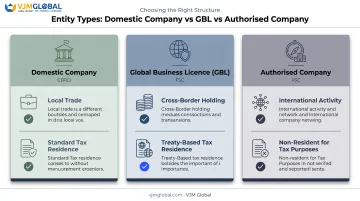
Entity Type (Domestic Company vs GBL vs Authorised Company) These are three distinct regulatory routes, not interchangeable labels:
- A domestic company runs through the CBRD and suits local trading
- A Global Business Licence (GBL) adds an FSC licensing layer and substance requirements, better suited to cross-border holding structures that need treaty access
- An Authorised Company is aimed at international activity and follows a different tax-residence treatment from a domestic company or GBL
Director and Shareholder Structure Clear, verifiable ownership speeds up bank approval significantly. Complex layered ownership without a clean chain of documentation is one of the fastest ways to stall a bank's KYC review.
UK Tax Residency and Control If the company is actually managed and controlled from the UK, HMRC's central-management-and-control test can still apply. Mauritius incorporation alone does not settle the question. This affects double taxation exposure and your UK reporting obligations.
Banking and Compliance Readiness Mauritius banks apply strict KYC and AML checks on foreign-owned companies, verifying directors, significant shareholders, beneficial owners, and source of funds. Incomplete documentation remains the leading cause of account-opening delays.

Common Mistakes UK Founders Make When Setting Up in Mauritius
- Assuming automatic tax savings without checking whether UK control and residency rules still apply to the entity
- Choosing an entity type based on cost alone, rather than matching the structure to actual business activity
- Submitting vague or inconsistent KYC documents, which slows both incorporation and bank account approval
- Ignoring ongoing obligations — annual filing, record-keeping, and potential audit requirements don't disappear once the certificate arrives
Alternatives to a Standalone Mauritius Private Limited Company
A domestic private company isn't the only route into Mauritius.
Global Business Company (GBC)
Better suited to cross-border holding, treasury, or investment activity that needs treaty access. The trade-off: it requires FSC licensing and demonstrable local substance, which adds cost and ongoing compliance work beyond a domestic company.
Branch or Representative Office
Useful for testing the Mauritius market without creating a new legal entity. The catch: your parent company remains fully liable for the branch's activities, and a representative office cannot generate local revenue.
Working with a Cross-Border Formation and Compliance Partner
Entity formation is only the starting point. Ongoing accounting, tax filing, payroll, and governance obligations continue for as long as the company exists.
VJM Global supports UK businesses with entity formation, documentation, and ongoing accounting and compliance across 100+ countries. That support helps founders avoid the setup and filing pitfalls that often trip up a first expansion into an unfamiliar jurisdiction.
Conclusion
Registering a private limited company in Mauritius from the UK is straightforward — provided you address entity type, documentation, and banking readiness before you file, not after.
Most delays trace back to the same three causes:
- Unclear business activity descriptions
- Incomplete KYC packs
- Overlooking UK tax residency implications until it is too late to plan around them
Work with advisers who handle Mauritius formation and UK cross-border tax together—such as VJM Global—so you structure correctly the first time and stay compliant after incorporation.
Frequently Asked Questions
What is a small private company in Mauritius?
A small private company is one with turnover below MUR 100 million in the preceding period. These companies generally don't need to appoint an auditor, though shareholders holding at least 5% can still require one.
Can a foreigner own a company in Mauritius?
Yes, foreign shareholders can hold substantial or full equity in a Mauritius private company, subject to standard KYC and due diligence checks. Note that a domestic company still needs at least one Mauritius-resident director.
How long does it take to register a private company in Mauritius?
Incorporation itself often completes within a few working days once your documents are complete and consistent. Bank account opening typically takes longer, since banks run their own KYC and AML review independently of the Registrar.
Do I need to visit Mauritius to set up a company?
Often not. Incorporation and bank account opening can usually be completed remotely through a registered agent, though some banks may request video verification or, occasionally, in-person checks depending on risk profile.
Will setting up a Mauritius company affect my UK tax obligations?
Possibly. UK tax residency rules can still apply based on where the company is actually managed and controlled, not just where it's incorporated. Seek specific tax advice before assuming Mauritius incorporation changes your UK position.
What ongoing compliance is required after incorporation?
Expect annual return filing (where required), financial statement or summary submission, and tax filing obligations with the Mauritius Revenue Authority, including VAT registration if turnover crosses the statutory threshold.