Introduction
If you've been searching for how to set up a "UK LLC," you're not alone — and you're about to save yourself a costly detour. The LLC is a US legal concept. It doesn't exist under UK law, which means registering under that name isn't an option.
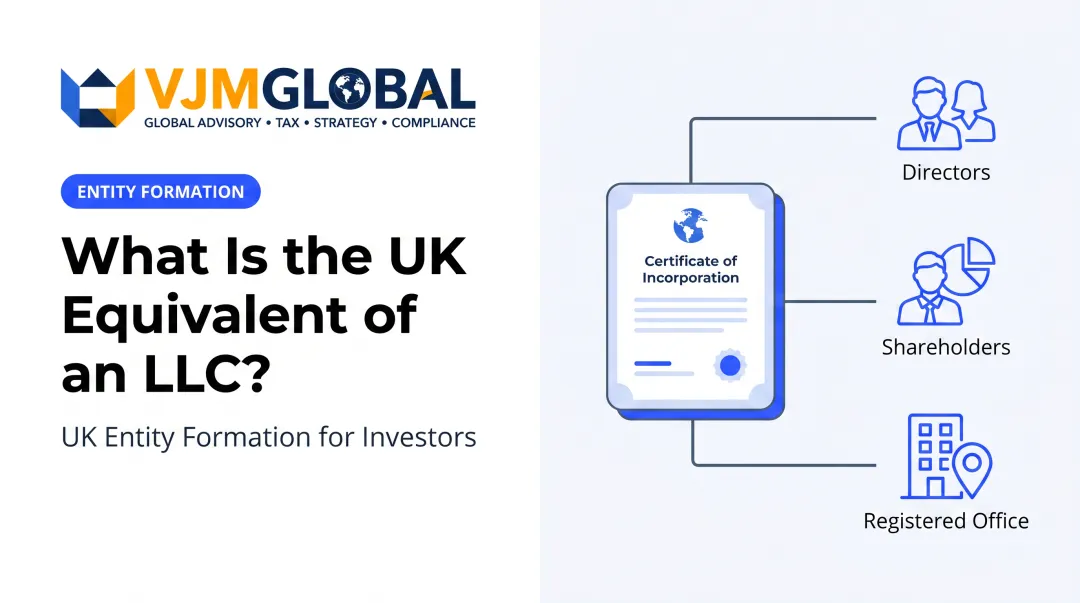
The closest UK equivalent is a Private Limited Company (Ltd), registered under the Companies Act 2006 with Companies House. It delivers the same core protection you're after — limited personal liability — just under different terminology.
This guide is written for entrepreneurs, foreign nationals, and businesses — particularly those based in India, the US, or Australia — who want to establish a legal UK presence.
It covers the right structure, registration steps, post-setup compliance, and the missteps that catch first-time directors off guard.
Key Takeaways
- The UK equivalent of an LLC is a Private Limited Company (Ltd); the term "UK LLC" has no legal standing
- Non-UK residents can fully own and direct a UK Ltd company — no residency requirement applies
- Online registration with Companies House costs £100 and typically completes within 24 hours
- Corporation Tax rates are 19% (profits under £50,000) or 25% (profits over £250,000)
- Annual compliance requires a Confirmation Statement, accounts filing, and a Corporation Tax return
What Is a "UK LLC"? Understanding the Right Business Structure
The term "LLC" originates from US corporate law and has no legal standing in the UK. GOV.UK's business setup guidance lists structures including limited companies, sole traders, partnerships, and overseas companies — but not LLCs.
The correct UK equivalent is a Private Limited Company (Ltd), defined under the Companies Act 2006. Under Section 3 of the Act, a company limited by shares means members' liability is capped at the amount unpaid on their shares, which is exactly the liability protection most people associate with an LLC.
What makes a Private Limited Company distinct:
- It is a separate legal entity from its owners
- It can hold assets, enter contracts, and incur liabilities in its own name
- Shareholders' personal assets (home, savings) are protected from company debts
- It can have one or multiple shareholders, who can also serve as directors
According to Companies House's 2024–25 statistical release, there are 5,229,368 private limited companies on the UK register, accounting for over 95% of all corporate bodies, a proportion that has held steady for a decade.
Key Benefits of Setting Up a UK Private Limited Company
Limited Liability Protection
Shareholders are personally liable only up to the value of their paid-up shares. If a company faces debt or a legal claim, creditors cannot pursue directors' or shareholders' personal assets beyond that amount. Many companies set share values at just £1, keeping personal exposure minimal from day one.
Credibility, Investment Access, and Tax Efficiency
Trading as a Ltd company carries weight with clients and suppliers in a way that sole trading doesn't. Beyond perception:
- The company can raise capital by issuing shares to investors
- Corporation Tax rates (19%–25% depending on profit level) are often more favourable than personal income tax rates for higher-earning sole traders
- The company structure separates business and personal finances cleanly, which matters when approaching banks or institutional clients
No UK Residency Requirement
This is the detail that makes the UK particularly attractive for international founders. GOV.UK confirms that directors do not need to live in the UK. Shareholders face no stated UK residency requirement either. The one non-negotiable: the company must have a registered UK office address.
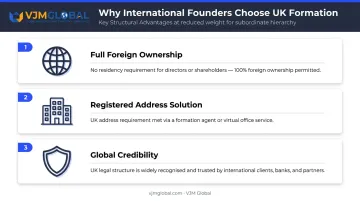
Three factors together explain why Indian, US-based, and Australian entrepreneurs frequently choose to establish UK companies:
- Full foreign ownership is permitted with no residency requirement for directors or shareholders
- The registered address requirement is easily met through a UK formation agent or virtual office
- The UK's internationally recognised legal structure adds credibility with global clients and investors
What You Need Before You Register
Getting your prerequisites right before you submit anything saves time and avoids rejection. Here's what Companies House requires:
Core requirements:
- A unique company name ending in "Limited" or "Ltd" (Welsh companies may use "Cyfyngedig" or "Cyf")
- A physical UK registered office address in the same country where the company is incorporated — PO Boxes are not accepted
- At least one director, aged 16 or over (no UK residency required)
- At least one shareholder (can be the same person as the director)
- A defined share structure
Founding documents you'll need:
- Memorandum of Association — a declaration by initial shareholders confirming their intent to form the company
- Articles of Association — the internal rulebook covering voting rights, dividend distribution, and director responsibilities
Companies House provides model Articles of Association that work for most standard setups and are freely available. You can adopt them as-is or customise them.
Foreign nationals without a UK address or prior Companies House experience often hit preventable snags at this stage. VJM Global has supported 250+ UK businesses through company formation and compliance, and works specifically with international founders setting up remotely — handling requirements they may not be familiar with from their home country.
Step-by-Step: How to Register a UK Private Limited Company
Registration follows a defined sequence through Companies House. The full process can be completed online in as little as 24 hours, though incomplete submissions or missed steps will cause delays.
Choosing and Checking Your Company Name
Use the Companies House name availability checker before settling on anything. A name will be rejected if it:
- Is identical to an existing registered company name
- Is too similar to an existing name or trademark
- Contains sensitive or offensive words without prior approval
- Implies a connection to government or local authorities
Always run the check — even names that appear unique can be flagged if they're close enough to an existing registration to cause confusion.
Appointing Directors and Shareholders
At least one director — a natural person aged 16 or over — must be appointed. Directors are legally responsible for the company's compliance obligations, not just its operations.
Key rules:
- The director and sole shareholder can be the same person
- Anyone holding more than 25% of shares must be registered as a Person of Significant Control (PSC)
- PSC details are filed with Companies House and are publicly accessible
Drafting the Memorandum and Articles of Association
The Memorandum is a simple statutory declaration confirming that subscribers agree to form the company and take at least one share each. It cannot be amended once filed.
The Articles cover more ground: they set the internal rules for how the company operates. Model Articles from Companies House are suitable for most standard setups and cover voting procedures, director powers, and dividend distribution. You can adopt them in full or tailor them to suit your structure.
Registering with Companies House
Three registration routes are available:
| Method | Cost | Processing Time |
|---|---|---|
| Online (standard) | £100 | Within 24 hours |
| Same-day online | £156 | Same working day |
| Postal | £124 | 8–10 working days |
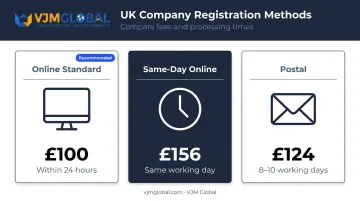
Fees are confirmed on the Companies House fee schedule, updated 1 February 2026. Upon approval, you receive a Certificate of Incorporation confirming the company's legal existence, company number, and formation date.
Registering for Corporation Tax with HMRC
With the company legally formed, tax registration is the immediate next obligation. Within 3 months of starting business activities, the company must register with HMRC for Corporation Tax. Current rates:
- 19% — profits under £50,000 (small profits rate)
- 25% — profits over £250,000 (main rate)
- Marginal relief applies on profits between £50,000 and £250,000
VAT registration becomes mandatory once taxable turnover exceeds £90,000 in a 12-month period, or if you expect to exceed that threshold within the next 30 days.
Post-Registration Compliance and Tax Obligations
Registering your company with Companies House is just step one. A UK private limited company carries ongoing annual obligations — and missing them can have real consequences.
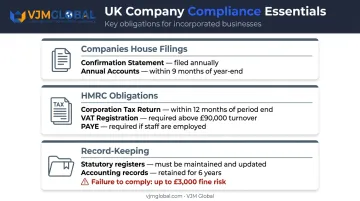
Annual Filings with Companies House
- Confirmation Statement — filed at least once a year to confirm the company's registered details are current; failure to file can result in the company being struck off the register
- Annual Accounts — filed within 9 months of the financial year-end for private companies; first accounts for a new company are due 21 months after registration
HMRC Obligations
- Corporation Tax Return — due 12 months after the end of the accounting period it covers
- VAT — mandatory registration once taxable turnover exceeds £90,000; quarterly returns typically required
- PAYE — if the company employs staff or the director draws a salary, payroll must be registered and operated through HMRC
Record-Keeping Requirements
Companies must keep the following statutory records current:
- Registers of directors, shareholders, share allocations, and PSCs
- Accounting records retained for at least 6 years from the end of the relevant financial year
- Failure to maintain adequate records can result in a £3,000 fine or director disqualification
Note that registered address, officer details, and PSC data are publicly visible on the Companies House register.
For foreign-owned UK companies managing these obligations from another country, the administrative load adds up quickly. VJM Global supports cross-border businesses with accounting, tax filing, and compliance across multiple jurisdictions — having worked with 250+ UK-connected clients navigating exactly these requirements.
Common Mistakes to Avoid When Setting Up a UK Limited Company
1. Choosing a Name Too Similar to an Existing One
Companies House can reject or flag names even when differences seem minor. Punctuation variations, abbreviated forms, or common word additions often aren't enough to make a name distinct. Always use the official name checker before finalising.
2. Missing the Corporation Tax Registration Deadline
You must register with HMRC within 3 months of starting business activities. Missing this window triggers penalties based on potential lost revenue:
- Up to 30% for non-deliberate failure
- Up to 100% for deliberate and concealed non-compliance
First-time directors — particularly those based outside the UK — frequently overlook this step.
3. Misunderstanding the Registered Office Requirement
The registered address must be a physical, deliverable UK address in the same UK country where the company is registered. Two commonly used options that do not qualify:
- Virtual offices
- PO Boxes
For foreign entrepreneurs without a UK address, a professional registered address service is the standard solution.
Frequently Asked Questions
Frequently Asked Questions
What is the UK equivalent of an LLC?
The UK has no LLC structure. The closest equivalent is a Private Limited Company (Ltd), registered with Companies House under the Companies Act 2006. It delivers the same core benefit — limited liability for shareholders — under UK legal terminology.
What is the difference between an LLC and an LLP in the UK?
A Private Limited Company (Ltd) is owned by shareholders, managed by directors, and pays Corporation Tax on profits. An LLP has members who each pay tax individually on their share of profits. Both provide limited liability, but differ in governance structure and tax treatment.
Can a non-UK resident set up a private limited company in the UK?
Yes. There is no residency requirement for directors or shareholders. The company does require a registered UK office address, which can be fulfilled through a professional address service if the founder has no physical UK address.
How long does it take to register a UK private limited company?
Online registration with Companies House typically completes within 24 hours once all information is correctly submitted. Same-day registration costs £156. Postal applications take 8–10 working days.
What are the main ongoing compliance requirements for a UK limited company?
Annual obligations include filing a Confirmation Statement and accounts with Companies House, submitting a Corporation Tax return to HMRC, and maintaining statutory registers. Missing deadlines triggers financial penalties or, in serious cases, the company being struck off the register.
How much does it cost to register a company in the UK?
Standard online registration with Companies House costs £100. Additional costs may include a registered address service, formation agent fees, and professional advisory support. The current Companies House fee schedule (updated February 2026) confirms all registration fees.