Singapore already plays a major part in that story. Bilateral trade hit USD 16.5 billion in 2021, up 17.2% year-on-year, with Singapore ranking as the Philippines' top foreign investor that year at USD 1.5 billion (Ministry of Foreign Affairs, Singapore, 2022).
There's a catch, though: the Philippines has no direct equivalent of Singapore's Pte Ltd. The closest structure is the Domestic Corporation, registered with the Securities and Exchange Commission (SEC), and it permits full or majority foreign ownership. This guide walks through the exact steps, costs, and pitfalls Singapore founders face, plus where specialist firms like VJM Global can remove friction along the way.
Key Takeaways
- The Philippine equivalent of a Private Limited Company is a Domestic Corporation, registered with the SEC
- Foreign equity level (0%, under 40%, or over 40%) directly drives your minimum paid-up capital requirement
- Your Corporate Secretary must be a Filipino citizen; your Treasurer must be a Philippine resident
- End-to-end setup usually runs 2-3 months once you factor in SEC, local permits, and tax registration
- Singapore-issued documents typically need notarisation and apostille before SEC will accept them
How to Set Up a Domestic Corporation in the Philippines from Singapore
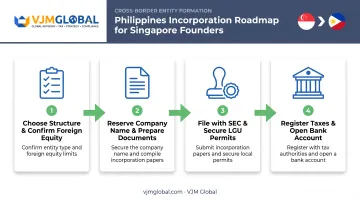
Step 1: Choose Your Business Structure and Confirm Foreign Equity Eligibility
Your ownership percentage determines almost everything downstream, so this decision comes first.
Philippine law recognises three broad foreign equity tiers:
- 0% foreign (Filipino-owned): No general minimum capital requirement under the Revised Corporation Code
- Under 40% foreign: Same flexible capital rule applies, subject to any sector-specific law
- Over 40% foreign: Triggers the standard USD 200,000 minimum paid-in capital under the Foreign Investments Act
That floor can drop to USD 100,000 for qualifying export enterprises, DOST-recognised advanced technology firms, or startups with at least 15 Filipino direct employees.
Before committing, check the Philippine Foreign Investment Negative List. It restricts or bars foreign equity entirely in sectors like mass media, small-scale mining, and land ownership, and caps others (advertising at 30%, for instance). Getting this wrong after filing is expensive to fix.
You'll also need to decide between a Domestic Corporation, Branch Office, or Representative Office here, since each carries different capital and reporting obligations. We cover the trade-offs later in this guide.
Step 2: Reserve Your Company Name and Prepare Core Documents
Nothing else moves until your company name is reserved and verified through the SEC's online registration system, known as eSPARC.
Once that's cleared, gather your core documents:
- Articles of Incorporation and By-Laws
- Treasurer's Affidavit
- Proof of business address in the Philippines
- Valid IDs and passport copies for every Singapore-based shareholder and director
Here's where cross-border founders often get tripped up. Since both Singapore and the Philippines are members of the Apostille Convention (Singapore since September 2021, the Philippines since May 2019), documents like board resolutions and powers of attorney don't need embassy legalisation.
They do need notarisation first, then apostille certification through the Singapore Academy of Law, before the SEC will accept them.
Step 3: File Incorporation with the SEC and Secure Local Government Permits
With documents in hand, submission runs through eSPARC: name verification, company details, capital structure, then officers and subscribers. The SEC's own guidance suggests allowing 7 working days for review, though real-world timelines often run longer once document authentication is factored in.
Approval gets you a Certificate of Incorporation and SEC registration number. That's not the finish line, though.
You'll still need to register with your Local Government Unit (LGU) for:
- Barangay Clearance - your local district's sign-off
- Business Permit - covering zoning, fire, and sanitation checks
- Mayor's Permit - required before commercial operations can legally begin
Requirements vary by city, and since incorporators are usually overseas, appointing a local liaison or registered agent at this stage tends to cut weeks off the process.
Step 4: Register for Taxes, Social Compliance, and Open a Corporate Bank Account
Next comes the Bureau of Internal Revenue (BIR). Filing BIR Form 1903 alongside your SEC Certificate gets you a Tax Identification Number and lets you register official receipts and invoices. The BIR's own service standard is one day for a complete manual application, though preparation time adds to that.
Once you start local hiring, enrolment becomes mandatory in:
- SSS (Social Security System)
- PhilHealth
- Pag-IBIG (HDMF)
Each requires separate employer registration forms and your SEC documents.
Opening a corporate bank account is often the most frustrating step for a non-resident-controlled entity. Philippine banks typically request:
- SEC Certificate
- Articles of Incorporation
- Board resolution authorising the account
- Valid IDs for signatories
Many still require an in-person appearance for verification.
What You Need Before Incorporating: Requirements for Singapore-Based Applicants
Ownership and Capital Requirements
Capital requirements scale directly with your foreign ownership percentage:
| Foreign Equity | Minimum Paid-Up Capital |
|---|---|
| 0-40% | No general minimum (sector rules may apply) |
| Over 40% (standard) | USD 200,000 |
| Over 40% (reduced-threshold cases) | USD 100,000 |
The reduced threshold applies where the enterprise uses DOST-recognised advanced technology, qualifies as a registered startup, or employs at least 15 Filipino staff directly (Republic Act 11647, 2022). This replaces an older, widely-cited 50-employee figure that no longer applies.
Export enterprises selling outside the Negative List's restricted categories can often reach 100% foreign ownership without hitting the USD 200,000 threshold at all.
Officer and Director Requirements
A Domestic Corporation needs 1 to 15 incorporators. Contrary to older guidance still circulating online, current law doesn't require a majority of incorporators or directors to be Philippine residents.
What it does require:
- A President who also sits on the board
- A Corporate Secretary who must be both a Filipino citizen and Philippine resident
- A Treasurer who must be a Philippine resident
- A Compliance Officer (for certain corporation types)
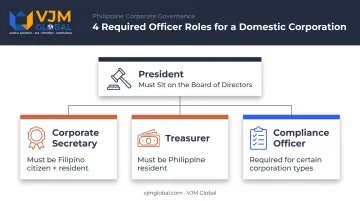
This means even a 100% Singapore-owned corporation needs at least two local appointments before the SEC will process the filing.
Document Checklist for Overseas Applicants
Gather these before you start, not after the SEC asks for them:
- Passport copies for all Singapore-based shareholders and directors
- Proof of residential address
- Tax Identification Number, if a local shareholder is involved
- Notarised and apostilled board resolutions and affidavits
- Draft Articles of Incorporation and By-Laws
Key Factors That Affect Your Setup Timeline and Cost
Several variables drive how long incorporation takes and what you pay:
- Foreign equity percentage. Crossing the 40% threshold raises your capital requirement and invites closer SEC scrutiny of ownership structure and fund sourcing.
- Industry and Negative List restrictions. Retail below ₱25 million paid-up capital, mass media, and land ownership carry foreign ownership limits or outright bars—check this before you draft anything.
- Apostille and cross-border documents. This step alone can add 1–3 weeks. Singapore’s apostille authority can process counter submissions on the spot, but notary prep and courier time between Singapore and the Philippines still add calendar days.
- Local registered agent or compliance partner. An experienced firm that liaises directly with SEC, LGU, and BIR offices cuts the back-and-forth that slows remote incorporations, especially across time zones.
Common Mistakes to Avoid When Incorporating from Singapore
Singapore founders often hit the same preventable delays when filing a Philippine Private Limited Company. Steer clear of these:
- Underestimating capital requirements by assuming your industry sits below the 40% foreign equity threshold, only to discover mid-filing that it does not
- Failing to appoint a Filipino Corporate Secretary and Philippine-resident Treasurer before filing, a near-guaranteed cause of SEC rejection
- Submitting Singapore-executed documents without proper notarisation or apostille, which stalls processing by weeks
- Assuming remote incorporation removes the need for a local contact, then struggling when LGU permits or bank account opening require someone physically present
Alternatives to Full Domestic Corporation Incorporation
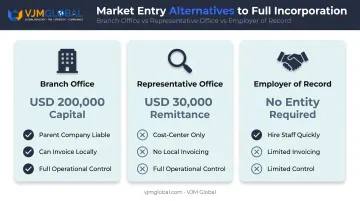
Full incorporation isn't always the fastest or cheapest way to test the Philippine market. Three alternatives are worth weighing.
Branch Office
When it's better: Suits a Singapore parent wanting to conduct income-generating activities directly under its own name, without setting up a separate local entity.
Key trade-offs: Requires a higher capital commitment, around USD 200,000, and the parent company remains fully liable for the branch's obligations.
Representative Office
When it's better: Ideal for market research, liaison work, or promotional activities that don't require generating local revenue.
Key trade-offs: Cannot invoice Philippine clients directly. Minimum inward remittance is USD 30,000 for operating expenses, and the office remains a cost centre only.
Employer of Record (EOR) for Market Testing
When it's better: Best when a Singapore company wants to hire Philippine talent or test demand before incorporating. VJM Global offers EOR across 100+ countries, so you can employ local staff compliantly without a Philippine entity.
Key trade-offs: No direct local invoicing and less operational control than a fully registered Domestic Corporation offers.
Frequently Asked Questions
What is a Ltd company in Singapore, and is it the same as a Philippine corporation?
A Singapore Pte Ltd is a private limited company under the Companies Act, capped at 50 shareholders. It's distinct from a Philippine Domestic Corporation, though both offer limited liability and allow foreign ownership.
Can a Singapore company or citizen own 100% of a Philippine corporation?
Yes, in most non-restricted industries. It's subject to the higher USD 200,000 capital tier and a check against the Foreign Investment Negative List.
How long does it take to register a company in the Philippines from Singapore?
Typically 2-3 months, covering SEC registration, LGU permits, and tax and social registrations. Document authentication delays are the most common cause of slippage.
Do I need to travel to the Philippines to incorporate my company?
Most steps can be done remotely with notarised and apostilled documents plus a local representative. Opening a bank account, however, often still requires in-person verification.
What is the minimum capital needed for a foreign-owned Philippine corporation?
It depends on equity level: no general minimum below 40% foreign ownership, USD 200,000 above 40% in standard cases, or USD 100,000 for qualifying startups and export enterprises.
Do Singapore-issued documents need an apostille for SEC filing in the Philippines?
Yes. Since both countries belong to the Apostille Convention, documents need apostille certification rather than embassy legalisation before SEC submission.
Setting up a Domestic Corporation from Singapore is entirely doable, but capital tiers, apostille timing, and local officer requirements tend to catch remote founders off guard. Firms like VJM Global that work across multiple jurisdictions can help structure the filing correctly the first time, saving weeks of rework and frustration.