The appeal isn't complicated. Manila is a short flight from Singapore, labor costs run a fraction of SGD rates, and the BPO industry has already proven the talent pool works for international business. Add ASEAN trade ties between the two countries, and the Philippines looks like a natural regional hub.
This interest isn't limited to giant multinationals. Singapore-based startups and SMEs diversifying their regional footprint are just as active in this space. What follows is a step-by-step breakdown of entity types, registration steps, costs, and compliance requirements you'll need to navigate.
TL;DR
- Choose a domestic corporation, branch, rep office, or ROHQ based on whether you'll earn Philippine income
- Foreign ownership can reach 100% in most sectors; capital minimums and Negative List rules still apply
- Registration takes several weeks, far longer than Singapore's near-instant ACRA process
- VJM Global's multi-jurisdiction accounting helps keep books and filings aligned across both entities
What Is Starting a Business in the Philippines (as a Singapore Entity)?
At its simplest, it means registering a legal business entity in the Philippines while you operate from a Singapore base. That entity might be a wholly foreign-owned corporation, a branch office linked to your Singapore parent, a representative office, or a partnership with a local party.
You are creating a legal presence under Philippine law. Remote freelancing and cross-border invoicing alone do not establish that presence.
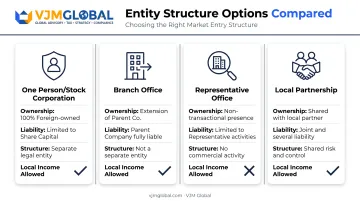
Common structures Singapore founders choose include:
- One Person Corporation or Stock Corporation – full operational control and local income generation
- Branch Office – linked to the Singapore parent, which shares liability
- Representative Office – market research and liaison only; no local income allowed
- Local partnership – shared ownership where foreign-equity rules call for a Philippine partner
What to Know Before You Start a Business in the Philippines from Singapore
Many Singapore founders assume Philippine registration mirrors ACRA's speed. It doesn't. Agencies, capital rules, and presence requirements shape timeline and cost before you file anything.
Time and Paperwork Differences
Singapore's BizFile system processes most applications within days. The Philippines involves multiple regulators — DTI or SEC, local government units, and the Bureau of Internal Revenue (BIR) — each with separate procedures and processing windows.
Capital Requirements Vary by Entity
Branch offices need proof of inward remittance (commonly cited at USD 200,000 for foreign-corporation applications). Domestic stock corporations face different thresholds depending on:
- Ownership structure (foreign vs. Filipino control)
- Whether the business serves the domestic or export market
- Industry rules and any foreign-equity caps that apply
Physical Presence Considerations
Some structures require local hires and a registered address. Others, like representative offices, exist only for non-income activities such as market research. Decide early:
- Do you need boots on the ground, or can this run remotely from Singapore?
- Will the entity generate local revenue, or only support the parent's operations?
- Can a lighter path (liaison activity or hiring via EOR) cover the first phase without full incorporation?
Why Start a Business in the Philippines from Singapore? (When It Makes Sense)
Expanding from Singapore into the Philippines pays off only under the right conditions—not as a default play. Weigh these factors:
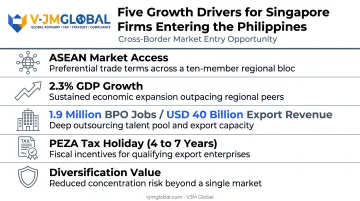
- ASEAN market access — existing trade ties and investment flows between Singapore and the Philippines create a smoother entry path than starting cold in an unfamiliar market
- Growth momentum — the Philippine economy grew 2.3% year-on-year in Q2 2026, according to the Philippine Statistics Authority
- Cost-competitive talent — the BPO and IT-BPM sector targeted 1.9 million jobs and USD 40 billion in export revenue in 2025 (IBPAP), giving Singapore firms lower-cost back-office and tech capacity
- Tax incentives — PEZA-registered exporters can get a 4–7 year income tax holiday, then a 5% special corporate tax or enhanced deductions for up to 10 years
- Diversification value — running a lower-cost Philippine operation alongside your Singapore entity spreads regional risk without abandoning your SG base
Early Decisions That Matter When Setting Up in the Philippines
Most early-stage friction for Singapore founders comes from underestimating bureaucratic complexity, not from lack of capital. Get these decisions right before filing anything.
- Cost stack: Singapore's ACRA process is largely a flat, fast fee. The Philippines layers DTI or SEC fees, LGU permits (rates vary by municipality), and BIR registration on top.
- Foreign equity: The 13th Foreign Investment Negative List (effective May 2026) caps ownership in listed sectors. Unlisted activities are generally open to 100% foreign equity—verify your sector before assuming full ownership.
- Subsidiary vs branch: A Philippine subsidiary is a separate legal entity that limits the Singapore parent's liability. A branch extends parent liability directly and changes tax treatment and risk exposure.
- Local agent: Singapore founders can't manage Philippine SEC and BIR filings remotely without a compliant local corporate secretary or registered agent for submissions and follow-up.
How to Start a Business in the Philippines from Singapore – Step by Step
This breaks cross-border setup into practical execution stages. The most common mistake: assuming this works like BizFile, or skipping SEC pre-approval on foreign parent documents before submission.
Step 1 – Identify Your Entity Type and Market Entry Strategy
Decide based on whether you need to earn local income:
- Domestic corporation – full local income generation, subject to FINL sector checks
- Branch office – parent-linked, generates local income, higher capital requirement
- Representative office – no local income, market research only
- ROHQ/RHQ – supportive functions for regional affiliates, restricted from local revenue
Common miss: choosing a representative office when the real goal is selling to Philippine customers. That structure legally can't generate revenue.
Step 2 – Prepare and Authenticate Singapore Parent Company Documents
You'll need:
- Certificate of Incorporation
- Board Resolution authorizing the Philippine registration
- Articles of Incorporation
All must be authenticated or consularized at the Philippine Embassy in Singapore. Branch offices additionally need proof of inward remittance.
Common miss: submitting documents that aren't properly notarized or consularized, triggering SEC rejection and weeks of delay.
Step 3 – Register with the SEC or DTI
Corporations, partnerships, and branch offices register with the SEC through its eSPARC platform. Sole proprietorships (rare for foreign entrants) go through DTI instead.
Required filings typically include:
- SEC application form
- Treasurer's Affidavit
- Joint affidavit of incorporators
SEC's own eSPARC page states applicants receive a review-status update within 7 working days, though this isn't a guaranteed approval timeline. Compare that to Singapore's near-instant ACRA turnaround, and plan accordingly.
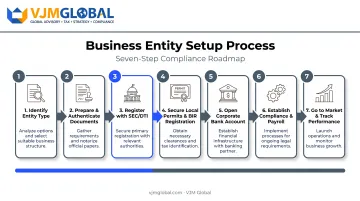
Step 4 – Secure Local Permits and BIR Registration
Before BIR registration, you need:
- Barangay clearance tied to your business address
- Mayor's or Municipal Permit from the local government unit
Then register with the BIR for a Tax Identification Number, Authority to Print invoices, and Books of Accounts.
Common miss: forgetting these local permits are prerequisites — BIR registration can't proceed without them.
Step 5 – Open a Corporate Bank Account and Set Up Finance Operations
You'll need the SEC Certificate of Registration, Articles of Incorporation, and a board resolution naming account signatories.
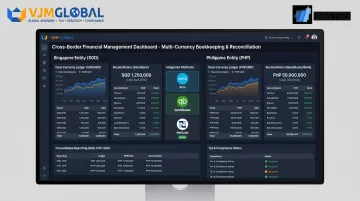
Singapore-linked entities also face cross-currency complexity managing SGD and PHP side by side. Multi-jurisdiction bookkeeping and reporting help keep both ledgers aligned.
VJM Global, for example, supports Singapore-based clients setting up abroad with outsourced bookkeeping, reconciliations, and management reporting on Xero, QuickBooks, or NetSuite, prepared under Philippine accounting standards.
Step 6 – Establish Ongoing Compliance and Payroll Processes
Recurring obligations include:
- BIR tax filings
- SEC annual reports
- LGU permit renewals
You'll also decide between hiring local Filipino staff directly or supporting operations remotely from your Singapore team. Note: compliance overhead here typically runs higher than Singapore's comparatively lean regime, so budget accordingly.
Common miss: underestimating this ongoing administrative load and treating registration as the finish line rather than the starting point.
Step 7 – Go to Market and Track Performance
Priorities at this stage:
- Build local credibility through PEZA or BOI registration where applicable, plus local partnerships
- Set up financial reporting that lets you monitor both entities from Singapore, not the Philippine business in isolation
Common miss: running the Philippine entity disconnected from your Singapore parent's broader compliance calendar, leading to missed filing deadlines on either side.
Conclusion
Starting a business in the Philippines from Singapore is achievable, but it demands patience with a slower, document-heavy registration process than what Singapore founders are used to at home. Entity choice, capital planning, and a reliable local compliance partner matter more than how fast you can move.
VJM Global delivers entity formation and compliance support across 100+ countries, helping Singapore-based founders manage bookkeeping, tax, and compliance obligations that span both markets. That reduces the coordination burden as you scale into Southeast Asia.
Frequently Asked Questions
Can a foreigner start a business in the Philippines?
Yes. Foreigners, including Singapore-based founders, can own up to 100% of most Philippine corporations, except sectors restricted by the Foreign Investment Negative List, subject to minimum capital requirements.
How much does it cost to start a business in the Philippines?
DTI business-name fees range from PHP 200 to PHP 2,000 depending on territorial scope, plus SEC filing fees, variable LGU permit charges, and BIR registration costs. Foreign-owned entities also face higher minimum capital rules, which raise total startup cost.
What business can I start with 50,000 pesos in the Philippines?
This budget generally fits Filipino-owned sole proprietorships or service-based micro-businesses. It is rarely enough for a foreign-owned entity, which usually needs much higher paid-up capital.
What business can I start with 200,000 pesos in the Philippines?
At the local level, this can support small retail, food and beverage, or online ventures. Foreign ownership structures usually still need higher capitalization, depending on the sector.
What is the cheapest business to start in the Philippines?
Service-based or online businesses — freelance consulting, digital services, e-commerce — tend to carry the lowest registration and capital costs compared to capital-intensive sectors.
What is the most profitable business to start in the Philippines?
BPO and outsourcing, real estate, ICT, and export-oriented manufacturing are among the stronger sectors. Singapore companies often favour these for cost advantage and access to an English-speaking talent pool.