Here's the catch. Setting up in the Philippines means dealing with the SEC, the BIR, your local LGU, and social agencies like SSS and PhilHealth — none of which talk to Companies House. Foreign ownership rules add another layer UK founders rarely anticipate.
This guide walks through the Philippine entity types, the registration steps, realistic costs and timelines, and the tax exposure UK founders need to plan for.
Key Takeaways
- A Philippine Corporation (SEC-registered) is the closest UK Ltd match: separate legal identity, limited liability, and shares.
- Foreign ownership is generally allowed but capped under the Foreign Investment Negative List (FINL).
- Full registration across SEC, BIR, LGU, and social agencies typically takes 2-3 months, not Companies House speed.
- UK founders face dual tax exposure; plan banking and capital requirements before filing.
What Is the Philippine Equivalent of a UK Private Limited Company?
The Philippine Domestic Corporation, registered with the Securities and Exchange Commission (SEC) under the Revised Corporation Code (RA 11232), is the structural equivalent of a UK Ltd. It has separate legal personality once the SEC issues a certificate of incorporation, and its capital is divided into shares.
If you're a solo founder, the One Person Corporation (OPC) mirrors a single-director, single-shareholder UK Ltd. One person can incorporate without co-founders, acting as sole stockholder, director, and president. Unlike an ordinary corporation, an OPC doesn't need to file by-laws. It must still include "OPC" in its registered name and appoint a nominee and alternate nominee.
Important: your UK Ltd does not automatically transfer status in the Philippines. There's no cross-border recognition. You'll need a fresh, separately incorporated Philippine entity.
Comparing Your Structure Options
| Structure | Liability | Foreign Ownership | Minimum Owners |
|---|---|---|---|
| Domestic Corporation | Limited | Up to 100% in most sectors (subject to the Foreign Investment Negative List (FINL)) | Two or more |
| One Person Corporation | Limited | Up to 100% in eligible sectors | One |
| Partnership | Often unlimited for general partners | Sector-dependent | Two or more |
| Branch Office | Liability extends to the foreign parent | Follows parent's ownership | N/A — extension of foreign company |
| Representative Office | No local revenue-generating activity permitted | 100% foreign | N/A |
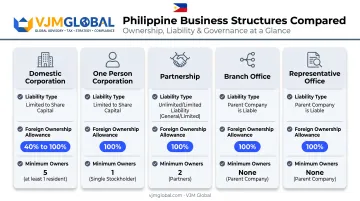
A UK Ltd doesn't have to disappear from the picture. It can act as the foreign parent shareholder of a new Philippine subsidiary, or the UK company can register a branch office instead of creating a separate legal entity. Branches carry liability back to the parent; subsidiaries ring-fence it.
Can a UK Resident or UK Company Set Up in the Philippines?
Yes, but ownership rules and visa status need checking before you pick a sector.
Foreign Ownership Rules to Check First
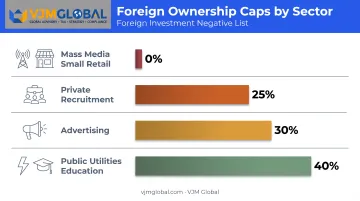
The Foreign Investment Negative List (FINL) sets sector-specific caps on foreign equity. The most recent confirmed list is the 12th FINL (Executive Order 175, 2022), though a 13th list (EO 113) has since been referenced without a confirmed effective date.
Always check the current NEDA/DEPDev publication before committing to a sector. This list changes, and older figures can mislead you.
Under the 12th FINL structure, restrictions ranged from:
- Zero foreign equity — mass media, small-scale retail below a set capital threshold, small-scale mining
- Up to 25% — private recruitment
- Up to 30% — advertising
- Up to 40% — public utilities, education, natural resources, and several others
Outside restricted sectors, fully foreign-owned corporations are common, subject to minimum paid-up capital and proof that funds were properly remitted into the country.
Visa Considerations
- UK passport holders can enter visa-free for 30 days for tourism or business.
- Longer business activity requires a Business Visa or a Special Investor's Resident Visa (SIRV).
- BOI material references a minimum SIRV remittance of at least USD 75,000; confirm current conditions with the Board of Investments.
Step-by-Step: Registering a Corporation in the Philippines
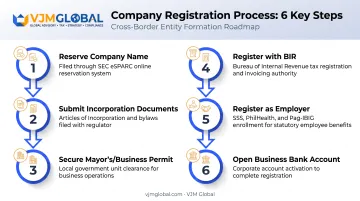
Registration runs through the SEC first, then your local government unit and the BIR. Complete the steps below in order.
1. Reserve Your Company Name
Submit up to three name options through the SEC's online system (eSPARC). The SEC's regular processing route typically sends a review status by email within seven working days.
2. Submit Your Incorporation Documents
You'll need:
- Articles of Incorporation
- By-laws (not required for an OPC)
- Treasurer's Affidavit
- For foreign shareholders: authenticated board resolutions and proof of remittance
Once your application is approved, you'll pay fees per the SEC's Payment Assessment Form, then submit two originally signed, notarised or authenticated hard copies within 60 calendar days.
3. Secure Your Mayor's/Business Permit
This is issued by the Local Government Unit (LGU) where you'll operate. Requirements, fees, and renewal dates vary by city — there's no single national checklist, so check directly with your chosen LGU.
4. Register with the BIR
You'll need a Tax Identification Number (TIN), official receipts, and VAT registration if your projected turnover exceeds the threshold (currently PHP 3 million in gross sales over 12 months).
5. Register as an Employer (If Hiring)
If you're taking on staff, register with:
- SSS (Social Security System)
- PhilHealth
- Pag-IBIG
SEC's Philippine Business Hub integration means employer numbers with these agencies can be obtained automatically alongside your BIR TIN application.
6. Open a Philippine Business Bank Account
Banks typically need this account to evidence paid-up capital—especially for foreign-owned entities—and to run day-to-day local operations.
Costs, Timeline and Capital Requirements
Precise fee figures shift frequently, so treat the following as a planning framework, not a quote:
- SEC filing fees: charged via the Payment Assessment Form; verify current amounts on eSPARC
- BIR registration: the flat PHP 500 Annual Registration Fee was scrapped in January 2024; total certificate costs beyond that aren't publicly confirmed
- Mayor's Permit: fully LGU-dependent; no national fee range exists
- Foreign-owned capital: non-pioneer sectors have historically required around USD200,000 paid-in capital, or USD100,000 if the business meets advanced-technology, start-up, or local-employment conditions
Realistic timeline: end-to-end registration across all agencies typically runs 2–3 months. Compare that to the UK, where Companies House usually registers a company within 24 hours. That gap catches a lot of UK founders off guard.
Tax and Compliance Considerations for UK-Owned Philippine Entities
Corporate Tax Rates
- 25% standard corporate income tax, dropping to 20% for domestic corporations with total assets under PHP100 million and net taxable income under PHP5 million
- 12% VAT, with registration required once gross sales pass the PHP3 million threshold
The UK-Philippines Tax Treaty
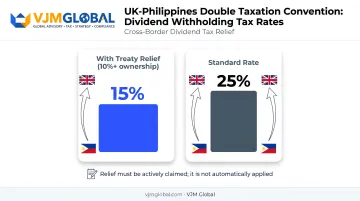
The 1976 UK-Philippines Double Taxation Convention can reduce withholding tax on dividends paid back to UK shareholders to 15% where the UK company holds at least 10% and is the beneficial owner, versus 25% in other cases. Treaty relief isn't automatic. You'll need to actively claim it and satisfy beneficial-ownership conditions.
Your UK Reporting Obligations Don't Disappear
UK-resident directors and shareholders may still owe UK tax reporting on Philippine-sourced income. Setting up abroad doesn't switch off HMRC's interest in your affairs — cross-border tax advice matters here, not just Philippine compliance.
Ongoing Compliance Duties
- BIR filings (returns, VAT, withholding)
- Annual SEC General Information Sheet (GIS), filed through eFAST within 30 calendar days of your annual meeting
- Audited financial statements
- LGU permit renewals
VJM Global's cross-border support on this route is mainly on the UK side. The firm handles Companies House formation, HMRC Corporation Tax registration, Confirmation Statements, CT600 filing, and UK payroll compliance.
That groundwork helps if you keep a UK Ltd running alongside a Philippine entity, or if you need clarity on the UK tax consequences of expanding abroad before you commit capital.
Common Mistakes UK Founders Make When Setting Up in the Philippines
UK founders often hit the same snags when forming a Philippine private limited company. Steer clear of these three:
- No UK Ltd passporting. A British company cannot trade in the Philippines until the foreign corporation obtains an SEC licence and completes separate SEC/DTI registration.
- Ownership caps first. Check the Foreign Investment Negative List (FINL) before choosing a sector, or equity limits surface too late.
- Longer than UK timelines. Budget for a 2-3 month multi-agency process and repeated certified document copies at each stage.
Frequently Asked Questions
Can I have a UK private limited company while living abroad, for example in the Philippines?
Yes. A UK Ltd can generally be owned and directed from outside the UK. You must still keep a UK registered office and file your Confirmation Statement and annual accounts wherever you live.
What is the Philippine equivalent of a UK private limited company or an LLC?
The Philippine Corporation, or the One Person Corporation for solo founders, is the closest structural match. Both offer limited liability and separate legal personality through SEC registration.
Can a UK company own 100% of a Philippine corporation?
In most sectors not restricted by the FINL, yes. You'll need to meet minimum paid-up capital requirements and demonstrate proper inward remittance of funds.
How long does it take to register a corporation in the Philippines?
Realistically, 2-3 months once you factor in SEC/DTI, BIR, LGU, and social agency registrations together.
Do I need a Philippine bank account to incorporate?
Generally, yes. A local account is typically required to show paid-up capital and to run day-to-day operations. That is separate from any UK banking arrangement you already have.
Will I still owe UK tax if I set up a company in the Philippines?
Possibly. Your UK tax residence, the income's source, and the UK-Philippines tax treaty all affect ongoing obligations. This is worth getting professional advice on before you file anything in Manila.