This distinction trips up a lot of founders, both Indian entrepreneurs launching their first venture and foreign companies eyeing the Indian market. Skip a step, misfile a document, or misunderstand your liability as a promoter, and you're looking at delays, penalties, or worse.
This guide walks through promotion, registration, incorporation, and what happens after you get your Certificate of Incorporation. Whether you're a first-time founder or a multinational setting up an Indian subsidiary, you'll find the practical roadmap here.
Key Takeaways
- Promotion and incorporation are legally distinct stages under the Companies Act, 2013
- The Certificate of Incorporation is conclusive proof that your company legally exists
- Picking the right entity type upfront saves months of compliance headaches later
- Foreign entrants face extra FEMA/RBI layers domestic founders do not
- Expert filing support reduces SPICe+ errors and shortens ROC processing time
What is Promotion and Incorporation of a Company
Promotion is a business activity, not a legal act. It's the groundwork: someone conceives the idea, studies feasibility, and decides how the company should be structured.
Section 2(69) of the Companies Act, 2013 defines a promoter as anyone named as promoter in a prospectus, anyone with direct or indirect control over the company's affairs, or anyone whose instructions the board is "accustomed to act on." Professionals acting purely in an advisory capacity don't count.
Incorporation, on the other hand, is a statutory act. It's the moment the Registrar of Companies (ROC) issues legal recognition and the business becomes a separate legal entity.
Think of the journey in four practical stages:
- Promotion – Idea, feasibility, planning
- Registration – Filing documents with the ROC
- Incorporation – Certificate issued, company legally exists
- Commencement of Business – Declaration filed (for companies with share capital)

The key takeaway: promotion is what you do; incorporation is what the law recognises.
Promotion Stage: Role and Responsibilities of Promoters
Promoters do more than generate the business idea. They carry fiduciary duties toward the company they're bringing into existence.
Core promoter functions include:
- Identifying the business opportunity and testing its feasibility
- Deciding company type, proposed name, and initial capital structure
- Negotiating pre-incorporation contracts (property leases, supplier deals, equipment purchases)
- Filing the initial documents with the ROC
Fiduciary Duties and Secret Profits
A promoter can make a profit. What they can't do is make a secret one. Any profit earned through the promotion process must be disclosed, and the company must give informed consent. Hide it, and you're liable to account for it, plus any loss caused by negligent overvaluation or misrepresentation.
Pre-Incorporation Contracts and Liability
Here's something founders often miss: a company can't sign contracts before it legally exists. Any agreement a promoter enters into on the future company's behalf is personally binding on the promoter. That liability lasts until the company, once incorporated, formally adopts (novates) the contract.
Promoter liability under the Companies Act, 2013 doesn't disappear at incorporation either:
- Section 34 – Criminal liability for untrue or misleading statements in a prospectus
- Section 35 – Civil compensation if a subscriber loses money due to a misleading prospectus; fraud makes liability personal and unlimited
- Section 447 – Fraud provisions apply where prospectus misstatements cross into fraudulent territory
Step-by-Step Incorporation Process in India
Once promotion work is done, registration follows a defined sequence through the Ministry of Corporate Affairs (MCA) portal.
- Reserve your company name via SPICe+ Part A. You can propose up to two names; once approved, the name is reserved for 20 days.
- Draft the MoA and AoA – The Memorandum of Association defines your company's objects and capital; the Articles of Association set out internal governance rules.
- File SPICe+ Part B and AGILE-PRO-S – This single integrated form covers company registration, CIN allotment, DIN for directors, and PAN/TAN application. AGILE-PRO-S mandatorily handles EPFO, ESIC, professional tax registration (where applicable), and bank account opening.
- ROC verification and Certificate of Incorporation (CoI) – Once the Registrar is satisfied, it issues the CoI along with a unique Corporate Identification Number (CIN).
- File Form INC-20A – Companies with share capital must file this declaration of commencement of business within 180 days of incorporation before they can start operating or exercise borrowing powers.

MCA's SPICe+ and linked filings guidance covers the exact document sequence in detail, including where e-MoA, e-AoA, and INC-9 fit in.
VJM Global's incorporation support manages the full sequence so founders aren't stuck chasing paperwork:
- Digital signature and DIN procurement
- Name reservation and MoA/AoA drafting
- Filing, ROC query resolution, and CoI issuance
Documents Required for Company Incorporation
Getting documentation right the first time avoids resubmission delays at the ROC.
For the company:
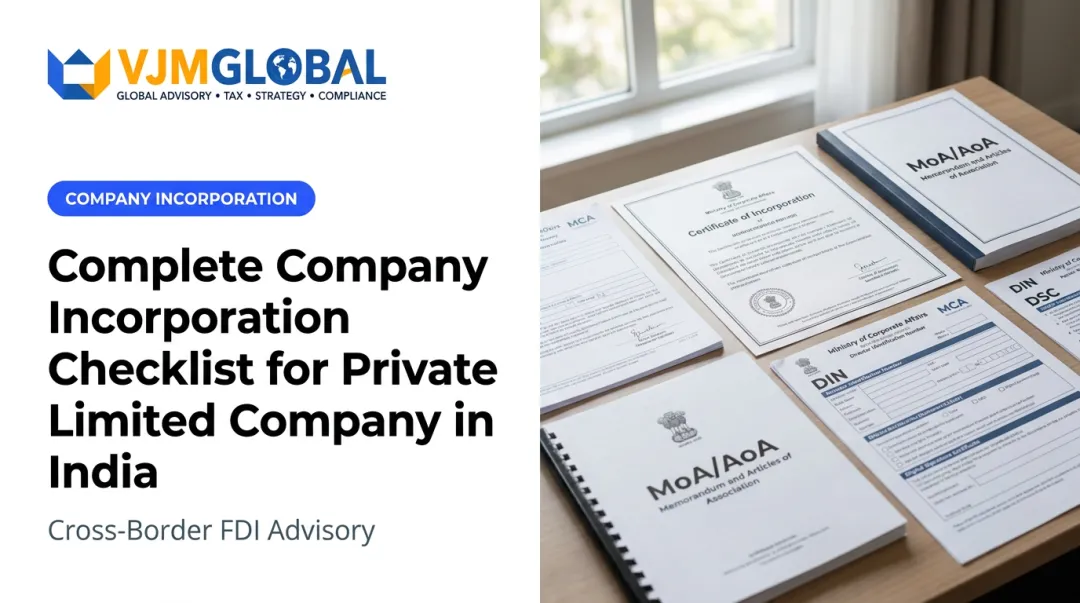
- Memorandum of Association (MoA) and Articles of Association (AoA) defining objects, capital, and governance
- Registered office proof — a utility bill no older than two months
- Rent agreement and landlord No Objection Certificate (NOC) if the premises are leased
For each director/subscriber:
- Identity proof (PAN, Aadhaar, passport, voter ID, or driving licence)
- Address proof — bank statement, electricity bill, or telephone bill, no older than two months
- Passport-size photograph and contact details for digital signature issuance
For foreign nationals:
- Passport is mandatory as identity proof
- Documents executed outside India need notarisation or apostille, depending on the country of execution
Professional declaration: INC-9 is auto-generated electronically where the combined number of directors and subscribers is 20 or fewer and everyone has a Director Identification Number (DIN)/PAN. Beyond that threshold, or where DIN/PAN is missing, a signed physical INC-9 is required instead.
Certificate of Incorporation and Its Legal Effects
The Certificate of Incorporation (CoI) is the legal birth certificate of your company.
Under Section 9 of the Companies Act, 2013, once the CoI is issued, subscribers become a body corporate with:
- Perpetual succession – the company survives even if founders leave or pass away
- Separate legal entity status – the company can own property, sue, and be sued in its own name
- Limited liability – shareholders aren't personally on the hook for company debts (subject to the entity type)
The company's date of existence is the date printed on the certificate, not the date founders receive it. The classic UK case Jubilee Cotton Mills v Lewis established that a certificate of incorporation is treated as conclusive evidence of registration — a principle still cited in Indian company law discussions.
Liability structures vary by entity type:
| Structure | Liability |
|---|---|
| Company limited by shares | Limited to unpaid share value |
| Company limited by guarantee | Limited to guaranteed amount |
| One Person Company (OPC) | Limited, single shareholder |
| Unlimited company | No cap on member liability |

Choosing the Right Structure for Foreign and Domestic Businesses
Structure decisions made at incorporation ripple through years of compliance. Get this wrong and you're stuck restructuring later, an expensive and time-consuming process.
Private vs. Public Company
Most Indian promoters and foreign entrants start with a private limited company: fewer shareholders, simpler compliance, and no minimum capital requirement.
Public companies suit businesses planning to raise capital from the public. They carry heavier disclosure and governance obligations in return.
Foreign Entry Options
Foreign companies entering India generally choose between:
- Wholly Owned Subsidiary (WOS) – A separate Indian legal entity; liability is generally limited to the parent's shareholding, governed by its own MoA and AoA
- Branch office – An extension of the parent company; carries unlimited liability and typically conducts the parent's existing business rather than a new one
- Liaison office – Representational only, no commercial activity; requires a three-year profit-making track record and minimum net worth of USD 50,000
- Project office – Set up for a specific Indian contract, valid for the project's tenure
- Joint venture or LLP – Shared-ownership paths with Indian partners (equity JV or LLP, depending on control and liability needs)

All these routes add FEMA and RBI layers that purely domestic incorporations do not face. Expect sector caps under the Automatic or Government Route, reporting through the FIRMS portal, and ongoing FDI compliance.
Choosing among these options means aligning entity type, capital, and FDI route before filings start. VJM Global helps foreign entrants compare WOS versus branch office, structure capital, and coordinate FEMA/RBI approvals with ROC filings so entry stays on timeline with fewer rework loops.
Frequently Asked Questions
What is promotion and incorporation of companies?
Promotion is the pre-incorporation groundwork: idea, feasibility, planning. Incorporation is the formal legal registration under the Companies Act, 2013, that gives the company its separate legal existence.
What does it mean for a company to be incorporated in India?
Incorporation grants the company separate legal entity status, perpetual succession, and the right to hold property, contract, and sue or be sued in its own name, independent of its founders or shareholders.
Who is eligible for a certificate of incorporation?
Eligibility depends on submitting a complete package (MoA, AoA, director consents, and registered office proof) that satisfies the Registrar of Companies. Incomplete filings trigger queries and delays.
How long does company incorporation take in India?
There's no fixed official benchmark. Timelines depend on name approval speed, document completeness, and how quickly ROC queries (if any) get resolved.
What is the difference between promoter and director?
A promoter's role is pre-incorporation: conceiving the business and setting it up. A director's role begins post-incorporation, managing the company's day-to-day affairs and statutory compliance.
Is a certificate of commencement of business still required?
No. The earlier commencement certificate has been replaced by a declaration under Form INC-20A, which companies with share capital must file within 180 days of incorporation.