Yet many first-time founders, NRIs, and foreign investors setting up in India misunderstand what registration actually changes. Does the company own the assets, or do the shareholders? Who's liable if a vendor contract goes wrong? When does personal liability protection actually begin?
Section 9 of the Companies Act, 2013 answers these questions directly. This article breaks down what the section says, explains each legal effect in plain language, and shows why it matters for businesses and foreign investors entering the Indian market.
Key Takeaways
- Section 9 grants body corporate status from the date of incorporation
- Registration ensures perpetual succession, surviving ownership changes or member exits
- Companies gain power to own property, contract, and sue or be sued independently
- The 2015 amendment made the common seal optional, not compulsory
- Foreign investors must weigh this separate legal identity when structuring their India entry
What Is Section 9 of the Companies Act, 2013?
Section 9 sits in Chapter II of the Companies Act, 2013, titled "Incorporation of Company and Matters Incidental Thereto." Here's the statutory language:
"From the date of incorporation mentioned in the certificate of incorporation, such subscribers to the memorandum and all other persons, as may, from time to time, become members of the company, shall be a body corporate by the name contained in the memorandum, capable of exercising all the functions of an incorporated company under this Act and having perpetual succession with power to acquire, hold and dispose of property, both movable and immovable, tangible and intangible, to contract and to sue and be sued, by the said name."
How It Connects to Sections 7 and 8
Section 9 doesn't operate in isolation. Section 7 lays out the incorporation procedure: the documents filed, the compliance declarations, and the Registrar's issuance of the certificate. Section 9 spells out what happens next.
Registration under Section 7 is the trigger. Section 9 is the consequence.
The effects apply "as from the date of incorporation," meaning the exact date printed on the Certificate of Incorporation, not the filing date or approval date. This applies uniformly across:
- Private limited companies
- Public limited companies
- One Person Companies (OPCs)
- Section 8 companies (charitable/non-profit entities)
A Brief Comparison to the 1956 Act
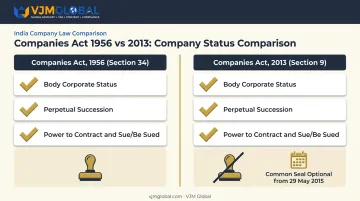
Section 9 isn't a new idea. Its predecessor, Section 34 of the Companies Act, 1956, used almost identical language — body corporate status, perpetual succession, and the power to contract and litigate. The one notable difference: the 1956 provision required a common seal.
The Companies (Amendment) Act, 2015 removed that requirement. Companies can now authenticate documents through authorised signatories instead of a physical seal, effective from 29 May 2015.
Key Effects of Registration Under Section 9
Registration produces five distinct legal effects, all operative from the date of incorporation. Together, they form the legal foundation every registered company stands on.
Becomes a Body Corporate
Subscribers to the memorandum, along with all subsequent members, become a body corporate under the name stated in the certificate of incorporation. This grants the company a legal personality entirely distinct from its owners, forming the foundation of the separate-entity principle in Indian company law.
Capable of Exercising All Functions of an Incorporated Company
This effect confirms full legal capacity. The company can act, decide, and operate exactly as any incorporated entity is empowered to under the Act, with no partial or conditional status.
Perpetual Succession
The company's existence doesn't depend on any individual. Death, insolvency, or exit of a member or director doesn't affect the company's standing.
In The Associated Journals Ltd. & Anr. v. Land & Development Office (Delhi High Court, 2019), the court confirmed that a change in shareholding pattern doesn't change the company's identity. The company, not its shareholders, owns its property and continues its legal existence regardless of who holds the shares.
Power to Acquire, Hold, and Dispose of Property
A registered company can own property in its own name:
- Movable and immovable assets
- Tangible property like office equipment or inventory
- Intangible property like trademarks or intellectual property
This ownership sits entirely separate from any individual member's personal assets.
Power to Contract and to Sue or Be Sued
The company enters contracts, initiates legal proceedings, and defends against claims solely in its own name. Members don't need to be named individually, and this structure shields them from personal litigation exposure tied to company disputes.
Separate Legal Entity and Perpetual Succession Explained
The idea that a company is legally distinct from the people who own it rests on more than statutory language in India. It reflects a legal doctrine with over a century of precedent behind it.
The Foundational Case
In Salomon v. A. Salomon & Co. Ltd. [1897] AC 22, the House of Lords held that once validly incorporated, a company is a legal person separate from its subscribers. Mr. Salomon's dominant ownership and control didn't erase the company's independent identity: its debts and liabilities remained the company's own, not his.
Indian courts adopted the same reasoning. In Bacha F. Guzdar v. Commissioner of Income-Tax, Bombay (AIR 1955 SC 74), the Supreme Court held that a shareholder does not own the company's property. A shareholder's rights are limited to dividends when declared, a share in winding-up surplus, and rights under the articles, not ownership of corporate assets.
What This Means Practically
Together, separate legal personality and perpetual succession produce real business consequences:
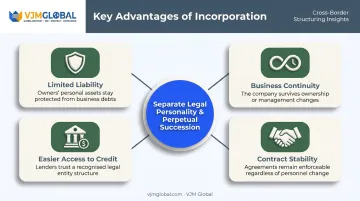
- Limited liability: Company debts generally can't be recovered from members' personal assets
- Business continuity: A company can trade for decades, surviving complete turnover of its original shareholders
- Easier access to credit: Lenders and investors deal with the entity, not fluctuating individuals
- Contract stability: Long-term agreements don't collapse when a founder exits or passes away
The Corporate Veil Exception
Section 9's protections aren't absolute. Courts can "lift the corporate veil" and disregard separate legal entity status in specific situations.
In Life Insurance Corporation of India v. Escorts Ltd. (1986) 1 SCC 264, the Supreme Court identified circumstances where veil-lifting applies:
- When a statute explicitly contemplates it
- To prevent fraud or improper conduct
- Where a taxing or beneficent statute is being evaded
- Where associated companies are so interconnected they're effectively one entity
The Court noted these categories aren't exhaustive. Courts assess each case on its facts.
Section 9 in Context: Related Provisions
Section 9 doesn't stand alone. It fits into a broader statutory sequence:
- Section 7 determines what gets filed with the Registrar, including the memorandum, articles, and subscriber details that shape the certificate of incorporation.
- Section 8 governs charitable and non-profit companies. These entities receive the same Section 9 effects as commercial companies (corporate status, perpetual succession, and property and contracting powers) despite different objects and dividend rules.
- Section 10 complements Section 9 by making the memorandum and articles a binding contract between the company and its members. It governs how internal rules bind everyone connected to the entity Section 9 creates.
Understanding this chain matters because errors at the Section 7 filing stage, such as a mismatched subscriber detail or an incomplete declaration, can delay when Section 9's protections actually activate.
Practical Implications for Businesses and Foreign Investors
For foreign companies and NRIs/OCIs setting up an Indian subsidiary or private limited company, Section 9 isn't abstract legal theory. It determines exactly when a business can start operating with full legal protection.
Once the Certificate of Incorporation is issued, a validly registered company can immediately:
- Open bank accounts in its own name
- Own or lease office property
- Sign vendor and employment contracts
- Raise capital as an independent legal entity
The catch: these rights don't begin until the certificate is actually issued. Errors during registration, such as mismatched documents, incomplete director details, or name approval rejections, postpone the date these protections start.
Because these errors are easy to make and costly to fix, professional guidance matters. At VJM Global, we manage this process end-to-end for foreign investors and NRIs/OCIs, including:
- Obtaining Digital Signature Certificates and Director Identification Numbers
- Securing name approval through the RUN application
- Preparing and filing the Memorandum and Articles of Association
- Handling PAN, TAN, and GST registration post-incorporation

A straightforward registration typically takes 10 to 15 working days when documentation is accurate from the start. For NRIs, OCIs, and foreign nationals serving as directors, additional requirements apply: notarized passports and address proof, plus certified translations for non-English documents.
Section 9's protections aren't permanent, however. Companies must maintain ongoing compliance, including annual filings, statutory registers, and audits, to preserve their standing on the register. A company that falls out of compliance risks losing the very protections registration granted it.
Frequently Asked Questions
What are the effects of company registration?
Registration makes the company a body corporate with perpetual succession. It gains the power to own property, enter contracts, and sue or be sued entirely in its own name, separate from its members.
What is Section 9 of the Companies Act, 2013?
It's the provision defining the legal consequences of incorporation. These effects take hold from the exact date stated on the Certificate of Incorporation, not the application date.
Does Section 9 apply to One Person Companies (OPC) as well?
Yes. Section 9 applies uniformly to every company type registered under the Act, including OPCs, private and public companies, and Section 8 non-profit entities.
Is a common seal mandatory for a company after registration?
No. The Companies (Amendment) Act, 2015 removed this requirement. Authorized signatories can validly execute documents without a physical seal.
What happens if a company's registration is later found to be invalid or defective?
Acts done in good faith before a defect is discovered remain protected. However, the Tribunal or RoC can take corrective action, including regulating management or, in serious cases, striking the company off the register.
How does perpetual succession benefit shareholders and creditors?
It guarantees business continuity regardless of ownership changes. Creditors, employees, and long-term investors can rely on contractual stability even as individual shareholders come and go.