The post-2021 political environment, active US sanctions, and foreign-exchange controls make this process fundamentally different from setting up in Vietnam, Thailand, or Indonesia. Getting it right depends on correct structuring, a workable resident-director arrangement, and serious compliance screening before you commit a dollar.
This guide walks through the exact DICA registration steps, PLC-specific eligibility rules, the sanctions and compliance risks unique to US investors, and the mistakes that sink filings or trap capital.
Key Takeaways
- Myanmar PLCs need three directors minimum, including one Myanmar citizen resident in-country (private companies need one)
- Register entirely through DICA’s MyCO portal; PLC filing fee is about MMK 2,500,000 (~US$1,190)
- The US has no investment or tax treaty with Myanmar; active OFAC sanctions create real compliance exposure
- A cross-border formation specialist with sanctions screening cuts filing delays and legal risk
How to Register a Public Limited Company in Myanmar from the USA
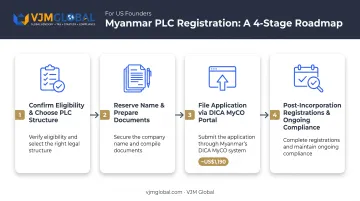
Step 1: Confirm Eligibility and Choose the PLC Structure
Before filing anything, verify a PLC is actually the right vehicle. Ask yourself:
- Does the business genuinely need to raise capital from more than 50 shareholders, or plan a future Yangon Stock Exchange listing?
- Can the founding group meet the minimum three-director requirement, including one Myanmar citizen who is ordinarily resident in the country?
- Does the intended business activity sit on Myanmar's investment "negative list," which restricts foreign ownership in certain sectors and may force a joint venture instead?
If you can't answer yes to the first two, a private company or joint venture is often the faster, cheaper route (more on that below).
Step 2: Reserve the Company Name and Prepare Incorporation Documents
Once PLC status makes sense, search and reserve a distinguishable company name ending in "Limited" through the DICA MyCO online portal. This step is quick, but the document preparation behind it takes more effort.
You'll need to compile:
- Shareholder and director identification documents for every named individual
- A Myanmar registered office address (a PO box won't work)
- A company constitution, either DICA's model version or a customized one
As a US-origin shareholder, check the current MyCO document prompts carefully. DICA's published forms don't state a blanket notarization or apostille requirement for foreign shareholders, but individual banks or specific transactions may still request certified copies.
Don't assume you need an apostille by default. Confirm what the portal or your receiving bank actually asks for.
Step 3: File the Incorporation Application with DICA via MyCO
Submit the online application, covering the constitution, director and shareholder details, and registered address. MyCO operates 24 hours a day, seven days a week, and DICA publishes no fixed mandatory waiting period; the certificate typically follows once the fee is paid.
Speaking of fees, expect to pay the PLC registration charge of roughly MMK 2,500,000 (~US$1,190), substantially higher than the private company fee.
Here's where many US founders get stuck: if your ownership group can't independently satisfy the resident-director rule, you'll need a qualified Myanmar-citizen nominee director.
That gap is common for US entrepreneurs with no local presence. A cross-border formation firm such as VJM Global can help source a candidate and verify their standing before you name them on the filing.
Step 4: Complete Post-Incorporation Registrations and Ongoing Compliance
Getting your Certificate of Incorporation isn't the finish line. Next comes:
- Register for a Tax Identification Number with the Internal Revenue Department (Business Taxpayer Registration Form, no later than one month before operations begin)
- Open a corporate bank account — banks typically require in-person verification of at least one authorized signatory
- Apply for a Myanmar Investment Commission (MIC) permit if the project is capital-intensive, in a promoted sector, or needs state land access
- Calendar recurring PLC obligations, including the first AGM, annual audited financials, and the DICA annual return
MIC permits (often relevant above roughly US$100 million, or when state land is involved) can support land leases of up to 50 years plus two 10-year extensions, and income-tax holidays of 3 to 7 years depending on zone. Hold your first AGM within 18 months of incorporation and yearly after that. File the DICA annual return within two months of incorporation, then annually, with mandatory externally audited financial statements.
Eligibility Requirements for US Investors Setting Up a Myanmar PLC
Directors and Residency Rules
Myanmar's Companies Law sets a hard floor: at least three directors, with a minimum of one Myanmar citizen ordinarily resident in the country. "Ordinarily resident" means either a permanent resident or someone physically present in Myanmar for at least 183 days in each 12-month period starting from the registration date.
One detail trips up US parent companies constantly: corporate directors aren't permitted. Every director must be a natural person aged 18 or older. If your US entity planned to appoint itself or a subsidiary as a board member, that structure won't fly, and you'll need to name individuals instead.
Shareholders and Foreign Ownership Limits
Unlike a private company's 50-shareholder cap, a PLC has no limit on the number of members, and shares can be held by individuals or corporate entities of any nationality.
The number that matters more is 35%. Under the Myanmar Companies Law 2017, foreign shareholding at or below this threshold keeps a company classified as "local." Cross above 35%, and the company gets reclassified as foreign, triggering sector-specific restrictions that may not have applied before.
That reclassification affects land lease eligibility and which activities you can pursue without a local partner.
Capital, Registered Office and Documentation
There's no general statutory minimum share capital for a PLC; a company needs just one issued share to incorporate. That said, specific sectors carry their own fixed minimums:
- Wholly foreign-owned wholesale trading: roughly US$5 million
- Wholly foreign-owned retail trading: roughly US$3 million
- Public share offerings: at least MMK 500 million subscribed, with 5% received in cash before allotment
You will also need:
- A genuine Myanmar registered office address
- Complete director and shareholder KYC files
- Your constitution and a clear business activity description
Critical Risks and Compliance Mistakes for US Investors
This is where Myanmar diverges sharply from most other Southeast Asian markets, and where most of the real risk actually lives.
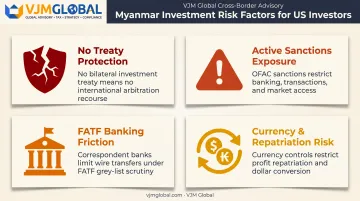
No treaty protection. The US has neither a bilateral investment treaty nor a tax treaty with Myanmar. That removes the standard investor protections and double-tax relief available almost everywhere else you might set up shop.
Active sanctions exposure. OFAC maintains an active Burma sanctions program, including designations against military-linked holding companies like Myanma Economic Holdings Limited and Myanmar Economic Corporation. These entities operate across trading, resources, telecommunications, and consumer goods.
Screen every local partner, landlord, and supplier against the OFAC SDN list and the US Consolidated Screening List before signing anything. Without that check, you can end up tied to a sanctioned counterparty without realizing it.
FATF-driven banking friction. Myanmar remains on the FATF's high-risk jurisdiction list, meaning US-dollar transactions routed through Myanmar banks face enhanced due diligence. Many correspondent banks simply refuse to process them, which complicates something as basic as injecting capital into your new entity.
Currency and repatriation risk. Central Bank of Myanmar foreign-exchange controls, combined with a volatile kyat, can trap profits in-country or force conversion at unfavorable fixed rates. The gap between official and market exchange rates has swung wildly in recent years, adding real uncertainty to any repatriation plan.
Beyond the structural risks, two filing mistakes come up again and again:
- Assuming a single US shareholder can also serve as sole director without a Myanmar-resident co-director — this gets DICA filings rejected outright
- Ignoring PLC-specific ongoing obligations like the mandatory audit and AGM, which don't apply to small private companies but carry real penalties for a PLC that skips them
Given the treaty gap and sanctions complexity, have a firm with multi-jurisdiction compliance experience, such as VJM Global, run screening and structure the entity before any capital moves.
Public Limited Company vs Other Myanmar Business Structures
A PLC isn't always the right entry point. These three alternatives fit different capital, liability, and sector-access goals.
Private Limited Company
When it's better: A single-owner subsidiary or small trading operation that doesn't need public capital or more than 50 shareholders.
Key trade-offs: Registration runs roughly US$143, far below the PLC fee, with simpler governance and no mandatory external audit. The catch: you can't list shares or raise capital from the public.
Branch or Representative Office
When it's better: A US company wanting a market-entry presence or the ability to execute contracts without forming a separate Myanmar legal entity.
Key trade-offs: No new liability shield—the branch or rep office is the overseas parent's registered presence, not a separate company. The US parent bears full legal liability, and a representative office generally can't trade for its own profit.
Joint Venture with a Local Partner
When it's better: Restricted sectors that require a Myanmar citizen or entity to hold a minimum stake, typically 20% of charter capital unless a specific notification says otherwise.
Key trade-offs: You share control and profit with a local partner, but gain easier navigation of sector restrictions and faster local market access than going it alone.
Conclusion
Registering a Myanmar PLC through DICA's MyCO system is, mechanically, straightforward. The portal runs around the clock, the forms are clear, and there's no mandatory waiting period holding up your certificate.
The real difficulty sits elsewhere. Success depends on meeting the resident-director and governance requirements built specifically for public companies. For a US investor, the larger threats sit outside the filing itself:
- Sanctions exposure
- Foreign-exchange controls
- No treaty protections of the kind most other markets take for granted
Screen these risks before incorporation, not after. That sequencing, more than any filing detail, separates a durable Myanmar entity from a costly, exposed one.
Frequently Asked Questions
How much does it cost to register a company in Myanmar?
DICA's official PLC registration fee runs around MMK 2,500,000 (~US$1,190), compared to about MMK 300,000 (~US$143) for a private company. Add separate costs for licenses, a registered office, and professional fees.
How many public companies are listed in Myanmar?
The Yangon Stock Exchange has roughly eight main-board issuers as of early 2026. Several large "public company limited" entities are military-linked conglomerates under active US sanctions, so run due diligence on any partner.
Can a US citizen own 100% of a Myanmar company?
Under the Myanmar Companies Law 2017, foreign ownership above 35% reclassifies a company as "foreign." Fully foreign-owned companies remain possible in most non-restricted sectors, though restricted activities carry added conditions or require a local joint-venture partner.
Is it safe for a US business to invest in Myanmar right now?
The State Department's 2025 Investment Climate Statement flags heightened political, reputational, and financial risk for foreign firms operating in Myanmar. Run enhanced due diligence before you commit capital.
How long does it take to register a PLC in Myanmar?
DICA processes MyCO filings without a mandatory waiting period, so incorporation itself can take just days. Licensing, bank account opening, FATF-related banking checks, and any MIC permits usually extend the full timeline to several weeks.
Do I need to travel to Myanmar to incorporate a company?
Incorporators generally aren't required to be physically present for DICA filing, since the process runs online through MyCO. Opening a corporate bank account, though, typically requires an authorized signatory to appear in person for verification.