But this isn't Vietnam or Thailand. Myanmar's post-2021 political upheaval, UK sanctions alignment with the US and EU, and strict foreign-exchange controls change the calculation entirely.
This guide walks through DICA registration via the MyCO portal, eligibility rules for UK investors, the compliance risks that catch people out, and how a private company stacks up against Myanmar's other structures.
Key Takeaways
- A private limited company needs only one director and one shareholder — but one director must be ordinarily resident in Myanmar
- Registration costs MMK 300,000 via DICA’s online MyCO portal, with no fixed statutory timeline
- UK investors have no bilateral investment treaty cover, and UK sanctions still apply to military-linked entities
- Screening partners, landlords, and suppliers before incorporation matters more than the filing itself
How to Register a Private Limited Company in Myanmar from the UK
Step 1: Confirm Eligibility and Structure the Shareholding
A private company suits most UK entrants: it allows up to 50 shareholders and doesn't require public capital raising.
Before you go further, check:
- Restricted activities under MIC Notification 15/2017 may need a Myanmar partner holding at least 20% of charter capital
- A director ordinarily resident in Myanmar is required for private companies, not only PLCs
- A local nominee director if none of your team qualifies as resident
This resident-director requirement is the detail most UK founders miss. It's not optional, and it shapes everything that follows.
Step 2: Reserve the Company Name and Prepare Documents
Search and reserve a distinguishable company name ending in "Limited" through MyCO. Then compile:
- Shareholder and director identity documents
- A genuine Myanmar registered office address (a PO box won't do)
- A company constitution, either DICA's model or a bespoke version
DICA doesn't mandate blanket apostille or notarisation for foreign shareholder documents. That said, confirm what your receiving bank specifically requests, because banking requirements often run stricter than DICA's own filing rules.
Step 3: File the Incorporation Application via MyCO
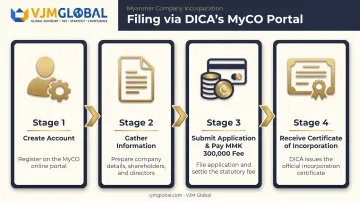
MyCO's process runs in four stages: create an account, gather the required information, complete the online application, and receive your Certificate of Incorporation. The portal operates continuously, and no mandatory waiting period appears in DICA's published guidance.
- Submit your application, covering constitution, director and shareholder details, and registered address
- Pay the MMK 300,000 registration fee
- Receive the Certificate of Incorporation once approved
No in-person appearance is required for the DICA filing; the process is entirely electronic.
If you lack a Myanmar-resident director, a cross-border formation specialist such as VJM Global can help source and vet a qualified local director before you name them on the application.
Step 4: Complete Post-Incorporation Registrations
Incorporation is only the starting line. Before trading, you'll typically need to:
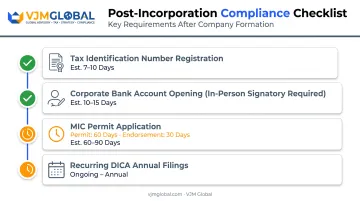
- Register for a Tax Identification Number with the Internal Revenue Department
- Open a corporate bank account, which usually involves in-person verification of an authorised signatory
- Apply for an MIC permit if the project is capital-intensive, uses state land, or has major environmental impact (about 60 days for a permit or 30 days for an endorsement, plus up to 10 working days to issue)
- Calendar recurring obligations, including DICA's annual return and financial filings
Taken together, these stages push the full operational timeline well beyond the MyCO filing, often by several weeks once licensing and banking checks are included.
Eligibility Requirements for UK Investors
Myanmar's Companies Law 2017 sets out clear rules for private companies:
- Minimum one director and one shareholder, who may be the same person
- At least one director ordinarily resident in Myanmar — a point many overseas investors miss
- No general statutory minimum share capital, though sector-specific thresholds apply (for example, wholly foreign-owned wholesale and retail trading)
- Foreign shareholding above 35% reclassifies the company as "foreign" and triggers sector restrictions, particularly around land leases
- Full KYC for all directors and shareholders, plus a genuine registered office address
A common misreading treats 35% as an ownership cap. It isn't. It's a classification threshold. Cross that line and your company becomes subject to different rules; you are not barred from holding more.
Critical Risks and Compliance Considerations for UK Investors
Treaty and Sanctions Exposure
The UK has no bilateral investment treaty with Myanmar, so standard investor protections available in many other markets simply don't exist here.
On top of that, the UK maintains sanctions against military-linked conglomerates, including entities such as Myanmar Timber Enterprise and Myanmar Gems Enterprise. These measures apply to UK-incorporated businesses worldwide and extend to entities owned or controlled by designated persons.
Check the UK Sanctions List before engaging any local partner, landlord, or supplier. This isn't a one-off check either — the list gets updated regularly, and your due diligence should too.
Banking and Currency Friction
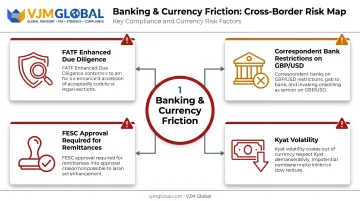
Myanmar remains on FATF's list of jurisdictions subject to a call for action as of June 2026, meaning enhanced due diligence applies (though not formal countermeasures, for now). In practice, this means:
- GBP and USD transactions face additional scrutiny
- Some correspondent banks decline to process Myanmar-linked payments entirely
- Outward remittances, including dividends, require prior approval from Myanmar's Foreign Exchange Supervisory Committee
Kyat volatility compounds this. Profits can get trapped or forced through unfavourable conversion rates if you haven't planned for it.
The Filing Mistake That Delays Everything
Founders frequently assume an informal shareholder agreement is enough. It isn't. DICA expects a properly drafted constitution, and gaps here are one of the most common reasons applications stall.
Private Limited Company vs Other Myanmar Business Structures
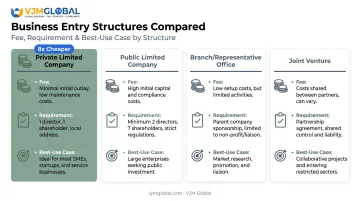
| Structure | Fee | Key requirement | Best for |
|---|---|---|---|
| Private limited company | MMK 300,000 | One director, at least one Myanmar-resident | Most UK entrants; fastest route to operating |
| Public limited company | MMK 2.5 million | Three directors, including a Myanmar-resident citizen | Businesses needing 50+ shareholders or a future Yangon Stock Exchange listing |
| Branch/representative office | Not standardised | Full UK parent liability applies | Market testing without a separate legal entity; representative offices generally cannot trade for profit |
| Joint venture | Sector-dependent | Myanmar partner holds minimum stake | Restricted sectors under MIC Notification 15/2017, typically requiring 20% local investment |
The private limited company wins on cost and speed: roughly 8x cheaper than a public company registration. Cheaper filing does not cut total compliance work — it shifts complexity onto the resident director, sanctions screening, and banking steps covered above.
Getting the Sequencing Right
DICA's MyCO system makes the paperwork side of private company registration genuinely fast. That's not where UK investors get tripped up.
The real complexity sits elsewhere:
- Resident-director planning before you file
- Sanctions screening against a live and shifting list
- Currency controls that can trap profits if you have not modelled them upfront
Do the due diligence before incorporation, not after. Advisers such as VJM Global can help structure those checks properly rather than treating them as an afterthought. That sequencing is what separates a durable Myanmar entity from a costly, exposed one.
Frequently Asked Questions
How much does it cost to register a private company in Myanmar?
DICA's official fee is MMK 300,000 for a private company. Budget separately for registered office costs, any required licences, and professional fees if you use a formation specialist.
Can a UK citizen own 100% of a Myanmar private company?
Often, yes. The 35% threshold reclassifies a company as "foreign" rather than capping ownership outright. Full foreign ownership remains possible outside restricted sectors, though land-related activities face extra limits.
Is it safe for a UK business to invest in Myanmar right now?
International investment climate assessments, including the World Bank's 2026 monitor, flag heightened political and financial risk. Enhanced due diligence on partners and counterparties is essential before committing funds.
How long does it take to register a private company in Myanmar?
The MyCO filing itself can be completed in days once documents are ready. Factor in licensing, banking checks, and any MIC permit reviews, and the full timeline typically runs to several weeks.
Do I need to travel to Myanmar to incorporate a company?
No. DICA's filing process runs entirely online. Opening a corporate bank account, however, usually requires an authorised signatory to appear in person.
Do I need a local resident director to set up a private company in Myanmar?
Yes. Myanmar's Companies Law requires at least one director ordinarily resident in Myanmar for private companies too, not just PLCs.