Many US-based entrepreneurs, NRIs, and established freight forwarders are watching this trend and asking the same question: is now the time to build an air cargo business in India? The appeal is real. There's predictable B2B demand, a genuinely open cargo policy, and lower entry barriers than launching a passenger airline. India also sits at a useful crossroads between Asia, the Middle East, and Europe.
Interest is coming from several directions at once: US freight forwarders wanting an India arm, NRI founders with local know-how, e-commerce sellers who need captive logistics, and investors drawn to India's infrastructure push. This guide walks through what it actually takes to build one, step by step.
Key Takeaways
- Pick your model first—freight forwarder, customs broker, or cargo airline—since capital and licensing differ sharply
- Subsidiary, branch, or JV choice drives liability, tax exposure, and how fast you can operate
- IATA/CASS, Customs Broker License, GST, and IEC are the baseline before you can legally operate
- Forwarding and brokerage need modest capital; a licensed cargo airline is a far higher investment tier
- A cross-border firm like VJM Global can coordinate entity setup, licensing, and compliance on the India side
What Is an Air Cargo Business?
An air cargo business arranges, books, or physically moves freight by air on behalf of shippers, domestically, internationally, or both. The value is operational: space booking, customs clearance, documentation, and cargo handling done reliably and on time.
That value shows up in a few common business formats:
- IATA-accredited freight forwarding agency: books cargo space directly with airlines and settles through CASS
- Customs house agent/broker: clears shipments through customs on behalf of importers and exporters
- Integrated air logistics provider: combines forwarding, warehousing, and last-mile delivery under one roof
- Cargo airline/charter operator: owns or leases aircraft under a DGCA Air Operator Certificate
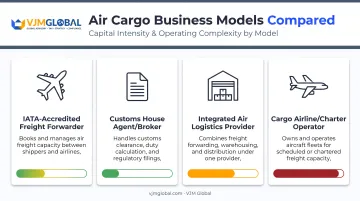
The first three options sit in professional-services territory: manageable capital, faster setup, and lower regulatory friction. A cargo airline is a different proposition, with DGCA certification, safety oversight under Rule 134A, and multi-crore capital requirements before a single flight takes off.
Most US founders exploring this space start with forwarding or brokerage, then scale from there.
Why Start an Air Cargo Business in India (When It Makes Sense)
Entering India's air cargo market makes sense under the right conditions. It isn't a guaranteed win, given how entrenched established players already are. Know what's driving the opportunity before you commit capital.
A Market That's Still Growing
Indian airports handled 3.70 million tonnes of cargo in FY2024-25. Industry analyst ICRA expects growth to continue at 4%-6% for FY2026, split between 5%-7% domestic expansion and 2%-4% international growth.
That's slower than the pandemic-recovery years, but it's still consistent forward motion in a sector many assumed had already peaked.
Behind those numbers:
- E-commerce parcels and cross-border express shipments keep volumes flowing even when broader trade slows
- Pharma, vaccines, and biologics require the speed only air freight can deliver
- Electronics and smartphones remain high-value, time-critical cargo categories
Structural Advantages Unique to This Sector
Two policy features set air cargo apart from most other India-entry plays:
- Open Sky policy for all-cargo flights. Under DGCA's 2024 Open Sky policy for non-scheduled cargo flights, foreign charter operators can fly cargo-only aircraft into any Indian international airport without co-terminal restrictions for three years. Scheduled foreign cargo still needs bilateral agreements; ad hoc charter space does not.
- 100% FDI under the automatic route. Non-scheduled air transport (cargo and charter) allows 100% FDI with no prior government approval. Pure freight forwarding isn't a DGCA aircraft category, so it usually falls under the residual-sector rule—also up to 100% automatic-route FDI.
Infrastructure Catching Up With Demand
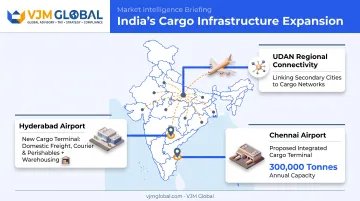
Government-backed cargo terminal expansion is opening options beyond the traditional Delhi-Mumbai axis. Hyderabad's airport operator is upgrading its cargo terminals with dedicated space for domestic freight, express courier, and export perishables, plus new warehousing.
Chennai has a proposed integrated cargo terminal targeting 300,000 tonnes of annual capacity. UDAN-linked regional connectivity is also pulling cargo toward secondary cities, not just the airports that have historically dominated volumes.
None of this guarantees profitability. For founders who pick the right niche and hub, though, the underlying conditions are more favorable than they've been in years.
How to Start an Air Cargo Business in India – Step by Step
Starting an air cargo business in India takes more than a generic company-registration checklist. Three mistakes come up again and again: underestimating how long IATA accreditation takes, treating freight-forwarding and cargo-airline licensing as interchangeable, and skipping bonded warehouse planning until it's too late.
Step 1 – Define Your Air Cargo Business Model
Before registering anything, decide what you're actually building:
- Freight-forwarding agency — books space, handles documentation, moderate capital
- Customs broker/CHA — clears cargo through customs, requires CBLR licensing
- Integrated air logistics company — combines forwarding with warehousing and delivery
- Full cargo airline — owns or operates aircraft, DGCA-certified, capital-intensive
The gap between the first three and the last is enormous. Think six-figure dollar setups versus multi-million-dollar fleets and safety certification. Most US founders start with forwarding or brokerage.
Pick your target cargo segment early too, whether that's e-commerce parcels, pharma and perishables, or general industrial cargo. This choice shapes which licenses you need and which hub makes sense.
Step 2 – Choose Entry Structure & Register Your Entity
Three main routes exist for US founders:
- Wholly owned subsidiary (Pvt Ltd) — a separate legal entity with liability limited to shareholding; requires at least 2 directors (1 India-resident) and 2 shareholders
- Branch office — an extension of the US parent, carrying unlimited liability, requiring RBI approval, and potentially facing income tax up to 40%
- JV with an established Indian forwarder — faster market access through an existing partner, but requires due diligence and FDI clearance where applicable
Most US founders choose the subsidiary route for liability protection and cleaner tax treatment, though a JV can shortcut the relationship-building that air cargo depends on.
Once the structure is chosen, complete the basics:
- PAN and TAN registration
- GST registration
- Import Export Code (IEC) — a 10-digit DGFT code mandatory for any cross-border cargo activity
Step 3 – Obtain Air Cargo-Specific Licenses and Accreditations
Three approvals matter most here:
- IATA accreditation/CASS membership — required to book cargo space directly with airlines rather than as a sub-agent
- Customs Broker License under CBLR 2018 — required to offer customs clearance services
- Regulated Agent/BCAS security clearance — required for airside cargo handling at certified terminals; confirm with BCAS against your physical setup
IATA’s accreditation process runs about 25 days, not counting company setup beforehand. CBLR licensing means passing NACIN written and oral exams (up to six attempts), showing at least ₹5,00,000 in assets, and posting a matching security deposit. After you pass, the license fee is ₹5,000 and validity runs 10 years.
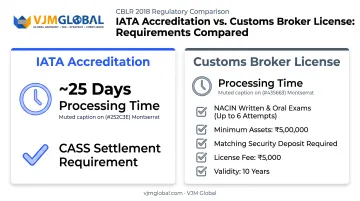
Don't assume IATA and CBLR run on the same clock. They're separate processes with separate exam cycles and separate application portals.
Step 4 – Plan Capital, Tax Structure, and Cross-Border Compliance
Budget beyond the obvious licensing fees:
| Cost Item | Amount |
|---|---|
| CBLR application fee | ₹500 |
| Customs Broker license fee | ₹5,000 |
| Customs Broker security deposit | ₹5,00,000 |
| Customs Broker renewal (10-year) | ₹15,000 |
| IATA financial security | Assessed case-by-case |
Build in a buffer for compliance delays. Exam cycles, audited financials, and premises verification all take longer than founders expect.
On the tax side, structure income flows with the India-US DTAA in mind to avoid double taxation. Prepare for FEMA reporting, specifically Form FC-GPR, the moment foreign capital enters your Indian entity.
Firms like VJM Global coordinate entity setup, FDI structuring, and FEMA filings in parallel so these steps don’t stack into a last-minute scramble.
Step 5 – Set Up Operations at a Key Air Cargo Hub
Pick a hub based on cargo volume and connectivity, not just city size:
| Hub | FY2024-25 Cargo Throughput |
|---|---|
| Delhi (IGI) | 1,109,519 tonnes (729,784 international) |
| Mumbai (CSMIA) | 889,899 tonnes (654,756 international) |
| Bengaluru (BLR) | 502,508 tonnes (321,283 international) |
| Hyderabad (HYD) | 98,825 tonnes international |
| Chennai (MAA) | 83,794 tonnes domestic |
Delhi and Mumbai dominate international volume; Bengaluru is a strong second for domestic cargo. Hyderabad and Chennai are smaller but growing fast, with expansion projects underway at both.
Once you've picked a hub, line up bonded warehousing, a cargo terminal handling agreement, and a tracking or ERP system that gives shippers real-time shipment visibility. Skipping bonded warehouse planning is one of the most common, and costly, early mistakes.
Step 6 – Build Airline Relationships and Go to Market
Secure space-booking agreements with airlines or their General Sales Agents (GSAs) before chasing customers. Without reliable capacity, you have nothing to sell.
Then go after B2B customers first:
- Exporters and importers with recurring shipment needs
- E-commerce sellers needing captive logistics
- US companies that need an India-side logistics partner
Word-of-mouth and referral business tend to matter more in air cargo than in most B2B sectors, since shippers are trusting you with time-sensitive, high-value freight.
Ongoing Compliance, Risk Management, and Financial Planning
Getting licensed is only the start. Ongoing compliance is where many founders underinvest, and where problems tend to surface years later, not in year one.
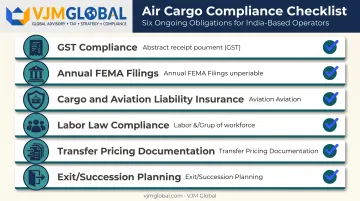
- GST compliance — file periodic returns and keep e-way bills current. Confirm whether Reverse Charge Mechanism applies to your transport services, since it can shift tax liability to the recipient.
- Annual FEMA filings — a foreign-invested Indian entity files an Annual FLA Return with the RBI every year, plus Form FC-GPR whenever fresh foreign capital comes in.
- Cargo and aviation liability insurance — protects against damage, loss, or regulatory claims. It's the coverage most founders skip until the first claim lands on their desk.
- Labor law compliance — PF and ESI contributions, plus wage regulations, apply to locally hired staff at cargo hubs and warehouses.
- Transfer pricing documentation — when income flows between your US and Indian entities, maintain master file, local file, and country-by-country reports benchmarked to arm's-length pricing.
- Exit and succession planning — even a growing business should have a basic plan for protecting licenses and assets if ownership or structure changes down the line.
This is also where dual filing obligations bite. A US parent with an Indian subsidiary typically needs separate India and US tax filings each year. Getting DTAA treatment wrong can mean paying tax twice on the same income.
Treat India and US compliance as one coordinated workstream rather than two separate projects. That approach usually saves real money over time and keeps financial planning aligned across both entities.
Conclusion
A profitable air cargo business in India comes from choosing the right entry structure, securing the correct licenses before you need them, and staying compliant on both sides of the India-US border.
The regulatory path is navigable: India's open FDI rules and cargo-specific Open Sky policy lower the barriers to entry. The paperwork alone can still consume months if you handle it piecemeal from the US.
VJM Global helps US founders and NRI entrepreneurs with entity registration, licensing coordination, and FEMA/tax compliance—so you can spend your time building airline relationships and winning customers instead of chasing signatures.
Frequently Asked Questions
Is air cargo business profitable?
Profitability depends heavily on the model. Forwarding agencies with strong volume and cost control tend to outperform operators who simply sell generic capacity. India's growing cargo demand gives well-positioned operators a real tailwind.
How much capital is required to start an air cargo business in India?
A freight-forwarding or customs broker setup mainly needs capital for licensing fees and security deposits. A licensed cargo airline requires vastly more, running into crores of rupees before operations even begin.
Can a US company or NRI own 100% of an air cargo business in India?
Yes. 100% FDI is permitted under the automatic route for most air cargo and freight-forwarding activities, though the path depends on whether you set up a subsidiary, branch office, or airline entity.
Is IATA accreditation mandatory to start an air freight forwarding business in India?
No. IATA/CASS accreditation is only needed if you plan to book cargo space directly with airlines. Sub-agents can operate under an accredited forwarder without holding the accreditation themselves initially.
How long does it take to set up an air cargo business in India from the USA?
Incorporation itself can move quickly, often within a couple of weeks. Licensing and accreditation, especially the Customs Broker License and IATA approval, add several more months depending on exam cycles and documentation readiness.
What licenses are required to operate an air cargo business in India?
At minimum: GST registration, an Import Export Code (IEC), and a Customs Broker License if offering clearance services. Add IATA/CASS accreditation and BCAS clearance if booking directly with airlines or handling cargo airside.