What makes this specifically attractive to US-based founders? Recurring parcel demand, UK company formation rules that are genuinely simple compared to many jurisdictions, and the ability to own a UK business without ever relocating.
The interest isn't coming from one type of buyer, either. It spans US logistics entrepreneurs scouting new territory, UK-born expats now living stateside, US companies wanting a delivery arm in Britain, and investors looking to back a UK-based operator.
This guide walks through the full picture: whether US ownership is even legally straightforward (it is), how the tax and compliance pieces fit together, and what it actually takes to get a UK courier operation running from thousands of miles away.
Key Takeaways
- US citizens and companies can own a UK courier business remotely; UK residency is not required for ownership or directorship.
- A UK private limited company (Ltd) via Companies House, with a UK registered office, is the most practical route.
- Cross-border tax—UK corporation tax plus US IRS foreign-entity reporting—trips up more founders than any other step.
- Remote ownership works; remote day-to-day operations rarely do, because couriers need people and vehicles on UK ground.
- Budget several weeks to a few months from incorporation to full operations with licences, insurance, and staff.
What Is a Courier Business, and Can a US Resident Own One in the UK?
A courier business picks up and delivers parcels, documents, or goods for paying customers, usually faster and with better tracking than standard mail. Beyond that basic definition, the format varies quite a bit:
- Solo owner-operator running deliveries with one vehicle
- Small local fleet covering a city or region
- Franchise-style operator, similar to a local DPD or Evri franchise
- Tech-enabled last-mile specialist built around routing software and app-based dispatch
Now, the question that actually matters for a US-based founder: can you own one without living in the UK?
Yes. UK company law doesn't restrict foreign nationals from owning or directing a UK limited company.
A US citizen can be the sole shareholder and sole director without holding a UK visa, provided the company has a valid UK registered office address on file with Companies House. You can own and control the entity from the US; day-to-day UK operations are a separate staffing and compliance question.
Why Start a UK Courier Business From the USA? (Market Opportunity)
The numbers behind UK courier activity are hard to ignore. UK courier activities revenue is forecast to hit £17.4 billion in 2025-26, following five years of steady 1.4% average annual growth and a projected 3.8% jump this year alone, according to IBISWorld.
The same report counts roughly 11,100 courier businesses operating in the UK, up at a 2.2% compound annual rate since 2020.
That's a crowded field, sure. But crowded doesn't mean closed.
Royal Mail, Evri, DPD, Yodel, and DHL dominate volume, and competition is rated high. Yet niche entrants keep finding room:
- Same-day delivery specialists
- Specialized cargo (medical supplies, legal documents, temperature-controlled goods)
- Regional B2B courier services that national carriers underprice or ignore
For US-based operators, this growth is accessible two ways. You can own and direct a UK-run operation remotely, or you can back a UK operating team as an investor.
Either path mirrors a broader pattern already underway: US logistics and e-commerce firms have been building UK last-mile capacity for years, because demand keeps compounding.
What to Know Before You Start (Cross-Border Considerations for USA-Based Founders)
Here's where most USA-based founders trip up: they conflate owning a UK company on paper with actually running one day-to-day. Those are two very different projects.
Foreign Ownership, Directorship, and Visas
No UK residency or visa is required to be a shareholder or director of a UK Ltd. A UK registered office address, however, is mandatory. Royal Mail PO boxes don't qualify; it needs to be a genuine address where statutory mail can be received.
Ownership and personal relocation are separate questions. If you plan to move to the UK and run daily operations rather than manage remotely, look into routes like the Innovator Founder visa. That path needs an endorsing body's approval and demonstrated business viability. Simply owning shares from New York or Chicago is a different project entirely.
Dual Tax Exposure
This is the blind spot that catches almost everyone. Your UK company owes UK corporation tax and, once turnover crosses the threshold, VAT. Separately, as the US owner, you likely carry IRS reporting obligations on a foreign entity:
- Form 5471 — required for US persons who acquire 10% or more of a foreign corporation's stock or voting power, with steeper reporting for majority ownership
- FBAR (FinCEN Form 114) — required when foreign financial accounts you have interest in or signature authority over exceed $10,000 in aggregate value at any point in the year
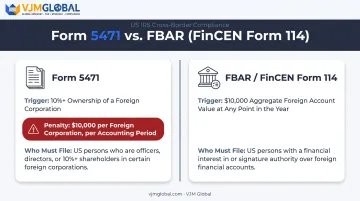
Missing Form 5471 alone can trigger a $10,000 penalty per foreign corporation, per accounting period. VJM Global helps founders align UK HMRC filings with parallel IRS reporting so nothing falls through the cracks between two tax systems that don't talk to each other.
Local Operations and Timeline
Couriers need drivers, dispatchers, and vehicles physically present in the UK. There's no version of this business that runs entirely from a laptop in Austin. Plan to hire a UK-based operations lead from day one, not as an afterthought once volume picks up.
Registering the company itself can happen fast. Getting licenses, insurance, vehicles, and staff in place takes noticeably longer for a remote founder than for someone already living in the UK.
How to Start a UK Courier Business from the USA – Step by Step
This is the practical execution path. The single most common mistake here: registering the UK company before validating local demand or lining up UK-based operational support. Paperwork is the easy part.
Step 1 – Research the UK Market and Choose a Niche
Start by researching target UK cities and existing competitors' pricing, coverage, and service types. Don't skip this because it feels obvious.
- Pull pricing from at least 3-4 regional couriers in your target area
- Map coverage gaps where national carriers are slow or expensive
- Choose a defensible niche, such as same-day, specialised goods, or B2B, rather than competing head-on against national carriers
The common miss: assuming a niche that works in your home US market will automatically translate to the UK without local validation. UK buying habits, delivery expectations, and pricing sensitivity aren't identical to the US.
Step 2 – Choose a Business Structure and Register with Companies House
A UK private limited company (Ltd) is generally the most practical structure for a US-owned courier business. It offers liability protection and carries more credibility with UK clients and insurers than a sole trader setup.
Registration essentials include:
- Company name check — confirm availability through Companies House
- UK registered office address — a genuine physical address, not a PO box
- At least one director and shareholder — can be the same US-based person
- SIC code selection — identifies your business activity for statutory records
Specialist cross-border entity formation firms, such as VJM Global, handle UK company registration, registered address provision, and initial compliance filings end-to-end, which matters when the founder can't be physically present for any of it.
Common miss: registering without a genuine UK registered address, which delays statutory correspondence and Companies House compliance notices.
Step 3 – Set Up UK Banking, Tax and Compliance Registrations
Opening a UK business bank account is where many remote founders hit their first real friction. Traditional banks often require in-person identity verification, which doesn't work from the US. Fintech and electronic money institution (EMI) alternatives are typically better suited to non-resident directors.
From there:
- Register for UK Corporation Tax with HMRC within the statutory deadline after incorporation
- Register for VAT once turnover approaches or exceeds the £90,000 registration threshold
- Set up parallel US reporting for the foreign entity with a qualified cross-border advisor
Common miss: treating UK tax registration as the finish line. It isn't. UK compliance alone doesn't satisfy IRS obligations, and a firm offering both UK entity compliance and cross-border tax advisory can keep HMRC filings and US reporting aligned instead of siloed.
Step 4 – Secure Licenses, Insurance and Legal Requirements
Vehicle requirements depend heavily on what you're operating. In Great Britain, goods vehicles above 3,500 kg gross plated weight generally need an Operator's Licence.
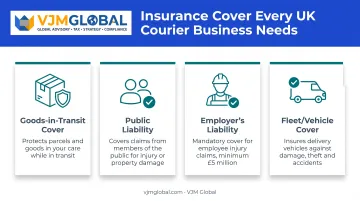
Insurance needs typically include:
- Goods-in-transit cover — protects against loss, theft, or damage to parcels
- Public liability — covers injury or property damage involving the public
- Employer's liability — legally required once you hire staff, minimum £5 million cover
- Fleet or vehicle cover — for owned or leased delivery vehicles
If hiring UK drivers, understand that the courier industry leans heavily on self-employed contractor classifications, but the label alone doesn't settle legal status. HMRC's employment status rules and recent tribunal cases (including the 2023 Deliveroo ruling) show that classification depends on the actual working arrangement, not just what the contract says.
Common miss: assuming US insurance or licensing concepts carry over directly. UK operator licensing thresholds and worker classification rules differ enough that a direct copy-paste from US practice will leave gaps.
Step 5 – Build Local Operations: Vehicles, Staff and Technology
Decide on vehicle types (bikes, vans, or cars) based on your niche and delivery radius. A same-day medical courier in central London needs a different vehicle mix than a regional B2B pallet service.
Just as important: hire or contract a UK-based operations lead who can make daily delivery decisions you simply can't make from a US time zone. Then implement route optimization, tracking, and dispatch software so you retain real-time visibility despite the gap.
Common miss: under-investing in local management and trying to personally run daily dispatch decisions from the USA. It doesn't scale, and it burns out fast.
Step 6 – Launch, Market and Manage the Business Remotely
Build local visibility through UK-focused SEO, a Google Business Profile, and direct outreach to regional retailers who need reliable delivery partners.
Set up remote-friendly reporting: dashboards, scheduled calls with your UK team, and clear KPIs you can check without micromanaging. Track early metrics like delivery success rate, customer retention, and cost per delivery, and stabilise before expanding.
Common miss: scaling into new UK cities before the first location's operations and pricing are actually stable. One profitable region beats three shaky ones.
Conclusion
Owning a UK courier business as a USA-based founder is legal and increasingly common. Success still hinges on locking in structure, tax, and local operations early—not patching them after launch.
For remote founders, the real gap is reliable UK management on the ground from day one. A US owner cannot cover that with a dashboard alone.
If UK company law and dual US–UK tax rules are new territory, a cross-border entity and compliance partner shortens the path. VJM Global helps American founders with UK company formation, tax compliance, and ongoing accounting so you can focus on building the operation.
Frequently Asked Questions
Is a courier business profitable in the UK?
Yes, but margins vary widely. National carriers compress pricing on standard deliveries, while niche services like same-day or specialized cargo tend to hold better margins through differentiation.
How do I start an international courier service?
Start with a stable domestic UK service, then expand into cross-border shipping by building customs handling capability and partnering with established international carriers for the long-haul legs.
Can a US citizen own a UK courier company without moving to the UK?
Yes. UK company law allows foreign nationals to own and direct a UK Ltd remotely, as long as the company maintains a valid UK registered office address and meets Companies House filing requirements.
Do I need a UK visa to start a courier business in the UK from the USA?
No visa is needed for ownership or directorship. You'd only need a visa if you personally plan to relocate and work in the business day-to-day within the UK.
How long does it take to register a UK company from the USA?
Standard online incorporation with Companies House often completes within 24 hours. Reaching full operational readiness, including licenses, insurance, and staff, typically takes several weeks to a few months longer.
What licenses do I need to run a courier business in the UK?
You'll need company registration, an Operator's Licence if using goods vehicles over 3.5 tonnes, and mandatory insurance including employer's liability if you hire staff.