Introduction
India's aviation sector is one of the fastest-growing in the world. IATA forecasts passenger journeys to, from, and within India will grow 5.6% annually for the next two decades, adding 425 million annual journeys by 2044.
That nearly triples 2024 traffic levels, according to IATA's June 2025 aviation report. Government schemes like UDAN and rapid airport expansion are fueling that growth.
This momentum is drawing attention from more than just aviation insiders. NRIs, US-based aviation professionals, high-net-worth individuals, and even American logistics companies are exploring whether they can launch or co-invest in an Indian airline while staying based in the USA.
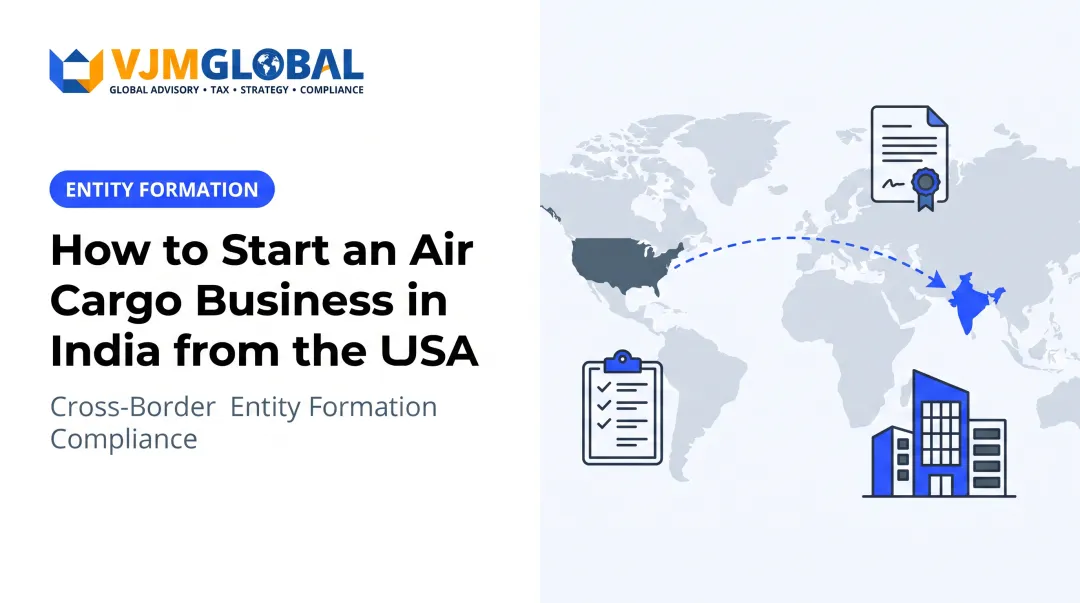
The honest answer: yes, but the rules change significantly once your operating base is outside India. This guide walks through exactly what shifts: ownership structure, entity registration, and cross-border compliance when you're founding an Indian airline from American soil.
Key Takeaways
- A US company cannot hold majority control of a scheduled Indian airline; Indian citizenship and directorship rules apply
- Paid-up capital requirements range from ₹2 crore for small charter operators to ₹50+ crore for scheduled carriers
- The DGCA's Air Operator Certificate process is the single biggest compliance and timeline hurdle
- FEMA/RBI reporting adds extra steps most domestic founders never encounter
- Structure and compliance must come before aircraft and operations
What Is an Airline Company - and What Changes When You're Starting It from the USA
An airline company is an entity licensed to operate scheduled, non-scheduled, or cargo air transport services under a government-issued certificate. In India, that license comes from the Directorate General of Civil Aviation (DGCA), and each service category carries its own eligibility and capital thresholds.
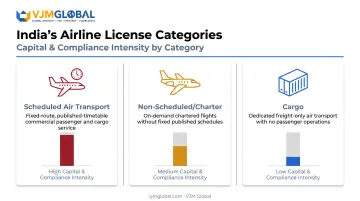
The three categories that matter:
- Scheduled Air Transport — fixed routes, published timetables, highest capital and regulatory bar
- Non-Scheduled/Charter — on-demand flights, lower capital thresholds, faster path to certification
- Cargo — freight-only operations, separate licensing track from passenger services
For a USA-based founder, the split is simple: you can fund the airline, co-own it, and shape its strategy. You cannot control it from outside India's regulatory framework.
The operating entity must be Indian-registered. Board composition, resident directorship, and chairman citizenship must remain in India. Money can cross borders. Control, for scheduled services, largely cannot.
Why Start an Airline Company in India as a US-Based Entrepreneur
Starting an airline in India can work for a US-based founder, but only under the right conditions. India's commercial fleet already exceeds 860 aircraft, with 739 additional aircraft on order for delivery over the next five years, per the same IATA report cited above. That order book is measurable demand growth you can underwrite, not a vague growth story.
Where US-based founders have a genuine edge:
- Access to capital markets and investor networks that many domestic-only founders lack
- Aviation industry experience gained from careers at US carriers, leasing firms, or MRO companies
- Firsthand understanding of diaspora travel demand on US-India routes, an underserved corridor for direct connectivity
Competition and cross-border friction cut the other way. Established Indian carriers like IndiGo, Air India, and Akasa already dominate domestic capacity.
A US-based founder also takes on work most local entrepreneurs never face: coordinating incorporation, banking, and regulatory filings across two time zones and two legal systems at once. Market demand is real; so is the dual-jurisdiction operating load. Build the entry plan around both.
What to Know Before You Start: Costs, Timelines & Ownership Rules
Most US-based founders underestimate two things going in: the true cost of entry, and how tightly India restricts foreign control of airline ownership. Get a handle on both before you evaluate whether this fits your capital and timeline.
Capital Requirements by Category
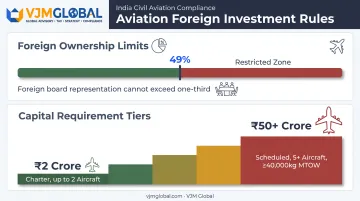
Paid-up capital requirements scale with aircraft count and weight. Per DGCA's current Civil Aviation Requirements:
| Category | Minimum Paid-Up Capital |
|---|---|
| Scheduled, aircraft ≥40,000 kg MTOW, up to 5 aircraft | ₹50 crore |
| Same category, each additional block of 5 aircraft | +₹20 crore |
| Scheduled, aircraft <40,000 kg MTOW, up to 5 aircraft | ₹20 crore |
| Non-scheduled/charter, up to 2 aircraft | ₹2 crore |
| Non-scheduled/charter, more than 10 aircraft | ₹15 crore |
DGCA application fees add on top: ₹20 lakh for a scheduled AOC application, ₹5 lakh for non-scheduled. These figures don't include leasing deposits, staffing, training, insurance, or working capital reserves.
The Ownership Rule That Trips Up Foreign Founders
Indian companies operating Scheduled Air Transport Services must keep substantial ownership and effective control vested in Indian nationals. In practice:
- Foreign airlines can invest up to 49% under the government-approval route
- Foreign investing entities, including foreign airlines, cannot exceed one-third board representation
- No shareholder agreement can grant a foreign investor management control of the Indian operator
This rule most often derails US-based founders who assume a clean majority-ownership structure will fly.
Timeline Reality
Budget generously. There's no single official processing benchmark. The MoCA No-Objection Certificate for a scheduled airline remains valid for three years. Full AOC certification (Operations Manual, Safety Management System, and demonstration flights) routinely takes well over a year from a standing start.
The common miss: assuming a US entity or US-based management team satisfies DGCA on its own. It doesn't. A compliant Indian entity, resident director, and FEMA/RBI reporting need to be in place from day one, not retrofitted after the business plan is finished.
How to Start an Airline Company in India from the USA - Step by Step
These steps blend India's standard airline licensing path with the extra cross-border coordination a USA-based founder has to plan for.
Two mistakes show up repeatedly: delaying entity registration until the business plan feels "ready," and assuming a US bank account or investor round can substitute for FEMA-compliant capital infusion. Neither works.
Step 1: Choose Your Entry Route and Ownership Structure
Decide upfront whether you're entering via:
- An Indian co-promoter or joint venture structure
- The NRI/OCI investment route
- A minority FDI position under the automatic or government approval route
Map your shareholding split so it satisfies DGCA's Indian-control requirement while still protecting your economic stake. Common miss: structuring majority US ownership without realizing it disqualifies the entity from scheduled airline eligibility entirely. Get this wrong and you'll rebuild the cap table later, an expensive redo.
Step 2: Register Your Indian Entity and Set Up Compliance
File incorporation through the Ministry of Corporate Affairs using the SPICe+ form, choosing between a Private Limited or Public Limited structure based on your fundraising ambitions. Then complete PAN, TAN, GST registration, and FEMA/RBI reporting for the inbound investment — before any operational spend begins.
This is where remote coordination from a US time zone tends to bite. Name reservation alone typically takes 3-5 working days and an approved name is only valid for 20 days, so delays compound quickly if paperwork sits waiting for a signature at 2am India time.
A cross-border compliance partner earns its fee here. VJM Global, for instance, works with US-based founders on this sequence:
- Pre-incorporation FDI structuring
- Digital signatures and DIN allotment
- RoC filing and query resolution
- Post-incorporation FEMA filings (Form FC-GPR and the Annual FLA Return)
Night-shift support helps stop US time-zone gaps from stalling sequential filings.
Step 3: Build a Bankable Airline Business Plan and Financial Model
Define your model (low-cost carrier, full-service, regional, or cargo) and back your route selection with real demand data, whether that's underserved domestic routes or the US-India corridor.
Investors and DGCA reviewers will expect a model built around:
- CASM (cost per available seat mile)
- RASM (revenue per available seat mile)
- Break-even load factor
Don't ignore ancillary revenue. IATA projects ancillary and other revenue will account for nearly 14% of total airline revenue in 2025, up from 12-13% pre-pandemic. Baggage fees, seat selection, and onboard sales aren't rounding errors anymore; they're a planning input.
Step 4: Secure Funding and Meet DGCA Capital Requirements
Match your funding plan to the paid-up capital slab for your target fleet size and aircraft category, as outlined above. Realistic sources for a USA-based founder include:
- US or global private investors
- Indian private equity
- Aircraft operating leases (far more common than outright purchase for startups)
- Bank and export credit financing
Plan your cross-border capital transfer around FEMA reporting timelines. A delayed FC-GPR filing can hold up your DGCA application just as easily as a missing document can.
Step 5: Obtain DGCA's Air Operator Certificate (AOC/AOP)
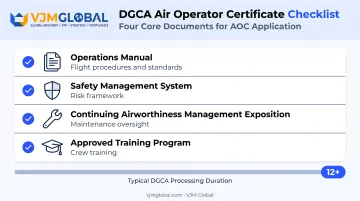
This is the core submission package:
- Operations Manual: flight procedures and standards
- Safety Management System (SMS): risk and safety framework
- Continuing Airworthiness Management Exposition: maintenance oversight documentation
- Approved training program: flight and cabin crew
You'll also need to appoint required post-holders and confirm each meets Indian regulatory eligibility. Key roles include Accountable Manager, Director Flight Operations, Continuing Airworthiness Manager, and Safety Manager.
Budget for a multi-phase process: pre-application meetings, documentation review, and demonstration flights before final certification. This routinely extends well beyond a year.
Step 6: Acquire Aircraft, Set Up Operations, and Launch
Decide between leasing (the preferred route for most startups) and purchasing, then lock in airport slots and ground handling agreements. Build your India-based operational team — pilots, engineers, ground staff — while managing hiring and oversight remotely from the USA.
For go-to-market, plan:
- GDS/OTA distribution integration
- Brand launch timing
- A soft-launch phase on limited routes before scaling fleet or network
Conclusion
Starting an airline in India from the USA is achievable, but the sequence matters as much as the capital. Structure and compliance come first; fleet acquisition and route launches come second, not the reverse.
The biggest risk for overseas founders is underestimating how strictly India enforces ownership rules and how long cross-border compliance takes to clear. Build the right Indian entity and advisory foundation early, validate your business model against real route data, then scale deliberately from there.
Frequently Asked Questions
How much does it cost to start an airline company in India?
Regulatory paid-up capital is only the floor. Total launch costs—leasing, staffing, deposits, and working capital—run far higher than the DGCA minimums and vary with fleet size and route plan.
How do you start an airline business in India?
Register a compliant Indian entity, build a bankable business plan, secure funding that meets DGCA's paid-up capital thresholds, obtain your Air Operator Certificate, then acquire aircraft and set up operations.
Is the airline business profitable in India?
Global airline net margins sit around 3.9%, per IATA's December 2025 outlook, and Indian carriers like IndiGo report EBITDAR margins near 27-28%. New entrants typically need a multi-year runway before consistent profitability.
Can a US citizen or NRI own an airline company in India?
Yes, foreign ownership is permitted, but Indian citizens and entities must hold the required control majority and directorship for scheduled air transport services. Foreign airlines are capped at 49% under the government approval route.
What is the minimum capital required to start an airline in India?
It depends on aircraft weight and fleet size: non-scheduled operators start at ₹2 crore, while scheduled carriers with heavier aircraft start at ₹20-50 crore, with additional capital required per extra block of aircraft.
How long does it take to get DGCA's Air Operator Certificate?
There's no fixed official timeline. Documentation, safety systems, and demonstration flights routinely take well over a year for prepared applicants, and longer if you start compliance work late.