Introduction
Australian interest in the China market has picked up noticeably in the past two years. ChAFTA tariff cuts and China's fast-growing e-commerce sector are fueling the shift, alongside steady demand for Australian goods and services.
China's Negative List keeps shrinking, and ease-of-business reforms keep landing, while digital sales channels make it easier to test demand before committing capital. The result: exporters, manufacturers, consultants, e-commerce sellers, and solo entrepreneurs are all looking at China seriously, not just the big end of town.
Yet many first-time entrants still get tripped up by unfamiliar entity types and licensing rules that work differently to Australia's own system.
This guide walks through what starting a business in China as an Australian actually involves, from entity choice through to your first invoice.
Key Takeaways
- Foreigners, including Australians, can own 100% of a business in most sectors through a WFOE
- No minimum registered capital is required, but it must be paid in full within 5 years
- Service or trading entities typically launch in 8-12 weeks; manufacturing and joint ventures take longer
- Once your entity is formed, a Z visa, business licence, and tax filings become mandatory
What Does Starting a Business in China as a Foreigner Involve?
At its simplest: registering a legally recognised entity (or using a compliant hiring mechanism) that lets you invoice customers, hire staff, and repatriate profit inside mainland China.
That's a different proposition from just having a market presence. A distributor relationship or a sales agent doesn't give you legal or operational standing in China. If you want to hold a bank account, issue a fapiao (official invoice), or employ people directly, you need one of the recognised structures.
Australians typically choose from four formats:
- Wholly Foreign-Owned Enterprise (WFOE) – full foreign ownership, can invoice and hire directly
- Joint Venture (JV) – required in Negative List sectors where a local partner is mandatory
- Representative Office – liaison and market research only; cannot invoice or sell
- Employer of Record (EOR) – lets you hire staff in China without setting up an entity at all
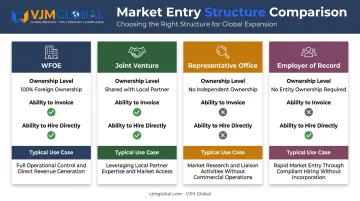
The right choice depends on your sector, how fast you need to trade, and whether you're testing the market or committing long term.
What Australian Businesses Need to Know Before Starting a Business in China
Many Australian founders underestimate the groundwork involved before day-to-day operations even begin, from visa processing and capital funding to compliance registration. This section focuses on the mechanics of getting there, not on validating your business idea.
Visa and Residency Requirements
A Z (work) visa is required to legally live and work in China. Once you arrive, it must be converted into a residence permit within 30 days. An M visa only covers short exploratory trips, meaning it does not authorise you to work, manage day-to-day operations, or draw a salary from your new entity.
Registered Capital and Real Costs
China removed the statutory minimum capital requirement back in 2014. However, Article 47 of the revised Company Law now requires shareholders to pay in the full subscribed capital within 5 years of establishment, effective from July 2024.
In practice, most consulting or services WFOEs are capitalised somewhere between USD 50,000 and USD 150,000. All-in setup costs (fees, apostille and notarisation, filings, chops or official company stamps, bank account opening) run USD 6,000 to USD 12,000, according to current WFOE setup benchmarks from MSA. Manufacturing entities cost more because of environmental impact assessments.
Realistic Timelines
A services or trading WFOE typically reaches its first invoice in 8-12 weeks, while manufacturing entities, which need environmental approvals before licensing, generally take 4-6 months. Bank account opening alone can add another 4-8 weeks on top of registration.
Cultural and Regulatory Groundwork
Three things trip up first-time entrants more than anything else:
- First-to-file trademarks – China awards trademark rights to whoever files first, not whoever used the mark first. File before you launch, not after.
- The Negative List – sectors like basic telecoms, aviation, and certain media remain restricted or require a local partner
- Guanxi – the relationship networks that underpin Chinese business culture. Trust, senior-level contacts, and patience matter more here than in most Western markets
Ongoing Compliance Load
Setup is only the beginning. Once trading, your entity carries year-round obligations:
- Corporate income tax (CIT) filings, generally at the standard 25% rate
- VAT reporting on a periodic basis
- Individual income tax (IIT) withholding, remitted monthly
- Annual statutory audit and CIT reconciliation
This is exactly why most Australian businesses running a China entity use a specialist cross-border accounting partner rather than trying to manage payroll, tax, and audit obligations in-house from Sydney or Melbourne.
Why Now Is a Good Time for Australian Businesses to Expand into China
Timing matters less than conditions. Right now, several conditions line up in Australia's favour, though none of this guarantees results without proper planning.
Trade fundamentals are strong, according to DFAT's China country brief:
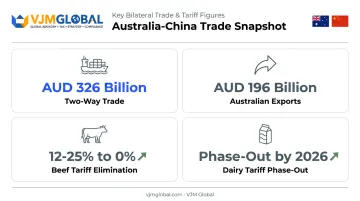
- Two-way Australia-China trade reached AUD 326 billion in 2025, or 25% of Australia's total trade
- Australian exports to China alone hit AUD 196 billion
- ChAFTA has eliminated beef tariffs (previously 12-25%), while dairy tariffs (up to 20%) are phasing out by 2026
- Full duty-free access across most Australian exports arrives by 2029
Regulatory reforms are reducing friction. China's 2024 national Negative List cut restrictions from 31 to 29 entries and removed the last remaining manufacturing restrictions. That means 100% foreign ownership is now available in more sectors than at any point in the past decade.
Free Trade Zone incentives sweeten the deal. Qualifying enterprises in Hainan and Lingang can access a 15% corporate income tax rate, well below the standard 25%, provided they meet substantive operation requirements.
Favourable conditions don't remove the complexity of running compliant operations across multiple tax jurisdictions at once. That's where a coordinating partner matters.
VJM Global supports Australian businesses expanding into new markets with entity formation, tax compliance, and payroll services across 100+ countries. This gives founders one point of contact for cross-border compliance, rather than juggling separate advisors in every jurisdiction.
How to Start a Business in China – Step by Step
The process breaks down into five practical phases. Most delays trace back to one of four mistakes: picking the wrong entity type, ignoring the Negative List, underfunding registered capital, or leaving the visa application until too late.
Step 1 – Choose Your Entity Type and Define Business Scope
Assess WFOE vs. Joint Venture vs. Representative Office vs. EOR based on your sector's Negative List status and hiring needs. Your business scope statement needs to be precise: too broad and SAMR may reject the application, too narrow and you'll be stuck re-filing later to add activities.
A common misstep: assuming a Representative Office can invoice clients or hire local staff directly. It can't do either.
Step 2 – Select a Location and Prepare Core Documents
Match your city to your industry: Shanghai for finance, Shenzhen for tech, Hainan or Lingang if you want the reduced CIT rate.
Parent company documents (certificate of incorporation, register of members, bank reference letter) now need only a single Apostille. China joined the Apostille Convention in November 2023, replacing the older consular legalisation process. You'll also need a compliant office lease carrying a valid property registration code.
Step 3 – Register with SAMR, MOFCOM and Tax Authorities
- File name approval and submit your business licence application through your local State Administration for Market Regulation (SAMR)
- Complete MOFCOM information filing for foreign investment and obtain your unified social credit code
- Register for tax with local tax authorities to activate CIT, VAT, and IIT obligations
Document translation and certification lead times are the most commonly underestimated part of this step. Build in buffer time.
Step 4 – Open Bank Accounts, Order Company Chops, and Fund Capital
- Open an RMB basic account, an RMB capital account, and a foreign-currency account
- Complete SAFE registration to bring capital into China legally
- Order official company chops (seals) – required for every contract, invoice, and banking transaction
- Build a realistic capital-funding schedule against the 5-year paid-in deadline, rather than trying to fund everything upfront
Step 5 – Sort Visas, Hiring and Ongoing Compliance
Apply for the Z visa and work permit for the founder or legal representative once the entity is registered. From there, decide how you'll build your team:
- Direct hiring through the WFOE – full control, but comes with mandatory social insurance contributions
- Employer of Record – faster and lower-commitment for early-stage hires before you're ready to scale headcount
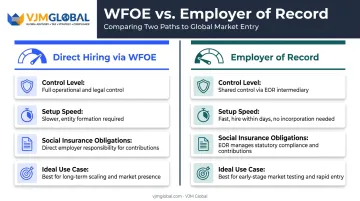
Whichever route you choose, set up accounting, tax filing, and payroll compliance from day one. Retrofitting compliance after penalties start accumulating is far more expensive than building it in from the start.
Conclusion
Starting a business in China as an Australian comes down to getting three things right from the outset: entity choice, capital planning, and visa timing. Speed matters less than getting the fundamentals correct the first time.
Clear business scope, realistic cost planning, and genuine cultural groundwork will serve you better than rushing registration. Long-term success in China depends on ongoing review of your tax and compliance obligations, not a one-off setup exercise.
VJM Global supports Australian businesses with this kind of ongoing multi-jurisdiction accounting and compliance work as they scale internationally. Across the markets it serves, the firm coordinates entity formation, tax filing, and payroll so founders can focus on running the business rather than chasing paperwork.
Frequently Asked Questions
How much money do I need to start a business in China?
There's no statutory minimum registered capital, but your funds need to realistically cover early operating costs. Services WFOEs typically see subscribed capital of USD 50,000 to USD 150,000, payable within 5 years.
Can an Australian start a business in China?
Yes, for most sectors, under China's national treatment rules. This framework applies to all foreign nationals equally, provided the sector isn't on the restricted Negative List.
Can an Australian own 100% of a business in China?
Yes. Australians can fully own a WFOE in any sector not on the Negative List, acting as director, shareholder, and legal representative simultaneously.
Do I need a Chinese partner to start a business in China?
Only for sectors on the Negative List, such as certain telecoms, media, and aviation activities. Outside those restricted sectors, a WFOE gives you full independence.
How long does it take to register a company in China?
Services or trading WFOEs typically take 8-12 weeks. Manufacturing entities and joint ventures usually take 4-6 months due to additional approvals like environmental impact assessments.
What visa does an Australian need to run a business in China?
You'll need a Z (work) visa, sponsored by your registered China entity. It must be converted to a residence permit within 30 days of arrival before you can legally work or draw income.