The reality is messier. China's regions behave like separate economies, its Foreign Investment Law keeps shifting through negative lists and encouraged catalogues, and intellectual property risk catches out businesses that skip registration before launch. Add cyclical trade tensions and inconsistent regulatory enforcement, and it's easy to see why so many well-funded entries stall in year one.
This guide walks through the four core entry strategies, how to match a business structure to your risk appetite, the compliance essentials you can't skip, and a practical roadmap for getting started. Whether you're testing demand through e-commerce or planning a wholly owned subsidiary, the structure you choose now will shape everything that follows.
Key Takeaways
- China remains Australia's top trading partner, but a single strategy rarely fits its regional and demographic sub-markets.
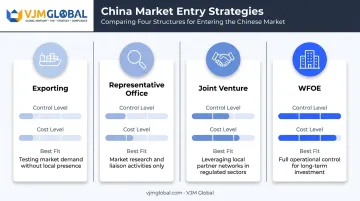
- Four entry models—exporting, representative office, joint venture and WFOE—each carry different cost and control trade-offs.
- Regulatory checks and trademark registration must happen before entry, not after.
- Digital and cross-border e-commerce channels let Australian SMEs test demand without a local entity.
- Specialist compliance partners can shorten setup timelines and reduce formation, tax and payroll risk.
Why China Matters for Australian Businesses
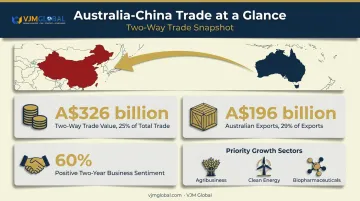
The numbers explain why China still dominates Australian trade strategy. Two-way goods and services trade between Australia and mainland China reached A$326 billion, representing 25% of Australia's total trade.
Australian exports alone hit A$196 billion, or 29% of all Australian goods and services exports, according to DFAT's China country brief.
That scale goes well beyond iron ore and gas. Growth sectors now include:
- Agribusiness and food - Australian provenance still carries weight with Chinese buyers
- Clean-energy technologies - aligned with China's continued renewables build-out
- Biopharmaceuticals and medical services - a category foreign firms increasingly name as high-potential
That growth outlook shows up in sentiment data too. Nearly 60% of foreign businesses surveyed said they felt positive about China opportunities over the next two years, per AustCham China's 2025 Doing Business in China report.
None of this removes the tension every board needs to weigh. China offers unmatched scale, but foreign ownership restrictions, geopolitical friction and trade cycles mean a China strategy has to sit inside a broader risk framework, not replace one.
The 4 Main Market Entry Strategies for China
International market entry theory generally sorts foreign expansion into four buckets: exporting, representative presence, collaborative ventures and direct investment. Australian businesses typically pick based on three variables: available capital, appetite for risk, and how much operational control they need to retain.
Exporting (Direct, Agents & Distributors)
Direct exporting means selling straight to Chinese buyers or importers from Australia, with no local entity involved. You keep full control and margin, but you're also on your own for market research, marketing and import-licensing knowledge.
Most businesses instead work through intermediaries: agents, who sell on commission without taking ownership of stock, or distributors, who buy inventory outright and resell, taking on more risk but also more local reach.
Whichever route you choose, due diligence isn't optional. Check trade references, run credit checks, and meet prospective partners in-market before signing anything. A distributor with poor cash flow can sink your China launch before it starts.
Representative Office (RO)
An RO is the cheapest, lowest-risk way into China, useful for market research, liaison work and building relationships ahead of a bigger commitment. It has no separate legal personality.
The catch: an RO cannot generate revenue, sign contracts, or issue invoices. Treat it as a scouting vehicle for early groundwork ahead of a fuller market commitment.
Joint Venture (JV)
A JV pairs your business with a Chinese partner, giving you access to restricted sectors and established local networks in exchange for shared control. Under China's Company Law, effective from 1 July 2024, shareholders must fully pay their subscribed registered capital within five years of establishment.
There's no statutory 50:50 control rule. Governance runs through the shareholders' meeting, and while a joint-venture agreement isn't a mandatory constitutional document, skipping one is a mistake. Define board seats, reserved matters, voting thresholds, deadlock resolution, IP ownership and exit terms in writing before you commit capital.
Wholly Foreign-Owned Enterprise (WFOE)
A WFOE gives you full ownership and full control over your IP, which matters if brand or technology protection is central to your strategy. There's no fixed national minimum capital requirement outside regulated sectors like banking and insurance, but your subscribed capital should realistically cover at least a year of rent, payroll and operating costs.
Registration requires naming a legal representative, typically a director or general manager, who executes company affairs. Subscribed capital is payable within five years under the schedule set in your articles of association.
Cross-border e-commerce is increasingly used as a fifth, lower-barrier route. Platforms let Australian brands test Chinese demand digitally before committing to any of the four formal structures above.
Choosing the Right Business Structure: Compliance & Regulatory Essentials
Matching structure to strategy comes down to control, cost and complexity.
| Structure | Ownership/Control | Setup Complexity | Best-Fit Scenario |
|---|---|---|---|
| RO | No local revenue capability | Low | Market research, early liaison |
| JV | Shared with Chinese partner | Moderate to high | Restricted sectors, local network access |
| WFOE | Full foreign ownership | High | Brand and IP protection priority |
Check the negative list before finalising your structure. China's current Negative List (2024 Edition) covers 29 restrictive measures, effective 1 November 2024, having removed manufacturing restrictions entirely.
Run your sector against the Encouraged Catalogue (2025 Edition) too, effective 1 February 2026; a sector open nationally can still require additional industry permits.
Licensing has two layers. The consolidated business licence covers company registration, tax registration, social insurance and statistics registration in one certificate. Sector-specific permits add further requirements: an import-export licence for direct exporters, or a Value-Added Telecommunications Services (VATS) licence for digital and tech businesses.
Labour law deserves a line item in your budget planning:
- Written contracts must be signed within one month of an employee's start date
- Employers contribute to five statutory funds: pension, medical, work injury, unemployment and maternity insurance
- Even fixed-term contracts trigger economic compensation on non-renewal, unless the employee turns down equal or better terms
Termination in China is far less flexible than in Australia, making specialist support valuable early on. Firms like VJM Global, which handle multi-jurisdiction entity formation, tax, payroll compliance and Employer of Record services, can help Australian businesses test demand or scale operations without carrying unfamiliar statutory obligations alone.
Localising Your Go-to-Market Strategy
China isn't one market. Tier 1 cities (Beijing, Shanghai, Guangzhou, Shenzhen) offer scale but brutal competition. Tier 2 and Tier 3 cities carry lower costs and less-saturated demand, often with faster paths to visibility for a new brand.
Consumer Behaviour & Branding
China's per-capita disposable income reached RMB43,377 in 2025, up 5.0% year on year. That growing spending power matters most in categories where Australian-origin branding already carries a trust premium: food, health, wellness and beauty.
Buyers associate "Made in Australia" with safety and quality. That reputation is worth protecting through consistent branding from day one.
Digital, E-commerce & Social Media
Online retail sales in China hit RMB15.97 trillion in 2025, up 8.6% according to China's National Bureau of Statistics.
Within FMCG e-commerce specifically, Bain's 2025 shopper data shows Taobao/Tmall holding roughly 28% share, Pinduoduo 15%, and JD.com 14%. Douyin and Pinduoduo combined now account for over 40% of that category.
Key platforms to plan around:
- Taobao/Tmall and JD.com - established marketplaces with strong logistics
- Douyin and Pinduoduo - "interest e-commerce," which grew from 15% to 26% of FMCG sales between 2023 and 2025
- WeChat and Xiaohongshu (RED) - social discovery and community-driven purchase decisions
IP Protection & Due Diligence
China runs a first-to-file system for both trademarks and patents. Whoever files first generally wins, regardless of who used the mark first elsewhere.
Register your trademark in English and in Chinese characters before:
- Launching in market
- Signing a distributor agreement
- Exhibiting at a trade show
Waiting until after entry is how brands end up negotiating to buy back their own name from a squatter.
Common Challenges & Building Your Entry Roadmap
The same pain points surface repeatedly in AustCham's China surveys. Its 2025 report highlights:
- 44% of respondents said regulatory predictability would have a large impact on their China decisions
- 47% of foreign-owned firms reported increased regulatory oversight
- Staffing shortages, particularly for qualified local managers
- Difficulty conducting reliable due diligence on partners
- Cyclical shifts in Australia-China and US-China relations
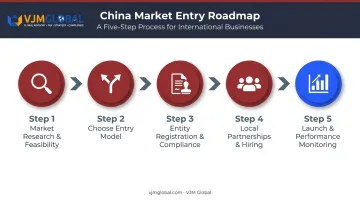
A structured entry roadmap helps manage that uncertainty:
- Market research and feasibility - validate demand at the city and category level, not just nationally
- Choose your entry model - weigh exporting, RO, JV or WFOE against your capital and control needs
- Entity registration and compliance - secure licensing, check the negative list, and set up tax and payroll systems
- Local partnerships and hiring - vet distributors and agents, and budget for China's labour law obligations
- Launch and performance monitoring - track sales, compliance deadlines and partner performance from month one
Engaging specialists early tends to shorten this timeline. Partners such as VJM Global, experienced in cross-border entity formation and compliance across 16+ core markets including regional hubs like Singapore and Hong Kong, can help validate your structure choice and manage the Australian and offshore compliance obligations that come with expanding into China.
Frequently Asked Questions
What are the 4 market entry strategies?
The four broad models are exporting, representative office, joint venture and WFOE. Your choice depends mainly on available capital, desired control, and how much risk you're willing to carry.
What is Australia's approach to China?
China is Australia's largest trading partner, with deep two-way trade ties across minerals, agribusiness and services. Government policy balances this economic relationship against strategic and security considerations.
How long does it take to register a business entity in China?
An RO is generally the fastest to establish, while a WFOE typically takes around 3-6 months end to end. Exact timelines depend on sector licensing, chosen city and document authentication steps.
Do Australian businesses need a local partner to enter the Chinese market?
Not for a WFOE, but restricted sectors require a joint venture with a Chinese partner. A local partner is also recommended, though not mandatory, when using agents or distributors.
What is the minimum capital requirement for a WFOE in China?
There's no fixed national statutory minimum outside regulated sectors like banking. Capital must credibly cover your planned business scope and is assessed as part of registration.
Can Australian SMEs sell into China without setting up a local entity?
Yes. Direct exporting, cross-border e-commerce platforms and agent or distributor relationships all let you sell into China without registering a local entity.