Introduction
China is Canada's second-largest merchandise trading partner, with bilateral trade reaching C$118.7 billion in 2024 — a relationship too significant for many Canadian entrepreneurs to ignore. Yet the leap from exporting goods to actually establishing a legal business presence in China is substantial, and many Canadian SMEs underestimate exactly how substantial.
This guide is for Canadian entrepreneurs, manufacturers, and business owners considering a formal entity in China, not just selling into it. Whether you're targeting Chinese consumers directly or seeking manufacturing advantages, the regulatory path involves more layers than most markets. Many first-timers are surprised to discover the process takes 6–12 months and requires significant upfront capital commitments before a single sale is made.
China's business setup process is entirely achievable for Canadian companies. It does require careful upfront planning, local expertise on the ground, and a realistic assessment of both the opportunity and the compliance obligations involved.
Key Takeaways
- Canadians can legally own 100% of a Chinese business through a Wholly Foreign-Owned Enterprise (WFOE)
- Business scope declared at registration determines every activity you can legally conduct
- The full setup process typically takes 3 to 6 months from start to finish
- Certain industries remain restricted or prohibited for foreign ownership under the 2024 Negative List
- Profit repatriation from China requires completing regulatory steps before funds can be transferred
- The Canada-China tax treaty affects withholding tax rates on dividends, interest, and royalties
What Starting a Business in China Actually Involves
Setting up a business in China means formally establishing a legal Chinese entity — one that can hire employees locally, issue RMB invoices, sign contracts under Chinese law, and conduct commercial activity within China. This is categorically different from exporting goods to Chinese buyers.
Three Main Options for Canadian Entrepreneurs
| Structure | Revenue Generating? | Foreign Ownership | Best For |
|---|---|---|---|
| WFOE | Yes | Up to 100% | Full operations, direct sales |
| Joint Venture (JV) | Yes | Shared with Chinese partner | Restricted sectors |
| Representative Office (RO) | No | N/A | Market research, liaison only |
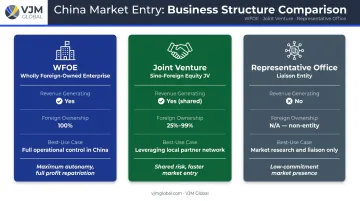
Choosing the wrong structure creates complications that are expensive to unwind. The right choice depends primarily on whether you intend to generate revenue directly in China.
One critical factor many Canadian businesses overlook: China is not a free-market economy. The 2024 Negative List — issued by China's National Development and Reform Commission and MOFCOM, effective November 1, 2024 — designates specific sectors as restricted or prohibited for foreign ownership.
Restricted sectors relevant to Canadian SMEs include:
- Value-added telecom services (capped at 50% foreign ownership)
- Medical institutions (limited to JV form only)
- Social survey companies
Prohibited sectors include compulsory education institutions, news organizations, and certain genetic technology applications.
Screen your intended activities against the Negative List before committing to any structure — it directly determines which options are even available to you.
What Canadian Entrepreneurs Should Know Before Starting
The Time Commitment Is Real
China operates on relationships — and relationships require presence. Remote management from Canada rarely works, particularly in the early stages. Banks commonly require the legal representative to appear in person with original documentation for account opening due to strict KYC requirements. Plan for frequent travel or appoint a dedicated in-country representative before you launch.
Geopolitical Risk Deserves Honest Assessment
The Canada-China relationship has experienced real diplomatic friction. Canada currently advises travelers to exercise a high degree of caution in China due to risks from arbitrary enforcement of local laws. In December 2024, China imposed sanctions on two Canadian civil society organizations and 20 human rights advocates. These dynamics don't make China off-limits, but they do require a realistic risk assessment that covers regulatory, reputational, and political exposure — not just commercial opportunity.
The Financial Reality Is Often Underestimated
WFOE setup costs typically span several categories:
- Government registration fees
- Legal and advisory fees
- Registered capital (sized to your operational needs)
- Office lease and initial payroll
- Accounting, audit, and bank fees
First-year totals vary significantly by city, sector, and entity complexity — no single figure applies across the board. What catches most entrants off guard is working capital: most first-time entrants underestimate how long before a Chinese entity becomes cash-flow positive, and how complex it is to repatriate profits back to Canada.
Choosing the Right Business Structure
Wholly Foreign-Owned Enterprise (WFOE)
The WFOE is the most common choice for Canadian entrepreneurs seeking full operational control. It allows 100% foreign ownership — no local partner required — and can generate revenue, issue invoices in RMB, and employ staff under Chinese labour law.
That said, it comes with real costs:
- More documentation and government approvals than an RO
- Business scope must be precisely defined at registration
- Registered capital must be committed and paid under current Company Law timelines
China's Foreign Investment Law (effective 2020) replaced standalone WFOE statutes, placing WFOEs and joint ventures under a single unified legal framework as foreign-invested enterprises.
Joint Venture (JV)
A JV pairs your Canadian entity with a Chinese partner, sharing ownership, control, and profits. In restricted sectors — certain telecom and media businesses, for instance — Chinese law requires local control, making a JV the only viable path for foreign entry.
The risks are significant:
- The Chinese partner often holds a controlling share
- IP protection in China has been inconsistent
- Misaligned interests between partners can surface quickly
For high-IP businesses, entering a JV with a Chinese counterpart requires careful due diligence and well-drafted contractual protections.
Representative Office (RO)
An RO is faster and simpler to establish than a WFOE, but it cannot generate revenue, issue invoices, or conduct direct commercial activity. It suits market research, liaison functions, or pre-entry scouting only. Some Canadian companies use an RO as a low-cost first step before committing to a full WFOE.
How to Start a Business in China from Canada — Step by Step
The following steps reflect the general path for establishing a WFOE. Exact sequence and requirements vary by province, sector, and entity type.
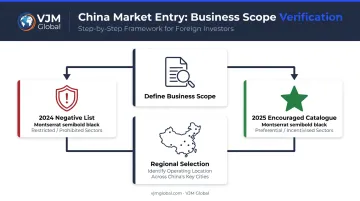
Step 1 – Define Your Business Scope and Target Market
Every Chinese entity must declare a precise business scope at registration. This declaration governs every activity you are legally permitted to conduct. Too broad, and the application gets denied. Too narrow, and you may find yourself operating outside it — a compliance risk.
Check your intended scope against:
- The 2024 Negative List (restricted/prohibited sectors)
- The 2025 Encouraged Catalogue (taking effect February 1, 2026) — sectors with preferential treatment for foreign investors
Also decide on a specific target region rather than treating China as a single market. GDP concentration, consumer demand, infrastructure quality, and preferential policies for foreign investors vary considerably between, say, Shanghai, Chengdu, and Guangzhou.
Step 2 – Prepare Documentation and Apply
Core documents typically required include:
- Certificate of Incorporation from the Canadian parent company (authenticated via apostille — Canada joined the Apostille Convention on January 11, 2024, simplifying this process)
- Passport copies for directors, legal representative, and supervisor
- Articles of Association for the proposed Chinese entity
- Proposed company name (Chinese and English)
- Registered office lease agreement
- Bank reference letters
- Business plan (often required for manufacturing entities)
Foreign investors now register with the Administration for Market Regulation (SAMR/AMR) to obtain a Business License, and submit initial and annual information reports through enterprise registration systems to MOFCOM's commercial departments.
Step 3 – Register, Obtain Your Business License, and Open Bank Accounts
Once registration is approved, the entity must obtain its Business License — the foundational operating document in China. Register with the local tax bureau within 30 days of receiving it.
You'll also need two types of bank accounts:
- A capital funds account for receiving investor capital contributions
- A basic RMB operating account for day-to-day transactions
Account opening timelines vary: China Briefing reports that Chinese banks typically process accounts in 3 to 5 working days, while international banks operating in China may take 3 to 4 weeks. Banks apply strict KYC checks and often require the legal representative to appear in person.
Sector-specific licenses (food safety, financial services, medical, etc.) may also be required before operations can begin.
Step 4 – Meet Registered Capital Requirements
China requires registered capital — the committed funding for the entity — to be paid into the capital funds account and properly documented. There is no general minimum registered capital amount for a WFOE, but the amount must be commercially realistic for the entity's operations.
Under State Council regulations effective July 1, 2024, companies must now pay in their subscribed registered capital within five years. Companies registered before June 30, 2024 face transition rules. Verify your contribution schedule with a local adviser before finalizing your registered capital amount.
Capital planning doesn't end at contribution — how you get profits out matters just as much. Repatriating RMB profits back to CAD requires completing several distinct steps:
- Withholding tax: A 10% standard rate applies (reduced rates may apply under the Canada–China tax treaty)
- Accounting sign-off: Audited financials are typically required before funds can be remitted
- Foreign exchange approval: Conversion and outward transfer requires SAFE (State Administration of Foreign Exchange) procedures
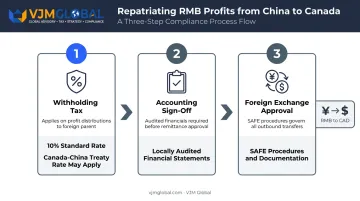
Build these steps into your financial model before committing to a registered capital amount.
Step 5 – Build Your Local Team and Establish Compliance Systems
Chinese labour law applies from your first hire. Key obligations under the Labour Contract Law include:
- Written employment contracts are mandatory
- Probation periods are capped by contract length: up to 1 month for contracts under 1 year, 2 months for 1–3 year contracts, and 6 months for contracts of 3 years or more
- Social insurance contributions (pension, medical, unemployment, work injury, and maternity) are mandatory — employer contribution rates vary by city
- Housing provident fund contributions are also locally determined
Non-compliance creates significant financial and legal liability. Build compliant HR systems before you make your first hire, not after.
Tax, Compliance, and Financial Considerations
Core Tax Obligations
| Tax | Rate | Notes |
|---|---|---|
| Corporate Income Tax (CIT) | Standard 25% | High/new technology enterprises may qualify for 15% |
| Value Added Tax (VAT) | 13%, 9%, or 6% | Rate depends on goods/services category |
| Withholding Tax (non-residents) | 10% | Applied to China-sourced income for non-resident enterprises |
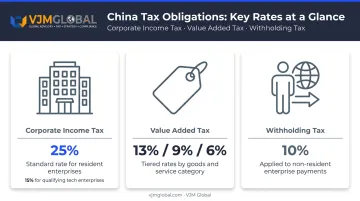
The VAT Law took effect January 1, 2026, consolidating prior VAT regulations.
Canada-China Tax Treaty
Canada and China's bilateral tax treaty directly affects how your profits are taxed when repatriated:
- Dividends: Capped at 10% withholding for corporate owners holding at least 10% voting stock; 15% otherwise
- Interest and royalties: Generally capped at 10%
Understanding how the treaty interacts with your entity structure is essential for avoiding double taxation. Engage a cross-border tax adviser before finalising your structure.
IP Protection — File Before You Enter
China operates on a first-to-file basis for trademarks. Your Canadian trademark registrations provide zero protection in China.
The Trade Commissioner Service and ISED explicitly warn: file your Chinese-language and English-language marks in China before entering the market, not after. Key categories at risk if you delay:
- Technology and software products
- Consumer brands and packaging
- Proprietary processes or formulations
Government Resources Available to Canadian Businesses
Canadian entrepreneurs have access to significant institutional support:
- Trade Commissioner Service (TCS): Offices in Beijing, Chongqing, Guangzhou, and Shanghai. TCS provides vetted local adviser connections, on-the-ground guidance, and references from active businesses in China
- Export Development Canada (EDC): Canada's export credit agency, offering trade financing, export credit insurance, and bonding services for Canadian businesses operating internationally
Use both resources early — before committing capital, not after.
Conclusion
Starting a business in China from Canada is achievable, but the margin for error is narrow. The businesses that gain traction choose the right structure upfront, define their business scope precisely, understand the capital and repatriation mechanics before committing funds, and build local partnerships grounded in proper due diligence.
Canada's government support infrastructure — the Trade Commissioner Service and EDC — exists precisely for situations like this, so use both before you commit. Before signing anything or wiring capital, engage advisers with verifiable China-specific expertise in legal, tax, and compliance. Fixing a poorly structured entity after the fact costs significantly more — in time, fees, and regulatory exposure — than getting qualified local advice at the outset.
Frequently Asked Questions
Can Canada do business with China?
Yes. China is Canada's second-largest merchandise trading partner, with C$118.7 billion in bilateral trade recorded in 2024. The Trade Commissioner Service maintains offices across China to support Canadian businesses, though current government advisories recommend managing geopolitical and regulatory risks carefully.
Can a foreigner set up a business in China?
Yes — foreigners, including Canadians, can legally establish and fully own a Chinese business through a WFOE. Certain sectors remain restricted or prohibited for foreign ownership under the 2024 Negative List, and the process requires government approvals, registered capital, and precise business scope declarations.
How much does it cost to set up a business in China?
No single authoritative average exists — costs vary significantly by city, sector, and entity complexity. Key components include government registration fees, legal and advisory fees, registered capital, office lease, payroll, and ongoing compliance. A local advisory firm can provide a city- and sector-specific estimate.
What is the best business structure for a Canadian company entering China?
For most Canadian businesses generating revenue directly in China, a WFOE offers full ownership and operational flexibility. A JV is required for certain restricted sectors, while an RO suits only non-revenue liaison or market research — it cannot conduct direct commercial activity.
How long does it take to register a company in China?
The full process for a WFOE — from initial application to receiving a Business License and opening a bank account — typically takes 3 to 6 months. Timeline depends on sector, province, and how complete your documentation is at submission.
Do I need to be physically present in China to set up and run a business there?
Not every step requires physical presence, but bank account opening typically demands the legal representative appear in person with original documentation. Chinese business culture also places significant weight on face-to-face relationships, so periodic visits are essential for building the local partnerships that matter.