
The appeal is specific. Investor pathways and residency programs, a low-cost IKE structure for smaller ventures, and warming India-Greece ties around ports, logistics and energy all play a part. In February 2024, both governments set a target to double bilateral trade by 2030.
Interest is coming from several directions: IT founders exploring EU delivery hubs, exporters wanting a foothold inside the single market, hospitality investors drawn to Greece's tourism economy, and professionals who simply want an EU-linked business base. This guide walks through what actually happens when an Indian founder sets up a company in Greece, step by step.
TL;DR
- Pick an entity (IKE, EPE, AE or branch), get a Greek Tax ID (AFM), and complete GEMI registration
- Greece–India DTAA (in force since 1967) shields profits and dividends from double tax
- Digital IKE/EPE filing fees start near €18; plan extra for notary, translation and advisors
- Non-EU founders need an AFM, a valid visa or residency route, and local compliance support
What Does Starting a Business in Greece from India Involve?
It means legally registering a company in Greece as an Indian citizen or Indian company. That requires GEMI registration, a Greek Tax Identification Number (AFM), and ongoing compliance with AADE, the Greek tax authority.
Indian founders can generally hold significant ownership in most Greek entity types. But there's a catch: owning a company and being permitted to actively manage it in Greece are two different things. A non-EU citizen who intends to live in Greece and run operations needs the appropriate residence permit, not just a signed incorporation certificate.
Common structures Indian founders choose:
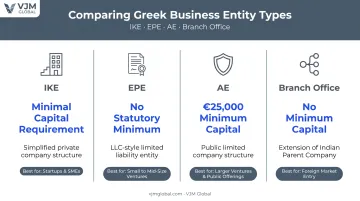
- IKE (private capital company) — minimal capital, popular for startups and SMEs
- EPE — traditional LLC-style structure, no statutory minimum capital
- AE (société anonyme) — needs €25,000 capital, suited to larger ventures
- Branch office — extension of an existing Indian company, no separate legal personality
What to Know Before You Start a Business in Greece from India
Before you commit, set realistic expectations on time, cost and effort.
Remote Coordination Is the Default, Not the Exception
Most Indian founders won't be physically present in Greece during setup. That means document arrangement, notary coordination and registrar communication mostly happen remotely, which naturally adds friction and back-and-forth compared to registering a company at home.
You'll Need Local Support
A local tax representative, accountant, or legal advisor isn't optional for non-resident founders — it's practically required. AADE allows a legal representative or authorised third party to request your AFM electronically, but someone still needs to manage identity verification, either at a tax office or via video call.
Realistic Timelines
Official estimates suggest:
- IKE formation via e-YMS: roughly 3 days
- EPE formation via e-YMS: roughly 7 hours (where eligible)
- AFM issuance: no guaranteed timeline; depends on identity verification method
- Bank account opening: no fixed SLA; subject to each bank's own KYC and source-of-funds checks
Add certified translations and apostille requirements into that mix, and a few weeks is a realistic overall window, not a guarantee.
Everything Must Be in Greek
Filings, constitutional documents, and financial statements all need to be in Greek. Foreign civil documents typically require apostille and certified translation before Greek authorities will accept them.
VJM Global has delivered entity formation and compliance work across 100+ countries. The firm coordinates Indian-side documentation and works with Greek advisors so you can complete setup without being on the ground.
Why Start a Business in Greece from India? (When It Makes Sense)
Greece expansion works well under certain conditions. It isn't automatically the right move for every founder.
The tax treaty is a practical advantage. The India-Greece Double Taxation Avoidance Agreement has been in force since 1967, and its permanent-establishment framework prevents the same business profits from being taxed twice across both jurisdictions.
Greece sits inside the EU single market, so a Greek entity gains access to free movement of goods, services and capital across the bloc, subject to sector-specific rules.
The macro picture supports the case. The OECD projects Greek GDP growth of 2.1% in 2025 and 2.2% in 2026, and Enterprise Greece reports net FDI inflows of €11.38 billion in 2025, up 62.2% from the year before.
Sectors worth watching for Indian businesses:
- Tourism and hospitality
- IT, AI and digital services
- Renewable energy
- Shipping and logistics, an area both governments flagged specifically in 2024

Greece also offers residency-linked routes tied to investment or business activity, including the Golden Visa program. Current investment thresholds change periodically, so verify the figure with an official source before committing capital.
How to Start a Business in Greece from India – Step by Step
This breaks the process into six practical stages. One warning up front: don't assume Indian LLP-style flexibility carries over to Greek structures. Don't underestimate translation timelines, and don't skip a local tax representative to save costs early on.
Step 1 – Choose the Right Business Structure and Entry Route
| Structure | Minimum capital | Best for |
|---|---|---|
| IKE | €0 permitted | Lean startups, SMEs |
| EPE | No statutory minimum | Traditional LLC preference |
| AE | €25,000 | Larger ventures, institutional capital |
| Branch | No minimum | Existing Indian company extending operations |
Decide whether you need physical presence, remote incorporation, or a branch of your existing Indian entity. A common mistake: choosing AE for a small venture when an IKE would cover the same activity for a fraction of the capital commitment.
Step 2 – Obtain Your Tax Identification Number (AFM) and Sort Visa Clearance
The AFM is required before anything else moves forward. It's requested electronically through myAADE, with identity confirmed at a tax office or via video call.
Separately, work out your residence route:
- Investor / Golden Visa pathway
- Digital Nomad Visa (for remote professionals)
- A startup-specific residence route, where currently applicable
Don't assume an Indian passport alone lets you set up and manage a Greek business. Company ownership and residence permission are handled under entirely separate rules.
Step 3 – Register with GEMI and AADE
Submit your articles of association, identification and registered address, either through the digital gov.gr portal or in person at a notary/GEMI office. This step also gets you your GEMI number and tax registration with AADE.
Fee benchmarks:
- Digital e-YMS route: around €18
- In-person GEMI department route: €60–€80
These cover the registration procedure only — notary, translation and professional fees sit on top.
Step 4 – Set Up Banking and Compliance Basics
Opening a Greek corporate bank account as a non-resident means clearing the bank's own KYC and AML checks, which vary institution to institution. Expect to also register for VAT (standard rate 24%) and enrol in myDATA, Greece's digital bookkeeping system.
VJM Global coordinates the cross-border side of this: banking documentation, bookkeeping, and tax compliance across the Indian and Greek ends simultaneously.
Step 5 – Handle Employment, Payroll and Local Hiring
Planning to hire locally? Two things happen automatically once your entity is registered: enrolment in the e-EFKA Employer Register and issuance of an Employer Registration Number. From there:
- File the ERGANI E3 hiring notification before the employee's start date
- Budget for the statutory minimum wage — €920/month from April 2026
- Account for employer social security contributions of 21.79% on top of gross salary
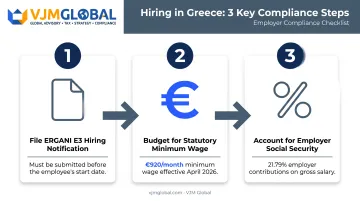
Common miss: hiring without filing the E3 notification on time, which triggers penalties fast.
Step 6 – Stay Compliant and Build Local Support
Annual financial statements, VAT returns and payroll filings all run on fixed schedules. Missing one because there's no dedicated tracking system is the single most common compliance failure among first-time founders abroad.
Build relationships early with:
- A local Greek accountant or legal advisor
- Enterprise Greece for sector-specific investment support
- The Indian Embassy's commercial wing
A compliance calendar is the difference between smooth operations and repeated penalty notices.
Conclusion
Starting a business in Greece from India works when you follow the right order—not when you rush the filings. Get the sequence right:
- Choose the entity structure
- Obtain a TIN
- Clear visa requirements
- Complete registration
- Set up banking and payroll
The India-Greece DTAA and EU market access make Greece a genuinely strong long-term base — provided compliance gets handled diligently from day one, not patched together after mistakes surface.
An experienced cross-border partner keeps that sequence on track. VJM Global has delivered entity formation and compliance work across 100+ countries and helps Indian founders set up in Greece with the structure, tax, and ongoing filings handled in the right order from day one.
Frequently Asked Questions
How much does it cost to start a business in Greece?
IKE and EPE structures can be set up with minimal or zero statutory capital, while an AE requires €25,000. Digital registration fees run around €18, plus notary, translation and professional costs.
Can an Indian start a business in Greece?
Yes. Indian founders can own significant stakes in most Greek entity types, but they need a Greek Tax ID (AFM) and the appropriate visa or residency route to actively manage operations there.
What are the most profitable businesses to start in Greece?
Tourism and hospitality, IT and AI services, renewable energy, and shipping and logistics are among the strongest sectors for new entrants right now.
Are there job and business opportunities for Indians in Greece?
Yes. Growing bilateral ties around ports, logistics and energy, combined with EU market access, are opening sector-specific opportunities in tech, shipping and property-linked investment.
What is the 5-year law in Greece?
It usually means Greece’s multi-year residence permits, including investor routes such as the Golden Visa. Confirm current investment thresholds against the latest official Ministry guidance before you act.