
The pull isn't just lifestyle. Greece offers EU market access, a Golden Visa pathway, and a digital registration system (GEMI/gov.gr) that's genuinely modernised. Interest is coming from sole traders, SMEs eyeing EU expansion, and investors weighing up the Golden Visa route, not just large corporates chasing headlines.
This guide walks through what starting a business in Greece from Australia actually involves, step by step.
TL;DR
- Greece permits full foreign ownership in most sectors, with no local shareholder requirement
- Entity options include the flexible IKE, plus EPE and AE companies, each with different capital and governance rules
- Registration runs through GEMI/gov.gr and requires a Greek Tax Identification Number (AFM) first
- Australians and other non-EU citizens need a business/investor visa to manage a Greek company long-term
- Professional support helps navigate Greek-language paperwork, banking checks, and dual-country tax compliance
What Does Starting a Business in Greece Involve?
Starting a business in Greece means registering a legally recognised entity or branch so you can trade within the EU single market. This isn't limited to tourism ventures. It applies equally to a solo consultancy, a small trading company, or a larger operation structured as an AE (Anonymi Etaireia — Greece's public limited company).
Australians typically pursue one of three paths:
- Incorporate a new Greek entity — the most common route for founders starting fresh
- Open a branch of an existing Australian company — useful if you want to keep your Australian entity as the parent
- Golden Visa or Digital Nomad Visa route — when Greek residency is the main goal, with or without active trading
Each path has different documentation and timeline implications, which we'll cover below.
What Australians Should Know Before Starting a Business in Greece
Founders based in Sydney or Melbourne often underestimate three things: the language barrier, the paperwork volume, and the residency requirement. Set realistic expectations for the setup mechanics before you test whether the idea works in the Greek market.
Residency and Documentation Realities
As a non-EU, non-EEA citizen, you'll need a business or investor visa (or Golden Visa) to legally reside in Greece and actively manage your company. Company ownership alone doesn't grant you the right to run day-to-day operations on the ground.
Every official document (contracts, filings, constitutional paperwork) must be submitted in Greek. Certified translations are required for anything drafted in English, which adds cost and lead time most founders don't budget for upfront.
Timing and Presence
Because of the distance and time-zone gap, early-stage setup usually benefits from a local representative or remote advisor who can handle notary appointments and in-person steps you can't do from Australia.
Realistic timeline expectations:
- Digital company registration: often only a few days
- Visa processing and bank account opening: several additional weeks
- End-to-end setup: plan in weeks, not days, once every step is included
Decide early whether you need a physical Greek presence or can operate remotely behind a local registered address. That choice drives your visa path, timeline and on-the-ground costs—get it clear before you file.
Why Start a Business in Greece from Australia? (When It Makes Sense)
The move stacks up under a specific set of conditions — not as a blanket yes for every Australian founder.
The case for Greece:
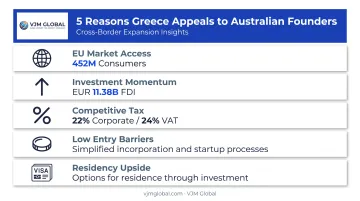
- EU market access. A Greek entity gives you a foothold inside a market of roughly 452 million consumers as of January 2026, without needing separate registrations across every member state.
- Investment momentum. Enterprise Greece reported EUR 11.38 billion in inward FDI during 2025, up from EUR 7.015 billion the year before — a clear lift in international capital flowing in.
- Competitive tax settings. Greece applies a 22% corporate income tax rate and a 24% standard VAT rate; domestic dividend withholding is often about 5%, with exemptions changing the final figure.
- Low entry barriers. Certain private company structures allow founders to start with minimal capital, reducing the financial threshold to get trading.
- Residency upside. The Golden Visa and Digital Nomad Visa pathways add lifestyle and residency value that goes beyond the pure business case — worth weighing even if trading volume is modest at first.
None of this guarantees profitability. It just means the structural conditions — access, cost, tax — are genuinely favourable right now.
Early Decisions That Matter When Setting Up in Greece
Most friction Australian founders hit isn't a lack of capital. It's underestimating bureaucracy and the tax complexity of running obligations in two countries simultaneously.
Areas founders often overlook:
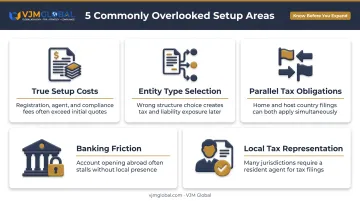
- True setup costs. Gov.gr lists modest online incorporation fees; in-person GEMI processing costs more. Notary and translation fees vary by document volume, so get itemised quotes rather than a headline figure.
- Entity type selection. IKE, EPE, AE, and branch offices carry different liability, capital, and compliance burdens. The wrong choice for your scale creates unnecessary overhead.
- Parallel tax obligations. Greek and Australian tax run side by side. Australia's Treasury tax treaty list shows no comprehensive income-tax treaty with Greece (only an airline profits agreement), so budget for tax-credit advice rather than automatic relief.
- Banking friction. Non-resident, non-EU founders face extra KYC/AML scrutiny. Banks will want identity, source-of-funds, and UBO documents before opening an account.
- Local tax representation. If you remain an Australian tax resident, you will likely need a local tax representative for Greek filings.
How to Start a Business in Greece from Australia — Step by Step
Here's the practical sequence. The most common mistake founders make is skipping visa planning until the end, or underestimating how long certified translations take from Australia.
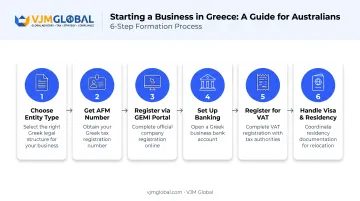
Step 1 – Choose Your Entity Type and Confirm Eligibility
Compare your options against your actual business size and liability needs:
- IKE — the flexible structure many small businesses and solo founders gravitate towards
- EPE — a traditional limited-liability structure with more formal governance
- AE — designed for larger operations with higher capital and compliance requirements
- Branch office — extends an existing Australian entity into Greece without creating a separate legal person
Confirm early whether you need an AFM and a business/investor visa. Common miss: choosing an AE structure for a small consultancy, which triggers capital and compliance obligations that outweigh any benefit.
Step 2 – Get Your Greek Tax Identification Number (AFM) and Documentation Ready
You can't register a company without an AFM first. Apply through AADE's non-resident service, and prepare certified Greek translations of your passport, business plan, and constitutional documents in parallel.
Common miss: underestimating how long translation and notary turnaround actually takes when you're coordinating from Australia's time zone.
Step 3 – Register with GEMI via the Digital Business Portal
Once you have an AFM and Taxisnet credentials, you (or an authorised third party) can complete registration through the eyms.businessportal.gr platform. If remote registration isn't feasible for your situation, in-person filing through a notary or GEMI department remains an option.
The portal electronically signs your articles of association, collects the registration fee, and automatically generates your GEMI number, company AFM, and chamber registration.
Common miss: assuming full remote registration is always possible without any local representative involved.
Step 4 – Set Up Banking and Cross-Border Payments
Opening a Greek business bank account requires your GEMI certificate, AFM, identification, and proof of address. As a non-resident, non-EU applicant, expect additional KYC/AML checks.
Consider a multi-currency account to manage AUD-EUR flows while local banking is still being finalised. That bridge smooths cash flow during the gap between incorporation and full bank approval.
Step 5 – Register for VAT and Understand Ongoing Tax Compliance
Register with AADE for corporate tax, VAT, and the myDATA digital bookkeeping system, which handles mandatory electronic invoicing. Filing frequency depends on your turnover and bookkeeping classification.
Common miss: treating Greek compliance as a standalone task, when Greek and Australian filing obligations run on parallel tracks that both need attention.
Step 6 – Handle Visa, Residency and Local Representation
Apply for the appropriate business/investor visa or Golden Visa if you plan to relocate or visit Greece frequently to manage operations directly. If you're staying an Australian tax resident, appoint a local tax representative to handle ongoing Greek filings.
Common miss: assuming a tourist visa covers active business management. It doesn't — active management requires proper residence status.
How VJM Global Simplifies Business Setup in Greece for Australians
Coordinating a Greek entity setup alongside your existing Australian accounting and tax reporting is where most of the friction actually lives. That's the gap VJM Global's cross-border services are built to close.
VJM Global has already worked with 250+ Australian businesses, delivering entity formation, tax compliance, and accounting services across 100+ countries. Each engagement uses that market's own regulators and statutory instruments rather than a one-size-fits-all template.

The firm already handles the Australian side directly:
- ASIC registration and ABN/ACN arrangements
- GST and BAS reporting
- Single Touch Payroll compliance
For a founder juggling Greek AFM registration, GEMI filings, and Australian company tax returns at once, one advisory team on both sides cuts the back-and-forth of running a Greek agent and an Australian accountant separately. That coordination matters even more for double-taxation exposure, given no comprehensive Australia-Greece tax treaty is currently in force.
Conclusion
Starting a business in Greece from Australia comes down to sequencing. Work through the steps in roughly this order:
- Choose your entity type
- Secure your AFM
- Register through GEMI
- Sort banking and tax registration
- Plan your visa route Speed matters less than clarity. Knowing your residency status and having Greek-language documentation ready early will save more time than rushing registration. Once you're trading, compliance on both the Greek and Australian sides is an ongoing obligation that grows with the business.
Frequently Asked Questions
How much does it cost to start a business in Greece?
Costs vary by entity type and structure. Online GEMI registration fees are relatively low; in-person processing costs more. Add notary and certified translation fees, which scale with document volume.
Which business is most profitable in Greece?
Enterprise Greece promotes tourism, energy, ICT, life sciences, food and agriculture, logistics, and audiovisual production as priority investment sectors. Profitability still depends on your model and market fit.
Can a foreigner start a business in Greece?
Yes. Greece allows 100% foreign ownership in most sectors. Australians need a Greek Tax Identification Number (AFM) and, for active management, an appropriate business or investor visa.
Do Australians need a visa to run a business in Greece?
Yes. As non-EU citizens, Australians need a business/investor visa or Golden Visa to actively manage a Greek company on an ongoing basis. Ownership alone doesn't grant management rights.
How long does it take to register a company in Greece?
Digital registration through GEMI can take just days once your AFM and documentation are ready. Visa processing, banking approval, and translation work typically stretch the full setup timeline to several weeks.
Is there a double tax treaty between Greece and Australia?
Australia's current Treasury treaty list shows no comprehensive income-tax treaty in force with Greece, only a limited airline profits agreement. Founders should get specific tax-credit advice to avoid double taxation on business income.