Introduction
Greece is drawing growing interest from Dutch entrepreneurs looking beyond the Netherlands' saturated home market. Many founders struggle with a simple question: does expanding into another EU country mean fresh visa paperwork and months of delay?
For Dutch nationals, the answer is straightforward. As EU citizens, you can register and operate a Greek company without a residence or work permit. The process runs largely online, through Greece's GEMI registry and AADE tax platform.
This guide walks through the legal structures available, the exact registration steps, the costs and tax rates you'll face, and the compliance obligations that follow once your company is live.
Key Takeaways
- Dutch (EU) citizens can register a Greek company remotely—no residence permit required
- IKE private company is the go-to structure for foreign founders, with €1 minimum capital
- Registration typically runs 10-20 business days through GEMI and AADE, mostly online
- Corporate tax is 22%, VAT 24%, and dividend withholding tax 5%
- Translation, tax registration, and banking are the steps most likely to cause delays
Why Start a Business in Greece as a Dutch Entrepreneur
Greece sits at the crossroads of Europe, Asia, and the Balkans. Enterprise Greece, the country's official investment agency, markets the nation as a logistics hub at Europe's gateway. That positioning matters for Dutch trading and logistics firms already fluent in the port-and-shipping economy of Rotterdam.
Both countries share the euro. That means zero currency conversion friction when invoicing between a Dutch parent and a Greek operation, unlike expansion into the UK or Switzerland.
Several growth sectors make the case concrete:
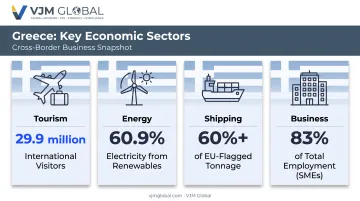
- Tourism: Greece welcomed 29.9 million international visitors in 2022, per the OECD
- Renewable energy: Greece derives 60.9% of its electricity consumption from renewables, among the EU's leaders, according to Eurostat
- Shipping: Greek owners control over 60% of EU-flagged shipping tonnage, per the Union of Greek Shipowners
- SMEs: SMEs account for 83% of total employment in Greece, per the OECD's 2024 Economic Survey
Key Advantages for Dutch Founders
Labour and commercial real estate in Greece run well below Dutch equivalents, which helps you test a new market without heavy overhead.
EU free-movement rules also mean you do not need a Greek residence permit before you register or run the company.
Legal Structures Available for Dutch-Owned Businesses in Greece
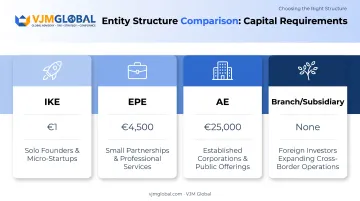
Your choice of entity determines capital requirements, personal liability exposure, and how much ongoing paperwork you will handle. Greece offers four practical routes for Dutch founders.
| Structure | Min. capital | Best for |
|---|---|---|
| IKE (Private Company) | €1 | Startups, freelancers, market testing |
| EPE (Limited Liability) | €4,500 | Medium ventures wanting a more formal form |
| AE (Public Limited) | €25,000 | Larger investments, boards, institutional capital |
| Branch of Dutch BV/NV | None | Testing Greece while keeping the Dutch parent |
Private Company (IKE)
The IKE (Idiotiki Kefalaiouchiki Etaireia) requires just €1 in minimum capital under Law 4072/2012. It's the default choice for startups, freelancers, and solo Dutch founders testing the Greek market, thanks to its flexible governance and light administrative load.
Limited Liability Company (EPE)
The EPE demands €4,500 minimum capital. It suits medium-sized ventures wanting a more established legal form than the IKE, though it comes with somewhat heavier formalities.
Public Limited Company (AE)
The Société Anonyme (AE) requires €25,000 minimum capital under Law 4548/2018. It fits larger investments needing formal board management, share structures, or plans to raise institutional capital.
Branch Office or Subsidiary
If your Dutch BV or NV is already registered at the KvK, you don't need a brand-new entity. Two options sit under an existing Dutch company:
- Greek branch — no separate legal personality, no Greek capital floor; identity stays with the Dutch parent
- Subsidiary — a distinct Greek legal entity formed as an IKE, EPE, or AE
Branches suit companies testing Greece while keeping full financial and legal identity tied to the Dutch parent.
100% Dutch ownership is allowed. Article 49 of the Treaty on the Functioning of the EU protects freedom of establishment, meaning Greek law imposes no local-partner requirement on EU founders.
Step-by-Step Process to Register a Company in Greece from the Netherlands
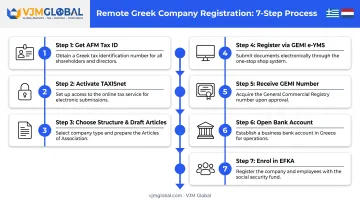
You can complete most of the Greek registration sequence remotely from the Netherlands:
- Get your Greek Tax Identification Number (AFM) — Apply on AADE's myAADE platform; as an EU citizen you can verify identity by video call instead of visiting a Greek tax office
- Activate TAXISnet credentials — This becomes your digital ID for every subsequent online filing
- Choose your structure and draft Articles of Association — IKE and EPE use standard digital templates; AE requires a notarial deed
- Register through GEMI via the e-YMS One-Stop Service — Log in with TAXISnet, reserve your trade name, and submit the articles for digital acceptance by all members
- Receive your GEMI number — VAT and tax registration happen automatically as part of this step
- Open a Greek corporate bank account — Use your GEMI certificate and AFM; banks like Eurobank and Piraeus Bank publish their required document lists online
- Enrol in EFKA and secure licences — Required if you're hiring staff or operating in a regulated activity
Formation itself is quick. The banking step is where non-residents usually lose time—most banks want a Greek proxy with power of attorney or a video KYC check.
Costs, Taxes, and Compliance Obligations
Registration Costs and Timeline
Filing digitally through e-YMS costs roughly €18-24; doing it in person at a GEMI office runs €60-80, plus a Chamber of Commerce fee. There's no official GEMI service-level guarantee, but practitioners consistently report a 10-20 business day turnaround for straightforward IKE registrations.
Tax Rates to Plan For
| Tax | Rate |
|---|---|
| Corporate income tax | 22% |
| Standard VAT | 24% |
| Dividend withholding tax | 5% (baseline) |
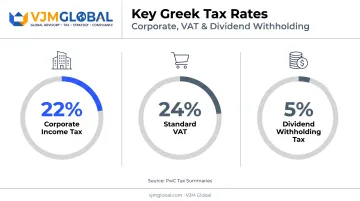
Source: PwC Tax Summaries, Greece
Ongoing Compliance
- Annual financial statements filed with GEMI
- VAT filings submitted through the myDATA electronic invoicing system, monthly or quarterly depending on turnover
- EFKA payroll contributions once you employ staff, with an aggregate employer burden around 22%
Double Taxation Relief
Greece and the Netherlands maintain an active double taxation treaty, confirmed in AADE's official treaty index. A qualifying Dutch parent holding a sufficient stake in a Greek subsidiary can often reduce or eliminate the 5% dividend withholding tax, though you should confirm the holding and eligibility conditions with a tax adviser before relying on it.
Common Challenges for Dutch Founders and How VJM Global Can Help
Registering the entity is rarely the hardest part. Dutch founders more often stumble on:
- Greek-language documentation — Articles of association, tax notices, and bank forms arrive in Greek, creating translation bottlenecks
- Bureaucratic delays — Particularly around bank KYC checks for non-resident directors
- Local tax representation — Non-residents often need a Greek-based contact for AFM registration and ongoing filings
- Dual compliance — Running Dutch and Greek obligations side by side, from VAT returns to annual accounts, without letting either slip
Those gaps are where cross-border coordination matters most.
VJM Global has over 30 years in cross-border entity formation, accounting, and tax compliance, with delivery across 100+ countries, including the Netherlands. Our Netherlands service line covers:
- BV, NV, cooperative, and branch formation
- KvK registration and UBO filings
- Dutch VAT compliance
For Dutch entrepreneurs expanding into Greece, we manage the Dutch side of your compliance calendar while you work with local Greek expertise on GEMI and AADE filings—so nothing falls through the cracks between the two jurisdictions.
Frequently Asked Questions
What is the 5 year law in Greece?
Greece's standard tax-audit statute of limitations runs five years from the end of the relevant tax year. It is unrelated to residency permits and only sets how far back Greek tax authorities can assess a company.
Can a Dutch citizen own 100% of a Greek company?
Yes. Article 49 TFEU protects freedom of establishment for EU citizens, so Greek law imposes no requirement for a local partner or minority Greek shareholder.
Do I need to be a Greek resident to register a company?
No. The registration itself runs remotely through e-YMS once you hold a Greek AFM and TAXISnet credentials. Opening a bank account afterwards is the step most likely to require in-person or video verification.
How long does it take to set up a business in Greece?
Most straightforward IKE registrations complete within 10-20 business days, not an official GEMI guarantee. Bank account opening can add extra time depending on KYC requirements.
What is the minimum capital needed to start a business in Greece?
It depends on structure: IKE requires just €1, EPE requires €4,500, and AE requires €25,000. Most Dutch founders testing the market start with an IKE.
Do I need a Greek bank account to run my business?
Yes, a corporate account is mandatory after registration. You'll need your GEMI certificate, AFM, and company documents. Non-residents often need a local proxy or a video KYC session to finish opening the account.